Agentic AI for Healthcare: How AI Agents Take the Busywork Out of Your Day
Quick answer: Agentic AI is software that does not just answer questions; it completes multi-step tasks on its own. In a healthcare business, an AI agent can answer a missed call, qualify the caller, book the visit, send reminders, chase missing documents and update your CRM, then hand the conversation to a person the moment judgment or empathy is needed. The result is not fewer people. It is fewer repetitive clicks, faster replies and more time for patients, clients and caregivers.
What is agentic AI, in plain English?
A chatbot waits for a question and replies. An AI agent is given a goal ("get this new lead booked" or "fill tomorrow's open shift") and works through the steps to reach it: it reads the message, checks your calendar or roster, sends the right text, waits for the reply, follows up if there is silence and logs everything in your CRM. Gartner named agentic AI a top strategic technology trend and predicts that at least 15% of day-to-day work decisions will be made autonomously through agentic AI by 2028, up from 0% in 2024.
Gartner also warns that more than 40% of agentic AI projects will be canceled by the end of 2027 because of rising costs, unclear value or weak risk controls. That is the real lesson for healthcare owners: start with narrow, boring, high-volume tasks where the value is obvious, and keep a human in charge of anything clinical or sensitive.
Why healthcare teams feel the pressure first
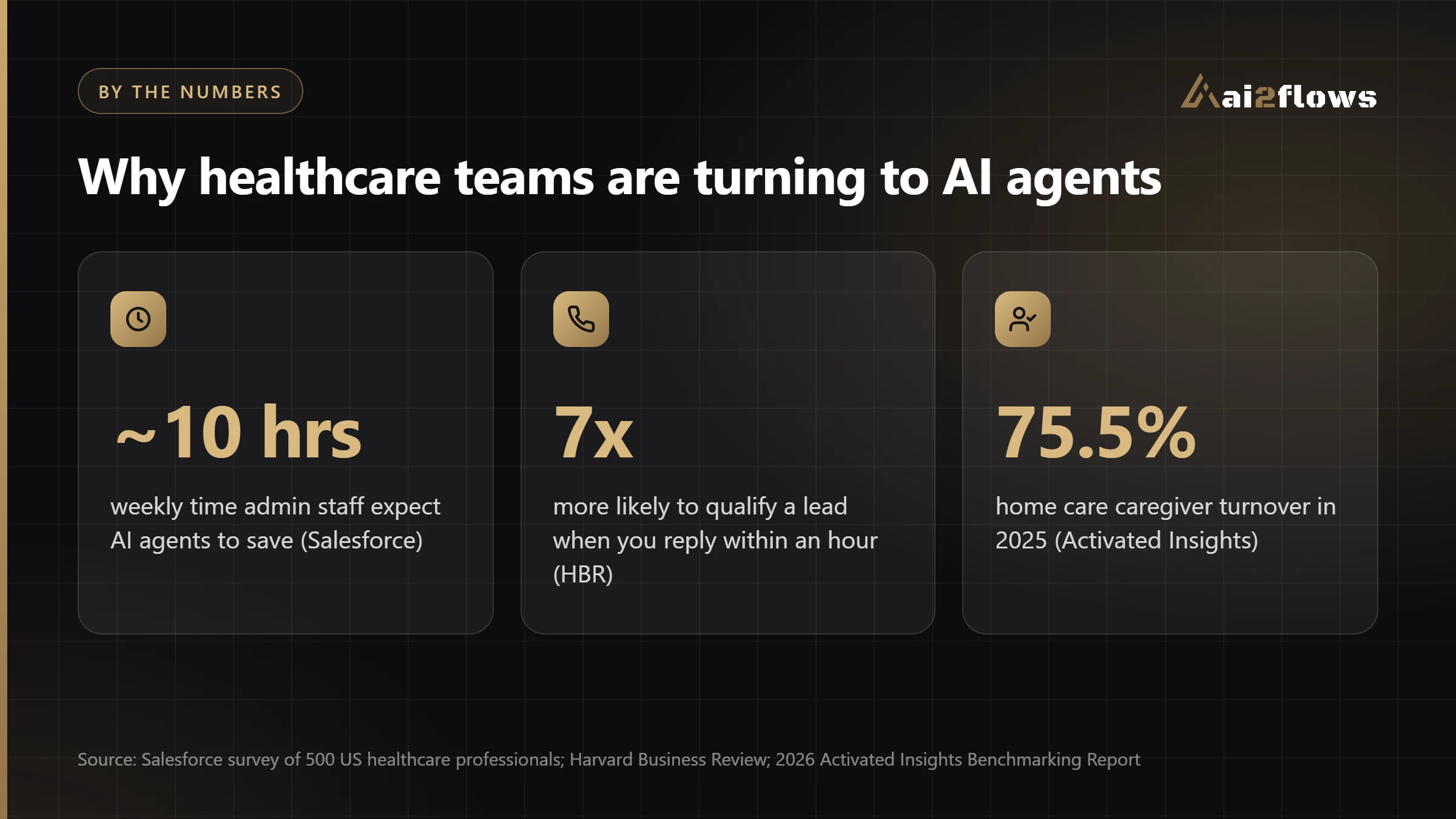
Admin eats the day. In a Salesforce survey of 500 US healthcare professionals, administrative workers estimated AI agents would save them about ten hours a week, and 83% said they were eager to use agents if it meant less clerical work.
The front desk wants relief. Weave's 2026 State of Healthcare Pulse Survey found the tasks practices most want to automate are scheduling and confirmations (49%), insurance verification (46%), patient intake and forms (42%) and billing and payment reminders (41%).
Speed decides who wins the lead. Harvard Business Review research on 1.25 million leads found firms that contacted a prospect within an hour were nearly 7 times more likely to qualify the lead than firms that waited even an hour longer, and more than 60 times more likely than firms that waited 24 hours.
Home care is fighting turnover. According to the 2026 Activated Insights Benchmarking Report, caregiver turnover was 75.5% in 2025. Every hour an office spends re-recruiting is an hour not spent on clients.
A day in the life: before and after AI agents
Time | Without AI agents | With AI agents |
|---|---|---|
7:30 am | Staff open voicemail and a pile of overnight web forms. | Every after-hours call and form already got a reply, a qualifying question and, where possible, a booked slot. Staff see a clean summary in the CRM. |
9:00 am | Someone phones no-show-risk patients one by one. | Reminder agent has sent confirmations by SMS and email; anyone who did not confirm is flagged for a human call. |
11:00 am | Recruiter chases candidates for licenses and references. | Document agent requests the missing file, nudges twice and moves the candidate forward when it arrives. |
2:00 pm | Ads run, but nobody can say which ones booked visits. | Every lead is tagged by source, so the ad report shows booked consults and hires, not just clicks. |
6:00 pm+ | Phones go to voicemail; leads call the next provider. | Voice and SMS agent answers in seconds, books or routes urgent issues to an on-call person. |
How agentic AI helps each type of healthcare business
Healthcare staffing agencies
Candidate screening: an agent replies to every applicant within minutes, asks about license type, state, shift preference and availability, then books a recruiter call.
Credential chasing: automatic, polite reminders for licenses, certifications and references until the file is complete.
Shift fill: open shifts are texted to matching, available clinicians; the first confirmed reply is logged and the rest are told it is filled.
Facility follow-up: new facility inquiries get a same-hour response and a meeting link instead of waiting for a callback.
Home care agencies
Family inquiries: worried families often call at night. An agent answers, asks about care needs, location and schedule, and books an assessment.
Caregiver recruiting: applicants are screened and scheduled fast, which matters when turnover is this high.
Check-ins and reviews: automated check-ins after the first visits, with any concern sent straight to the care coordinator, and review requests to happy families.
Aesthetic clinics and med spas
Consult booking: ad leads get an instant reply, answers to common questions about treatments and pricing ranges you approve, and a booked consult.
Rebooking: agents remind clients when a treatment is typically due for a touch-up and offer open slots.
No-show control: confirmations, deposit links and easy rescheduling reduce empty chairs.
Dental practices
New patient intake: forms and insurance details are collected before the visit, so check-in is quick.
Recall and reactivation: patients overdue for cleanings get friendly, personalized nudges with a booking link.
Treatment follow-up: patients who did not schedule recommended treatment get a reminder and a way to ask questions, with a human handling anything clinical.
Where humans must stay in the loop
Good agentic AI knows its limits. Set clear handoff rules so a person takes over for clinical questions, emergencies, complaints, billing disputes and any emotional conversation. Keep messages to what you would put in a standard reminder, avoid sharing sensitive health details over SMS, and use HIPAA-ready vendors and settings for anything that touches protected health information. If you are a covered entity, talk to your compliance advisor about business associate agreements with the vendors that handle patient data. In Weave's 2026 survey, 60% of practices said they were still concerned about data privacy, so being open with patients about how you use AI builds trust.
Traditional marketing agency vs an agentic AI growth partner
We looked at the agencies and vendors selling to healthcare today. Most fall into three groups: marketing agencies that focus on one niche such as dental or med spa and mainly sell SEO and ads; single-tool vendors that sell an AI receptionist or a recruiting bot on its own; and staffing software that handles applicant tracking but not marketing. Each solves one piece. The gap is the handoff between pieces, where leads go cold.
What you get | Typical agency | Single AI tool | Agentic AI growth engine |
|---|---|---|---|
Ads and SEO | Yes | No | Yes, including AEO and GEO for AI search |
Instant reply to every lead, 24/7 | Rarely | Yes, one channel | Yes, calls, SMS, email and web chat |
CRM with automated follow-up | Sometimes | Limited | Yes, one pipeline for every lead |
Reporting on booked visits and hires | Clicks and leads | Calls handled | From ad click to booked appointment |
Human handoff rules | Not applicable | Basic | Built around your team and compliance needs |
How to get started in 30 days
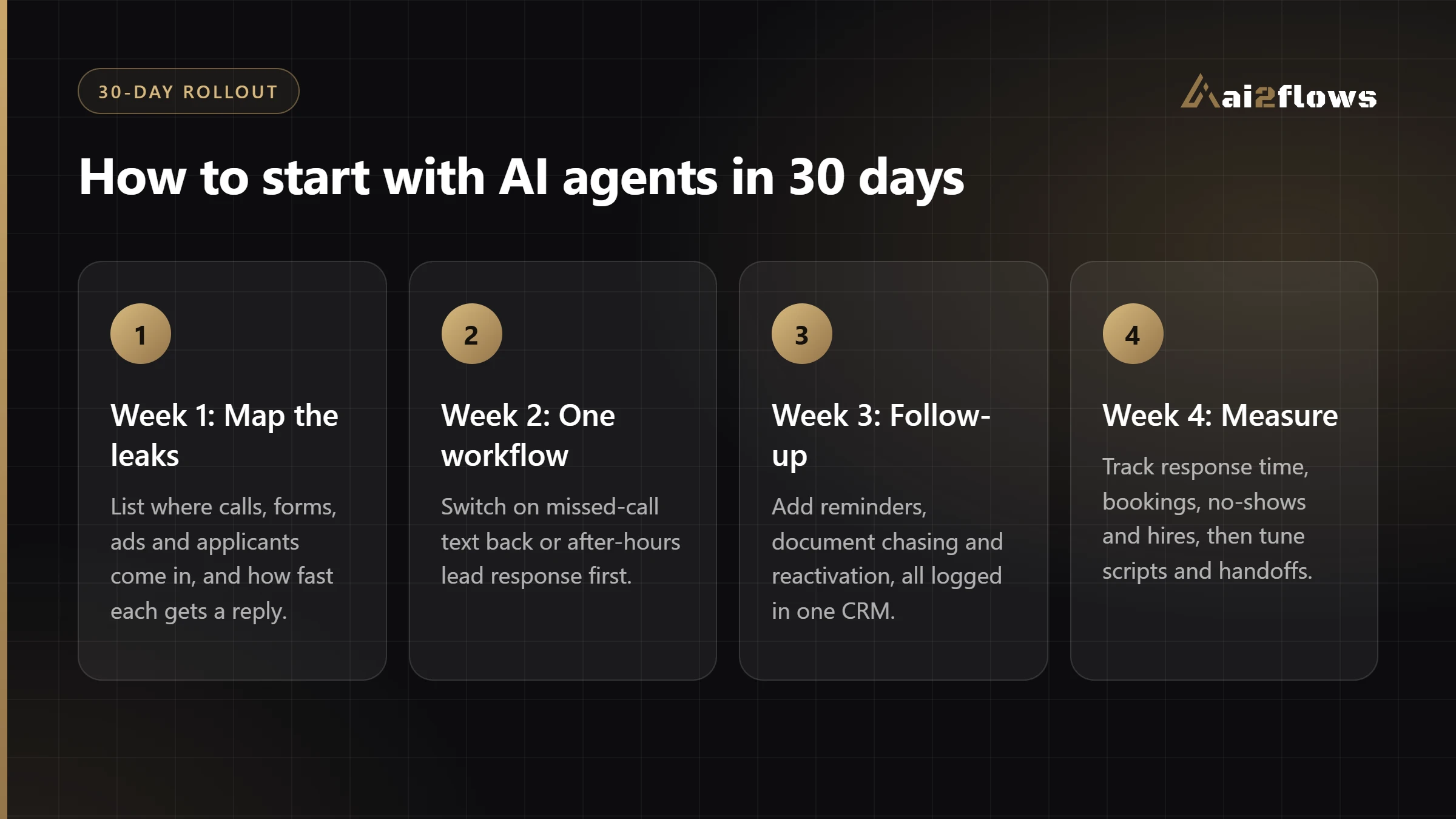
Week 1, map the leaks: list where requests come in (calls, forms, ads, job boards) and how long each takes to get a reply today.
Week 2, automate one workflow: start with missed-call text back or after-hours lead response. It is simple and the value shows fast.
Week 3, add follow-up: reminders, document chasing and reactivation campaigns, all logged in one CRM.
Week 4, measure and tune: track response time, booked appointments, no-shows and hires, then adjust scripts and handoff rules.
Frequently asked questions
What is the difference between a chatbot and an AI agent?
A chatbot answers questions. An AI agent works toward a goal across several steps, such as replying to a lead, qualifying it, booking an appointment, sending reminders and updating the CRM, and it hands off to a person when needed.
Will AI agents replace my front desk or recruiters?
No. They take over repetitive tasks such as reminders, first replies and document chasing so your team can focus on patients, families, caregivers and complex conversations.
Is agentic AI safe to use in healthcare?
It can be when it is set up with clear limits: no clinical advice, minimal health details in messages, HIPAA-ready tools for protected health information and a fast human handoff. Review your setup with your compliance advisor.
Which task should a healthcare business automate first?
Start with speed to lead: an instant reply to missed calls and new web or ad inquiries. Research shows replying within an hour makes you far more likely to qualify a lead, and most businesses still respond slowly.
Does this work for agencies outside the US?
Yes. The same workflows work for healthcare businesses in Canada, the UK and EU and Australia, with messaging and data rules adjusted for each region.
Sources
Gartner: at least 15% of day-to-day work decisions made autonomously by agentic AI by 2028
Staffing Industry Analysts: Gartner on agentic AI project cancellations and agent washing
Salesforce: Healthcare administrative teams project ten-hour weekly gains with AI agents
Harvard Business Review: The Short Life of Online Sales Leads
Want to see these workflows built for your agency or clinic? Book a free strategy call and we will map your biggest time leaks and show you which AI agents to switch on first.