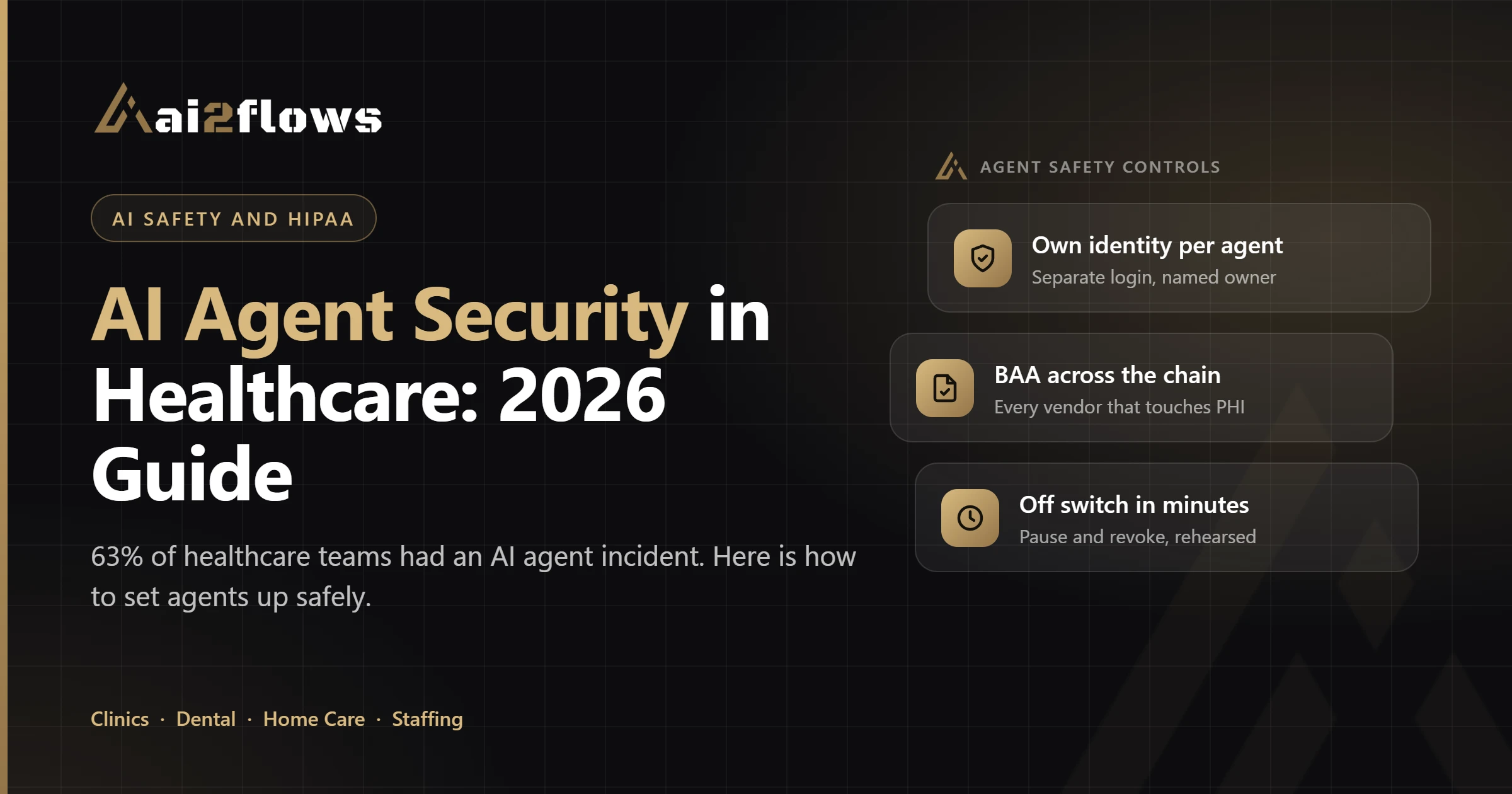
AI Agent Security in Healthcare: 2026 Risks and a Safe Setup
Quick answer: AI agents are now answering calls, booking visits and touching patient records, and the security controls around them have not kept pace. According to Gravitee's November 2026 State of AI Agent Security research, 63% of healthcare organizations surveyed had an AI agent related security or privacy incident in the past year, some involving exposed patient data. The fix is not to avoid agents. It is to treat each agent like a new staff member: give it its own identity, limit what it can touch, log everything it does, keep a human within reach, and make sure you can switch it off in minutes.
What is an AI agent, and why does security work differently?
An AI agent is software built on a large language model that does not just answer questions. It takes actions: it reads your calendar, books or moves appointments, sends texts, updates a CRM record, or hands a task to another agent. A chatbot talks. An agent acts.
That difference matters for security. A traditional website form can only do one thing. An agent can be connected to your phone system, scheduling software, smart CRM and sometimes your EHR or practice management system at the same time. If it is tricked, misconfigured or simply given too much access, the damage can spread across every system it touches.
For healthcare businesses, the stakes are higher because agents often handle protected health information (PHI): names, dates of birth, appointment reasons, insurance details and visit history. Under HIPAA, that data carries legal obligations no matter whether a person or a piece of software is handling it.
How common are AI agent security incidents in healthcare?
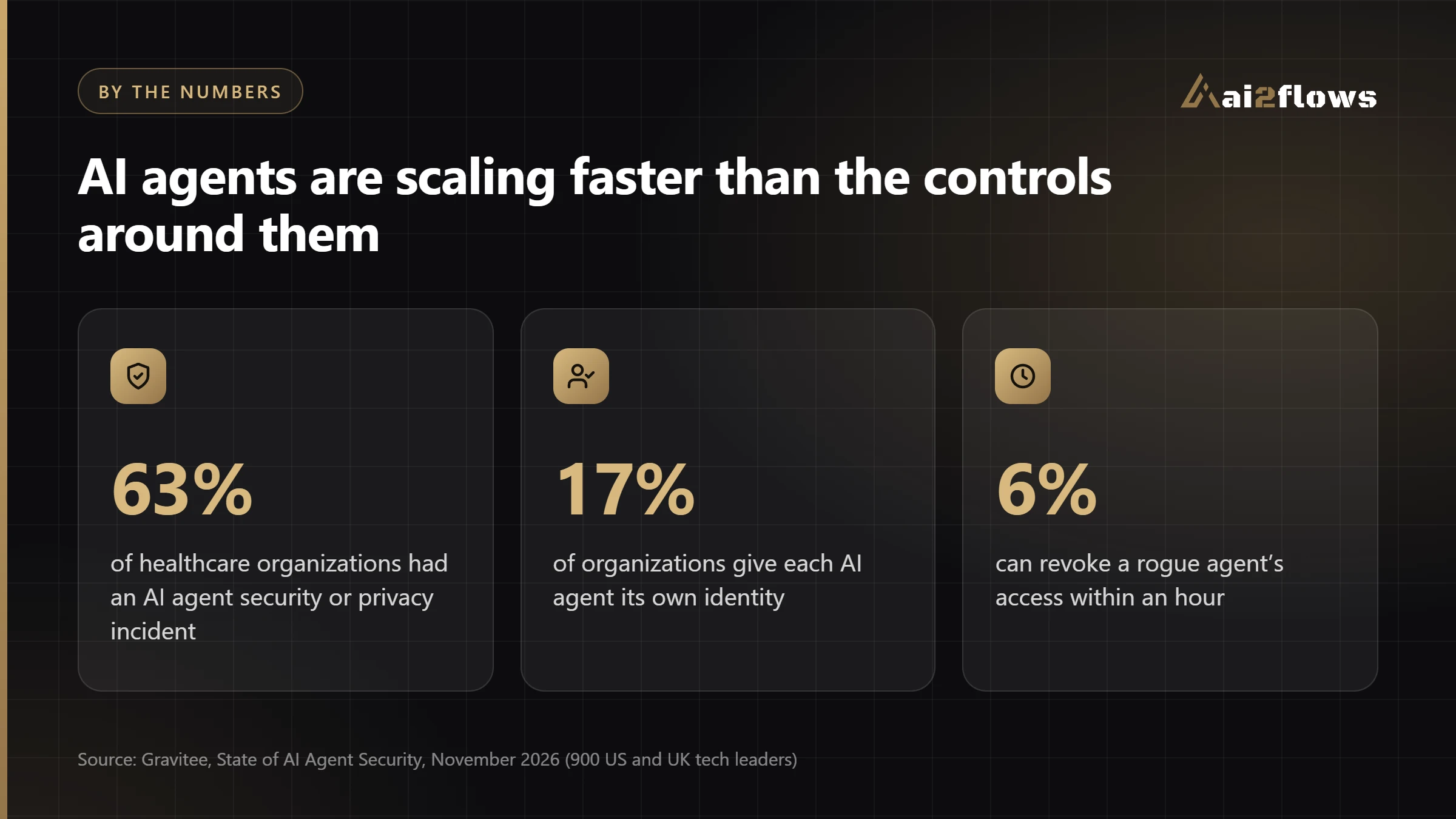
Gravitee, an AI agent management company, released the third wave of its State of AI Agent Security research on November 9, 2026. The survey covered 900 senior technology leaders in the US (600) and UK (300), fielded in October 2026 by Opinion Matters, across six sectors including healthcare.
The headline findings are sobering:
Healthcare: 63% of healthcare respondents had an agent related security or privacy incident, including exposed patient data.
All sectors: 52% reported an agent related security or privacy incident in the past year.
Identity: only 17% give each agent its own identity.
Kill switch: only 6% can revoke a rogue agent's access within an hour.
Audit trail: only 1 in 8 can fully reconstruct what an agent did 30 days ago.
Accountability: fewer than 1 in 10 have a named person formally accountable for agent behavior.
Confidence is also slipping. According to the same research, the share of leaders who felt "very prepared" to respond to an agent incident fell from 47% in April 2026 to 29% in October 2026. These are enterprise respondents, but the pattern applies to smaller practices and agencies too: agents are being switched on faster than anyone is writing down who owns them and what they are allowed to do.
What do patients actually trust AI agents to do?
Security is not only an IT question. It shapes whether patients will use your AI tools at all. Five9's Care-Completion Gap Report, released November 10, 2026 and based on a September 2026 Dynata survey of 1,000 US adults, draws a clear line around where patients accept AI.
38% are comfortable using AI to schedule or reschedule an appointment.
Only 12% are comfortable using AI for medical advice about symptoms, a diagnosis or treatment.
The top trust builder is being able to easily reach a human (39%), ahead of knowing their personal and health information is secure (29%).
44% have delayed care, stopped trying to schedule or resolve a billing issue, or switched providers in the past 12 months because dealing with a provider was too difficult.
The takeaway for practice owners is practical. Patients want fast, convenient administrative help, and they want a human safety net. An agent that books, confirms and reroutes calls fits that expectation. An agent that wanders into clinical advice does not, and it also raises your risk profile.
What are the biggest AI agent risks for practices and agencies?
The OWASP Gen AI Security Project published its Top 10 for Agentic Applications for 2026 on December 9, 2025, a peer-reviewed framework built with more than 100 industry experts. You do not need to be a security engineer to apply its spirit. For a clinic, home care agency or staffing firm, the most common risks look like this:
Risk | What it looks like in a healthcare business | Practical control |
|---|---|---|
Too much access | A booking agent can also read full chart notes or billing history | Give the agent only the fields it needs for its task |
Shared logins | Several agents and staff use one admin account, so no one can tell who did what | One identity per agent, with its own API key or user |
Manipulated instructions | A caller or a pasted message tries to talk the agent into revealing another patient's details | Verify identity before sharing anything; block disclosures in the agent's rules |
Agent to agent chains | A voice agent hands off to a CRM workflow that triggers an outside tool nobody reviewed | Map every handoff and require approval for new connections |
No audit trail | A patient complains, and nobody can show what the agent said or changed | Keep call recordings, transcripts and action logs with a retention policy |
No off switch | An agent sends wrong reminders all weekend because no one can pause it | A documented pause and revoke process that takes minutes |
Notice that most of these are process gaps, not exotic hacks. That is good news, because process gaps can be fixed with clear rules and the right setup.
How does HIPAA apply to AI agents in 2026?
HIPAA does not have a special chapter for AI agents, but existing rules already apply. HHS guidance on cloud computing states that when a covered entity uses a cloud service provider to create, receive, maintain or transmit electronic PHI on its behalf, that provider is a business associate, and a HIPAA-compliant business associate agreement (BAA) is required. The guidance adds that this is true even if the provider only stores encrypted data and lacks the key.
In plain terms: if your voice agent, SMS platform, transcription tool or AI model provider touches PHI, you need a BAA with each vendor in that chain before go-live.
On the regulatory calendar, the HIPAA Journal reports that the HHS Office for Civil Rights delayed the final rule for its proposed HIPAA Security Rule update, first proposed on December 27, 2024. According to the OMB's 2026 Regulatory Agenda, a final rule is now expected by July 2027. OCR Director Paula M. Stannard has said the core requirements of the proposed rule are sound cybersecurity best practices, so waiting is not a strategy. Practices that adopt asset inventories, access controls and logging now will be ready either way.
Compliance note: AI2Flows builds HIPAA-ready setups, but no tool or agency can guarantee compliance on its own. Compliance depends on your policies, vendor contracts, staff training and risk analysis. We recommend reviewing your AI agent plans with a qualified healthcare compliance advisor.
What should a safe AI agent setup include?
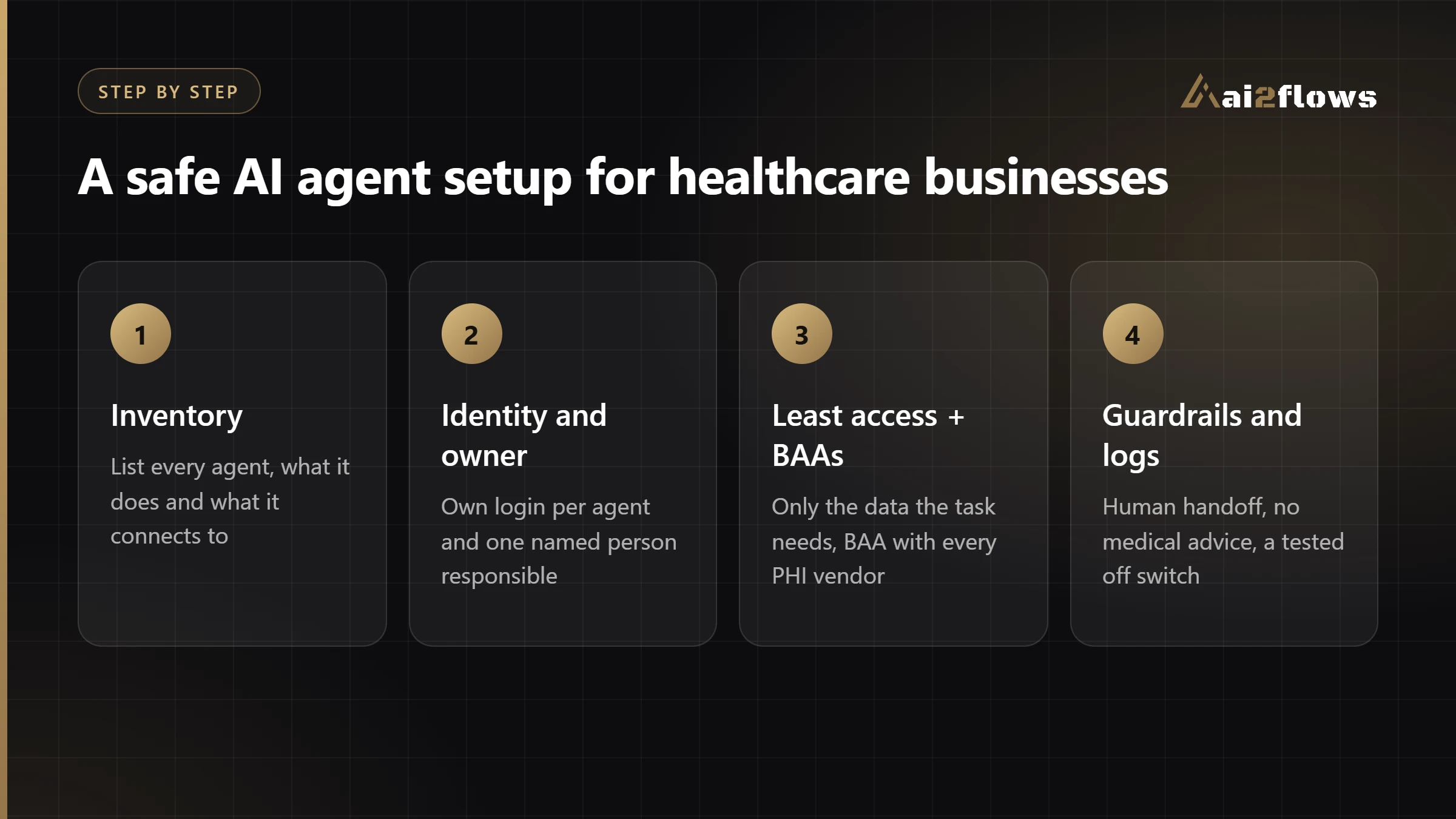
Gravitee's research team suggests managing agents the way you would manage any employee with access to sensitive systems. That framing works well for healthcare. Here is a step plan any practice, home care agency or staffing firm can follow:
Inventory every agent. List each AI agent, chatbot and automation you run, what it does, which systems it connects to and which vendor powers it. Include tools staff adopted on their own.
Give each agent an identity and an owner. Create a separate user or API key for every agent, and name one person responsible for its behavior, settings and reviews.
Limit access to the minimum. A scheduling agent needs open slots, a name and a phone number. It does not need clinical notes. Restrict fields, calendars and actions to what the task requires.
Sign BAAs across the chain. Confirm a business associate agreement with every vendor that will handle PHI, including the telephony, messaging, transcription and AI model layers.
Set guardrails and human handoffs. Write clear rules: verify identity before discussing appointments, never give medical advice, and transfer to a person on request or when the agent is unsure.
Log, review and rehearse the off switch. Keep transcripts and action logs, review a sample every week, and practice pausing or revoking an agent so it takes minutes, not days.
For most small and midsize healthcare businesses, this plan fits naturally into a well-configured AI voice and chat agent setup paired with a smart CRM with automated follow-up, where every message, call and status change is already recorded in one place.
How do these rules differ for clinics, home care and staffing?
The principles are the same, but the sensitive data differs by business type:
Dental practices, med spas and clinics: agents mostly handle scheduling, reminders and recall. Keep them away from treatment history and clinical questions, and route anything symptom related to staff.
Home care agencies: family enquiries often include detailed health and safety information about a loved one. Capture only what intake needs, and hand complex conversations to a coordinator quickly.
Healthcare staffing agencies: recruiting agents handle candidate data such as licenses, background checks and contact details. That may not always be PHI, but it is sensitive personal data, and state privacy laws and client contracts still apply. See how we approach recruiting and credentialing automation with the same access limits.
What questions should you ask an AI agent vendor?
Before you sign, ask any AI agent or automation vendor these questions and get the answers in writing:
Will you sign a BAA, and do your subprocessors, including the AI model provider, also sign one?
Can each agent have its own credentials and permission scope?
Where are call recordings and transcripts stored, for how long, and can we delete them?
Is our data used to train shared AI models?
How quickly can we pause an agent or revoke its access, and who can do it?
Can we export a full log of what an agent said and did on a specific date?
A vendor that answers these clearly is usually one that has thought about healthcare. A vendor that cannot answer them is a risk you can avoid.
Frequently asked questions
Are AI agents safe to use in a healthcare practice?
They can be, when they are set up with limited access, a business associate agreement for any vendor handling PHI, clear rules against medical advice, full logging and a fast way to pause them. Most reported incidents trace back to missing controls rather than the technology itself.
Do I need a BAA for an AI voice agent?
If the voice agent or any vendor behind it creates, receives, maintains or transmits PHI on your behalf, HHS guidance treats that vendor as a business associate, so a BAA is required. Confirm this for every layer, including telephony, transcription and the AI model provider.
What is the biggest security mistake practices make with AI agents?
Giving agents broad, shared access. Gravitee's 2026 research found only 17% of organizations give each agent its own identity, which makes it hard to limit permissions, trace actions or shut down a single misbehaving agent.
Should an AI agent ever give patients medical advice?
No. Keep agents focused on administrative tasks such as scheduling, reminders, intake and routing. Five9's 2026 survey found only 12% of patients are comfortable using AI for medical advice, so symptom and treatment questions should go to qualified staff.
Has the new HIPAA Security Rule been finalized?
Not yet. The HIPAA Journal reports that OCR delayed the final rule, and the OMB's 2026 Regulatory Agenda lists a target of July 2027. The existing Security Rule still applies today, and its proposed updates reflect widely accepted best practices.
How fast should we be able to shut down an AI agent?
Aim for minutes, not hours. Gravitee's research found only 6% of organizations can revoke a rogue agent's access within an hour, so a documented and rehearsed pause process is a quick way to get ahead of most of the market.
Sources
Gravitee, State of AI Agent Security research, November 9, 2026 (GlobeNewswire)
Five9, Care-Completion Gap Report, November 10, 2026 (Business Wire)
OWASP Gen AI Security Project, Top 10 for Agentic Applications for 2026
The HIPAA Journal, Final Rule Implementing HIPAA Security Rule Updates (updated July 2026)
Want AI agents that answer every call and book every visit without creating new risk? AI2Flows designs HIPAA-ready voice, SMS and chat agents with tight access controls, full logging and human handoff built in. Book a free strategy call and we will review your current setup together.