AI Caregiver Recruiting for Home Care: Interview in 48 Hours
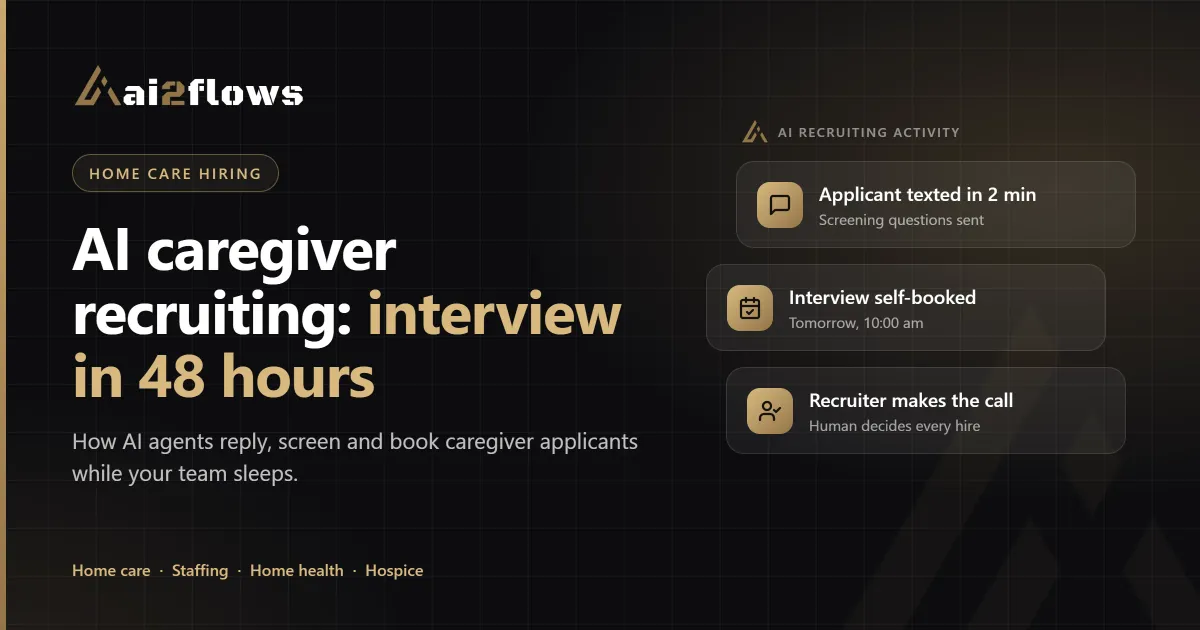
Quick answer: AI caregiver recruiting means using AI agents to reply to every applicant within minutes, run a short screening by text or voice, and book an interview automatically, so a human recruiter can meet the best candidates within 24 to 48 hours. Recent home care data shows speed to interview is now the deciding factor in who gets hired. AI handles the repetitive first steps; people still make every hiring decision.
Why is caregiver recruiting so hard for home care agencies in 2026?
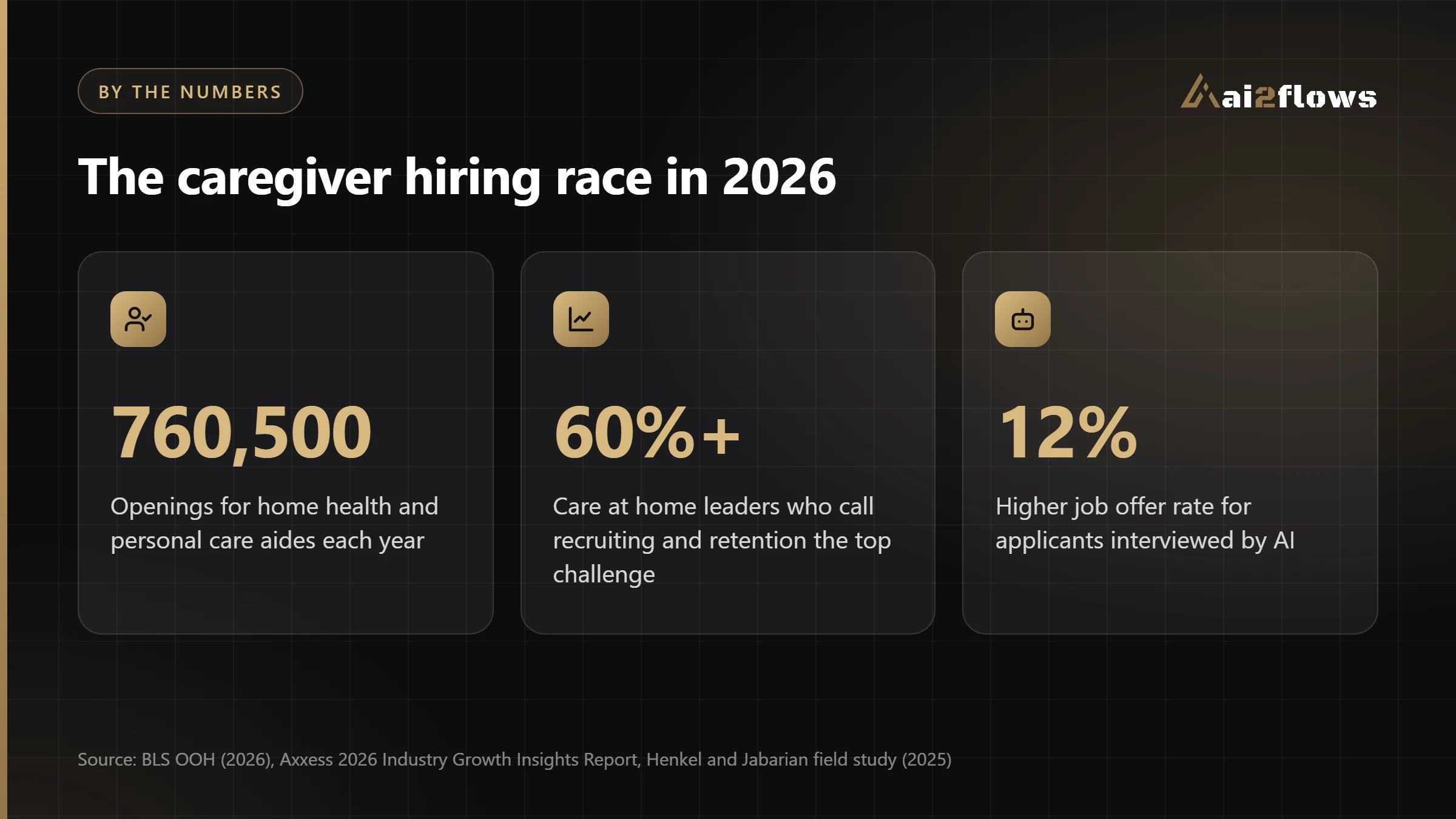
Demand for caregivers keeps rising faster than the supply of workers. According to the U.S. Bureau of Labor Statistics Occupational Outlook Handbook (updated August 2026), employment of home health and personal care aides is projected to grow 18 percent from 2025 to 2035, adding about 847,300 jobs. BLS also projects about 760,500 openings for these aides every year on average, many of them to replace workers who leave the field or retire.
Agency leaders feel that pressure every week. The 2026 Axxess Industry Growth Insights Report, which surveyed home health, hospice, palliative and home care leaders, found that more than 60 percent of organizations named recruitment and retention as their biggest challenge heading into 2026. AxisCare's 2026 home care survey of more than 300 industry leaders found caregiver shortages are still the top pain point, cited by 53 percent, down from 59 percent the year before.
Home care also competes for the same hourly workers as retail, warehousing, fast food and gig apps. Those employers let people apply by phone and hear back fast. If your agency replies two days later, many applicants have already accepted another offer.
What is AI caregiver recruiting?
AI caregiver recruiting is the use of AI agents and automation to manage the early stages of hiring caregivers, CNAs and home health aides. An AI agent here is software that can hold a two-way conversation by SMS, chat or phone, follow a script you approve, and take actions such as tagging a candidate or booking a calendar slot.
In practice, an AI recruiting workflow usually covers four jobs:
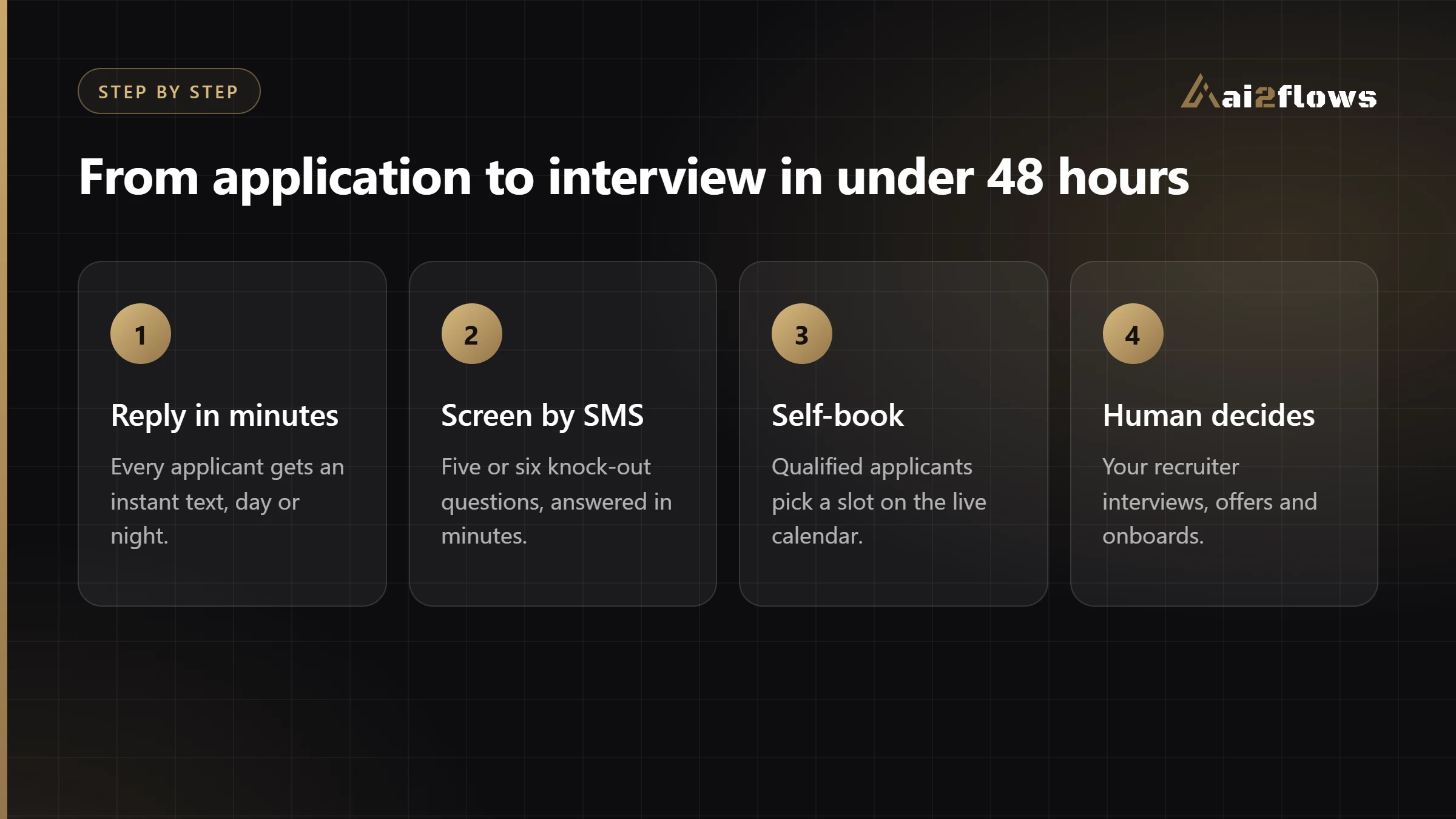
Instant response: a text or call goes out within minutes of an application, day or night.
Pre-screening: the agent asks your knock-out questions, such as availability, service area, transportation and certifications.
Scheduling: qualified applicants pick an interview time from your recruiter's live calendar.
Follow-up: reminders before the interview and gentle nudges for applicants who go quiet.
Everything is logged in a smart CRM, so your recruiter sees the full conversation and the candidate's answers before the interview starts.
How fast should you respond to caregiver applicants?
Fast enough that the applicant is still thinking about your job. Augusta's Q1 2026 National Caregiver Recruitment Benchmark Report, which analyzed more than 122,000 caregiver applicants across North America, advises interviewing applicants within four days of their application, and found engagement and hires were noticeably better when interviews happened within 24 to 48 hours, as summarized by Home Health Care News in July 2026.
The reason is simple. Many caregivers apply to several agencies at once. When one agency stays silent, the applicant reads that silence as a signal to move on. A recruiter who works business hours cannot answer a 9 p.m. application on a Friday. An AI agent can.
Hiring step | Typical manual process | AI-assisted process |
|---|---|---|
First reply | Next business day, when someone checks the inbox | Within minutes by SMS or call, 24/7 |
Screening questions | Phone tag over several days | Answered by text in a few minutes |
Interview booking | Back and forth emails or calls | Applicant self-books from a live calendar |
No-show prevention | Manual reminder calls, often skipped | Automatic reminders and easy rescheduling |
Hiring decision | Recruiter or manager | Recruiter or manager (unchanged) |
What does the research say about AI-led interviews?
The strongest evidence so far comes from a large field experiment by Brian Jabarian of the University of Chicago Booth School of Business and Luca Henkel of Erasmus School of Economics. According to Erasmus University Rotterdam's August 2025 summary of the working paper, about 70,000 job candidates were randomly assigned to be interviewed by human recruiters, by AI voice agents, or given the choice.
Key findings from that study:
Applicants interviewed by the AI were 12 percent more likely to receive a job offer and more likely to still be employed after one month.
Applicant satisfaction was similar across groups.
When given the choice, 78 percent of applicants chose the AI interviewer.
Technical problems occurred in about 7 percent of AI-led interviews, a reminder that you need a fallback to a human.
The study was not limited to home care, so treat it as a signal, not a guarantee. Still, it matches what home care operators report. In the same Home Health Care News piece, Comfort Keepers COO Ramzi Abdine described using AI to engage and screen candidates, and in some cases run early interview rounds, with shorter time to hire as a result.
Where should humans stay in the loop?
Caregiving is a trust job, and the human side of recruiting still converts best. Augusta's report found that in-person hiring events produced only about 0.09 percent of applicants but converted at 3.1 times the average rate, according to Home Health Care News. Referrals and local partnerships follow the same pattern.
A practical split looks like this:
AI handles: first reply, FAQs about pay ranges and shifts, knock-out questions, scheduling, reminders and re-engagement.
Humans handle: the real interview, judgment calls, background check decisions, offers, onboarding and the first-week check-in.
Public opinion supports this split. Home Health Care News cites a 2023 Pew Research Center poll in which 71 percent of Americans opposed AI making final hiring decisions. Keep the final yes or no with a person, and say so in your job ads.
How do you set up AI caregiver recruiting in 30 days?
You do not need to replace your applicant tracking system or your scheduling software. Most agencies start by connecting job board applications to a smart CRM and an AI agent that texts first. Here is a simple plan:
Map your current funnel. Pull the last 90 days of applicants and note where each came from, how long the first reply took, and how many reached an interview and a first shift.
Write your knock-out questions. Keep it to five or six: service area, availability, reliable transportation, certifications, start date and preferred contact time.
Connect every application source to one inbox. Route Indeed, your careers page, Facebook lead forms and referral forms into the CRM so no applicant sits unseen.
Launch an instant SMS reply and screening flow. The agent introduces itself as your agency's assistant, asks the questions and tags each applicant as qualified, not yet, or needs a human.
Turn on self-scheduling and reminders. Qualified applicants book directly into recruiter calendars, with reminders the day before and two hours before.
Add a voice agent for missed calls and no-replies. A short outbound call can reach applicants who ignore texts, with an easy handoff to a recruiter.
Review weekly and tune. Track time to first reply, time to interview, show rate and 90-day retention, then adjust questions and messages.
If you want a deeper look at how voice agents handle calls, see our guide to AI voice agents for healthcare. Agencies that also place nurses and allied staff can apply the same pattern through healthcare recruiting automation.
What compliance and privacy rules apply to AI in hiring?
Recruiting data is usually employment data rather than patient health information, but it is still sensitive, and AI hiring tools are now regulated in several places. Plan for these basics:
Notice: Illinois amended its Human Rights Act (HB 3773) so that, starting January 1, 2026, employers must notify applicants and employees when AI is used for recruiting, hiring and other employment decisions, according to law firm Fisher Phillips.
No discriminatory impact: the same Illinois law bars AI use that results in discrimination against protected classes, including using zip codes as a proxy for race. Avoid screening rules that indirectly filter by neighborhood.
Consent for texting: get clear opt-in on your application form before sending SMS, and honor STOP replies right away.
Data handling: limit what the agent collects, keep records in a secure system with access controls, and use HIPAA-ready vendors if any client or patient information could appear in the same system.
Human review: document that a person makes the final hiring decision and can override the AI.
Rules vary by state and country, so review your setup with an employment attorney or compliance advisor before launch. Nothing here is legal advice.
What results should home care agencies track?
AI recruiting is worth it only if it moves real numbers. Track these from day one:
Time to first reply: target minutes, not hours.
Time to interview: aim for 24 to 48 hours, in line with Augusta's benchmark findings.
Interview show rate: reminders and easy rescheduling should lift it.
Applicant to first shift: the conversion rate that matters for staffing hours.
90-day retention by source: shows whether faster hiring is also better hiring.
Pair these with your client-side numbers. Faster hiring means fewer declined referrals and more billable hours. Our page for home care agencies shows how recruiting and client intake can share one smart CRM.
Frequently asked questions
Can AI replace home care recruiters?
No. AI is best at fast replies, screening questions, scheduling and reminders. Recruiters still run interviews, judge fit, make offers and build the relationships that keep caregivers on staff.
How quickly should a home care agency interview caregiver applicants?
Augusta's Q1 2026 benchmark report advises interviewing within four days of an application and found better engagement and hiring results when interviews happen within 24 to 48 hours.
Will caregiver applicants accept talking to an AI agent?
Evidence suggests many will. In a field experiment with about 70,000 candidates by researchers from the University of Chicago and Erasmus School of Economics, 78 percent of applicants who were given the choice picked the AI interviewer, and satisfaction was similar to human-led interviews.
Do I have to tell applicants that AI is used in hiring?
In some places, yes. Illinois requires employers to notify applicants when AI is used in recruiting and hiring decisions starting January 1, 2026. Being transparent is good practice everywhere, so state it in job ads and in the agent's first message.
Is AI caregiver recruiting HIPAA compliant?
Applicant data is usually not protected health information, but your CRM may also hold client data. Use HIPAA-ready vendors, sign business associate agreements where needed, and have a compliance advisor review your setup. No tool guarantees compliance on its own.
Sources
U.S. Bureau of Labor Statistics: Home Health and Personal Care Aides, Occupational Outlook Handbook
Axxess: 2026 Industry Growth Insights Report announcement (PR Newswire)
HomeCare Magazine: Survey Reveals 2026 Homecare Agency Trends (AxisCare survey)
Erasmus University Rotterdam: Study finds AI matches humans in conducting job interviews
Fisher Phillips: Illinois employers using AI for workplace purposes need to provide notice
Want to reply to every caregiver applicant in minutes and fill interview slots without adding recruiters? AI2Flows builds HIPAA-ready AI agents and smart CRM workflows for home care and staffing agencies. Book a free strategy call and we will map your hiring funnel with you.