AI Credentialing Automation for Healthcare Staffing in 2026
Quick answer: AI credentialing automation uses software agents to collect licenses, certifications and health records from clinicians, check them against job requirements, chase missing items by SMS or email, and flag expirations before they cause a lost shift. For healthcare staffing agencies, the payoff is recruiter time: Bullhorn's 2026 GRID healthcare survey found 77% of healthcare recruiters spend at least an hour a day on manual credentialing tasks. AI handles the paperwork chase; humans keep the final verification and compliance sign-off.
What is AI credentialing automation in healthcare staffing?
Credentialing is the process of collecting and verifying a clinician's qualifications (licenses, board certifications, BLS or ACLS cards, immunization records, background checks, skills checklists) before they can work a shift or assignment. Primary source verification means confirming a credential directly with the issuing body, such as a state board of nursing, rather than trusting a photocopy.
AI credentialing automation is the use of AI tools to run the repetitive parts of that process. In a staffing agency, that usually means three jobs:
Document intake: reading uploaded files, extracting names, license numbers and expiration dates, and filing them to the right candidate record.
Readiness matching: comparing what a candidate has against what a specific facility or assignment requires, and listing the gaps.
Follow-up: an AI agent texts, emails or calls the clinician to request missing or expiring items, answers simple questions, and escalates anything unusual to a credentialing specialist.
It is not a replacement for the credentialing team. It is a way to stop skilled people from spending their day chasing PDFs.
Why is credentialing a bottleneck for staffing agencies in 2026?
The 2026 data points in one direction: demand for clinicians is high, recruiters are stretched, and paperwork eats a large share of their day.
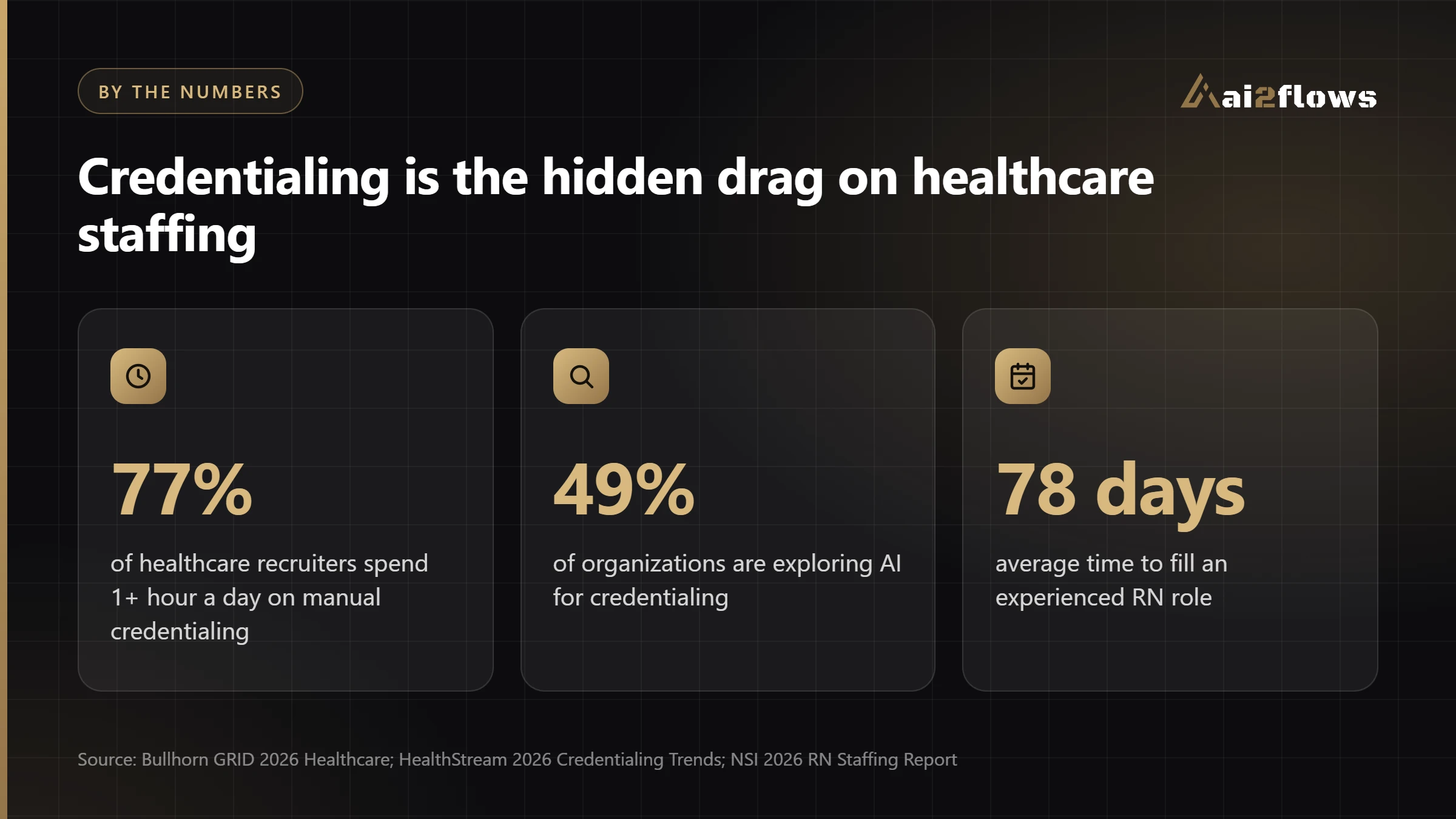
According to Bullhorn's GRID 2026 Industry Trends Report healthcare spotlight, a survey of nearly 200 healthcare staffing leaders and recruiters in North America, 77% of healthcare recruiters spend at least one hour daily on manual credentialing tasks, and 37% spend three hours or more.
The 2026 NSI National Health Care Retention and RN Staffing Report, based on 527 US hospitals, puts the average time to fill an experienced RN role at 78 days and estimates a national RN shortage of 158,600.
Staffing Industry Analysts' 2026 US healthcare staffing assessment notes healthcare and social assistance recorded roughly 1.35 million job openings against 701,000 hires, close to two openings per hire.
When a facility needs a nurse on Monday and your candidate is missing one TB test result, the shift goes to whichever agency is file-ready first. Speed of credentialing has become a competitive advantage, not just a back-office metric.
How much are healthcare organizations using AI for credentialing today?
Adoption is real but early. HealthStream's 10th annual 2026 Trends in Medical Staff Credentialing report surveyed 673 medical services professionals across the US. It found 49% of organizations are exploring AI for credentialing, and it describes adoption as early and uneven. Organizations using platforms with built-in AI reported higher satisfaction with their process.
On the staffing side, Bullhorn's 2026 healthcare data shows a similar picture:
26% of healthcare staffing firms are not using AI extensively, compared with 20% across the wider staffing industry.
Only 7% have AI embedded throughout their entire workflow.
75% want AI to screen automatically for specialty, skills and licensure, and 56% want automated verification of credential readiness against job requirements.
In plain terms: most agencies know where AI would help, and few have wired it in end to end. That gap is the opportunity.
Which credentialing tasks can AI agents safely handle?
Not every step should be automated. A useful rule: let AI gather, organize and remind; let trained people verify, decide and sign off. The table below shows a practical split.
Credentialing task | Good fit for AI automation? | Human role |
|---|---|---|
Requesting documents from new applicants | Yes, via SMS, email or voice agent | Set the checklist per facility |
Reading uploads and extracting expiration dates | Yes, with confidence checks | Review low-confidence or unclear files |
Matching candidate files to job requirements | Yes, rules plus AI | Approve exceptions |
Reminders for expiring licenses and certifications | Yes, fully automated | Handle non-response escalations |
Primary source verification | Partly, where official lookups or approved vendors exist | Confirm results and document them |
Background check adjudication | No | Decide under applicable law and client policy |
Final clearance to work | No | Credentialing specialist sign-off |
Keeping the last three rows human protects patients, clients and your agency's reputation, and it keeps accountability clear if an auditor asks who approved a file.
What results does the 2026 research link to AI in staffing?
Vendor surveys are not controlled studies, so read these as associations, not guarantees. Still, the patterns in Bullhorn's GRID 2026 healthcare data are consistent:
Firms using AI at any stage of recruitment were 1.5 times more likely to report revenue growth.
Firms using AI for candidate sourcing were 49% more likely to report 2025 revenue growth, and those using it for prescreening were 47% more likely.
64% of healthcare recruiters using AI for screening said it cut screening time by at least half.
41% of healthcare leaders said AI let them reclaim time for direct engagement with clients and candidates.
HealthStream's report adds a revealing finding from the provider side: 57% of organizations are unaware of the revenue gains that faster onboarding can bring. For an agency, the math is simpler. Every day a cleared clinician is not working is a day of billable hours lost.
How do you set up AI credentialing automation step by step?
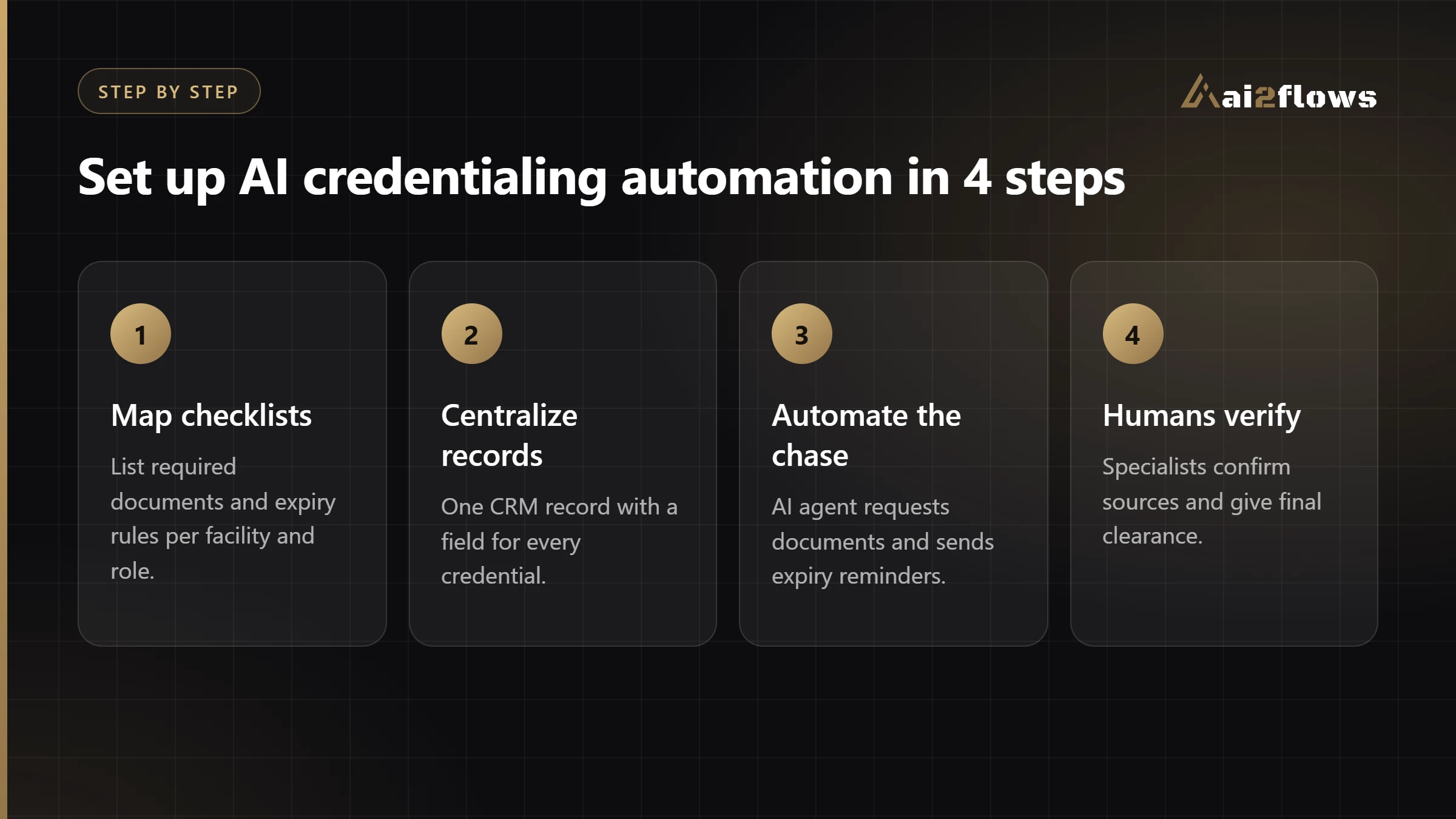
You do not need a large IT project. Most agencies can start with a smart CRM, an AI messaging agent and clear checklists. Here is a plan that fits a small to mid-size agency:
Map your checklists. List the documents each client facility and role requires (for example, RN med-surg versus CNA long-term care), with expiration rules for each item.
Centralize candidate records. Move credential files and dates into one system with a field for every required item, so automation has something reliable to check against.
Automate the chase. Use an AI agent to send document requests by SMS and email, answer common questions, and remind clinicians at 60, 30 and 7 days before an item expires.
Keep humans on verification. Route extracted data to a specialist for primary source checks and final clearance, log every approval, and review results weekly to refine the rules.
If you already run recruiting workflows, connect this to your healthcare recruiting automation so new applicants enter the credentialing sequence the moment they apply.
What about HIPAA, privacy and compliance?
Credential files often hold sensitive personal information: Social Security numbers, immunization and health screening records, and background check results. Treat AI tools that touch this data with the same care as any system holding protected information.
Choose vendors that will sign a business associate agreement (BAA) where health information is involved, and confirm where data is stored.
Do not paste candidate documents into consumer chat tools.
Limit who can see full records, and keep audit logs of who viewed or approved each file.
Disclose to candidates when they are messaging with an AI assistant, and follow any state rules on AI disclosure and automated employment decisions.
Follow consent and opt-out rules for SMS and calls.
A well-built setup can be HIPAA-ready, but no software makes an agency compliant on its own. Review your workflow with a qualified compliance advisor or attorney, especially for background checks and any AI used in hiring decisions.
How does this fit with the rest of your agency's growth stack?
Credentialing speed only pays off if your pipeline stays full. The same automation that chases documents can also respond to new applicants within minutes, re-engage past clinicians when new assignments open, and keep facility clients updated on fill status. A smart CRM with automated follow-up ties these together, and AI voice agents can handle after-hours calls from clinicians asking about open shifts or missing paperwork. For agency-specific setups, see our healthcare staffing page.
Frequently asked questions
Can AI fully replace a credentialing specialist?
No. AI is best at collecting documents, extracting dates, matching files to requirements and sending reminders. Primary source verification review, background check decisions and final clearance to work should stay with trained staff who are accountable for the decision.
How much time can AI credentialing automation save recruiters?
It depends on your volume and current process, but the starting point is large: Bullhorn's GRID 2026 healthcare survey found 77% of healthcare recruiters spend at least an hour a day on manual credentialing, and 37% spend three or more hours. Automating document requests and reminders targets much of that time.
Is it safe to use AI with clinician health and background records?
It can be, if you use vendors that sign a business associate agreement where required, restrict access, keep audit logs and never paste records into consumer AI tools. Have a compliance advisor review your setup before going live.
What is the difference between credentialing and onboarding?
Credentialing confirms a clinician is qualified and cleared to work, based on licenses, certifications and checks. Onboarding is the broader process of getting them ready for a specific assignment, including orientation, scheduling, payroll setup and facility-specific training.
Where should a small staffing agency start?
Start with one role and one client checklist. Put every required document and expiration date into your CRM, then automate requests and expiration reminders. Once that runs smoothly, expand to more roles and add readiness matching against job orders.
Sources
Bullhorn: GRID 2026 Industry Trends Report, Healthcare spotlight
Bullhorn: Healthcare staffing in 2026, how AI is helping firms reclaim recruiter productivity
HealthStream: Key Credentialing Trends Shaping Healthcare in 2026
NSI Nursing Solutions: 2026 National Health Care Retention and RN Staffing Report
Staffing Industry Analysts: US Healthcare Staffing Market Growth Assessment 2026
Want to see how much recruiter time your agency could win back? Book a free strategy call with AI2Flows and we will map your credentialing workflow and show where AI agents and a smart CRM fit, with your team keeping the final say.