AI Provider Search 2026: How Patients Use ChatGPT to Choose
Quick answer: Patients now ask AI assistants like ChatGPT, Gemini and Google's AI Overviews to recommend doctors, dentists, med spas and care agencies. According to rater8's 2026 Patient Choice Report, 47% of US patients have used an AI chatbot to find a provider, and AI tools now influence care decisions slightly more than classic Google results. To get recommended, a practice needs accurate facts everywhere online, strong and recent reviews, clear answer-style web pages, and a fast way to respond when an AI-referred patient calls or messages at 9 pm.
How are patients using AI assistants to find healthcare providers?
AI provider search is when a patient asks a conversational AI tool, rather than a list of blue links, to suggest a clinician or business. Typical prompts look like "best pediatric dentist near me that takes Delta Dental" or "home care agency in Tampa with weekend caregivers." The assistant reads websites, maps listings and reviews, then answers with a short list and a summary of each option.
This behavior has grown quickly. rater8's 2026 Patient Choice Report, a survey of nearly 1,000 US adults published in June 2026, found that 47% of patients now use AI chatbots to find a provider, up from 31% at the end of 2025, as reported by TechTarget. The same survey found the most common AI queries were:
"Specialty near me" (55%)
"Best or top-rated" specialty (34%)
A specific doctor's name (32%)
Reviews for a practice (26%)
Specialty plus insurance (23%)
Adoption is not only a young person's habit. rater8 reported that 64% of patients aged 45 to 60 have used AI to research a provider, compared with 28% of those aged 18 to 29. That matters for dental, aesthetic and home care businesses, because adults in their 40s and 50s are often the ones booking for themselves, their children and their aging parents.
Why does AI search matter so much for clinics and care agencies right now?
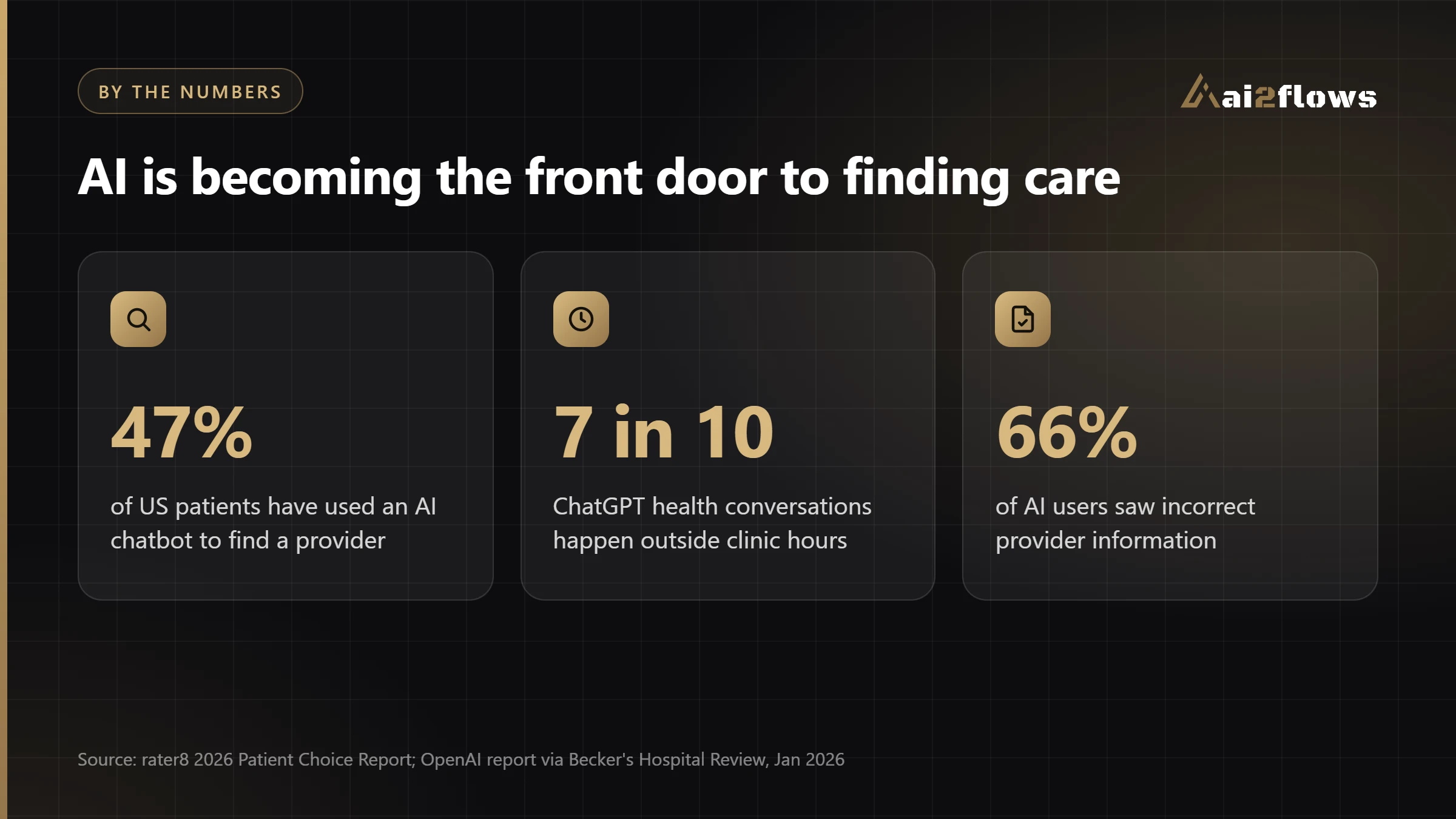
AI assistants are becoming a front door to healthcare. In January 2026, OpenAI shared a report titled "AI as a Healthcare Ally" with Becker's Hospital Review. It said more than 40 million Americans use ChatGPT each day for healthcare questions, more than 5% of all ChatGPT messages globally relate to health, and seven in 10 health conversations happen outside normal clinic hours.
Independent polling points the same way. The KFF Tracking Poll on Health Information and Trust, fielded February 24 to March 2, 2026 with 1,343 US adults, found that 32% of adults used AI chatbots for health information in the past year. Among them, 41% said they used AI to look things up before deciding whether to see a provider.
The influence on choice is now measurable. In rater8's 2026 data, 36% of patients who searched for a doctor said AI tools influenced their decision, edging past Google search results at 34%. Among patients who switched doctors in the past year, 39% named AI tools as their top digital influence.
Finding | Figure | Source |
|---|---|---|
Patients who used an AI chatbot to find a provider | 47% (up from 31% in late 2025) | rater8 2026 Patient Choice Report |
Searchers who said AI influenced their choice | 36% (vs 34% for Google results) | rater8 2026 Patient Choice Report |
US adults using AI chatbots for health information | 32% in the past year | KFF poll, March 2026 |
Americans asking ChatGPT health questions daily | More than 40 million | OpenAI report via Becker's, January 2026 |
ChatGPT health conversations outside clinic hours | 7 in 10 | OpenAI report via Becker's, January 2026 |
What goes wrong when AI describes your practice?
AI assistants summarize what they can find, and what they find is often stale. rater8 reported that about two-thirds of patients who used AI to research a provider had encountered incorrect information, such as wrong addresses, phone numbers, insurance details or office hours. Yet 60% said they trusted the AI summary without checking it.
For a practice, that gap is costly. A patient who is told you are closed on Saturdays, or that you do not accept their plan, may never call to find out otherwise. Common causes include:
An old address or phone number still listed on a directory site
Insurance lists on your website that are out of date or buried in a PDF
Service pages that describe treatments vaguely, so the AI cannot match you to a specific question
Holiday or seasonal hours never updated on your Google Business Profile
Few recent reviews, which leaves the assistant little to say about patient experience
How do reviews shape AI recommendations?
Reviews are one of the richest signals an assistant can read, and they still drive patient behavior directly. rater8's 2026 report found that 75% of patients would not book with a provider rated below 4.0 stars, and 55% have walked away from at least one provider because of what they read online, up 15 points from 2025.
How you respond matters too. In the same survey, 66% of patients said a provider's response to reviews affects their trust. The top complaints that put patients off were rude or unhelpful staff and "the doctor didn't listen," each at 52%. Those are front-desk and communication problems, which means faster, friendlier follow-up can improve both reviews and the summaries AI tools write about you.
When you reply to reviews, keep privacy in mind. Never confirm that a reviewer is a patient or mention any treatment detail. A short, warm, generic reply that invites the person to call the office is the safer pattern. Ask your compliance advisor to approve a set of reply templates.
What does Google say about appearing in AI Overviews and AI Mode?
Google's Search Central page "AI features and your website," last updated December 2025, is clear that there is no special trick. A page is eligible to appear as a supporting link in AI Overviews or AI Mode if it is indexed and can show in Search with a snippet. Google says there are no extra technical requirements, no AI-specific files and no special schema needed.
Google's listed best practices are familiar SEO fundamentals:
Allow crawling in robots.txt and in your hosting or CDN setup
Make content easy to find through internal links
Keep important content in text, supported by relevant images and video
Make sure structured data matches the visible text on the page
Keep your Google Business Profile information current
Verify your site in Search Console to catch technical issues
In other words, answer engine optimization (AEO) and generative engine optimization (GEO) are not replacements for SEO. AEO means structuring content so assistants can lift a direct answer. GEO means making your business easy for generative AI tools to understand, trust and cite. Both sit on top of a well-built, accurate website. Our AI search services for SEO, AEO and GEO page explains how we approach this for healthcare businesses.
How can a practice get recommended by AI assistants? A step-by-step plan
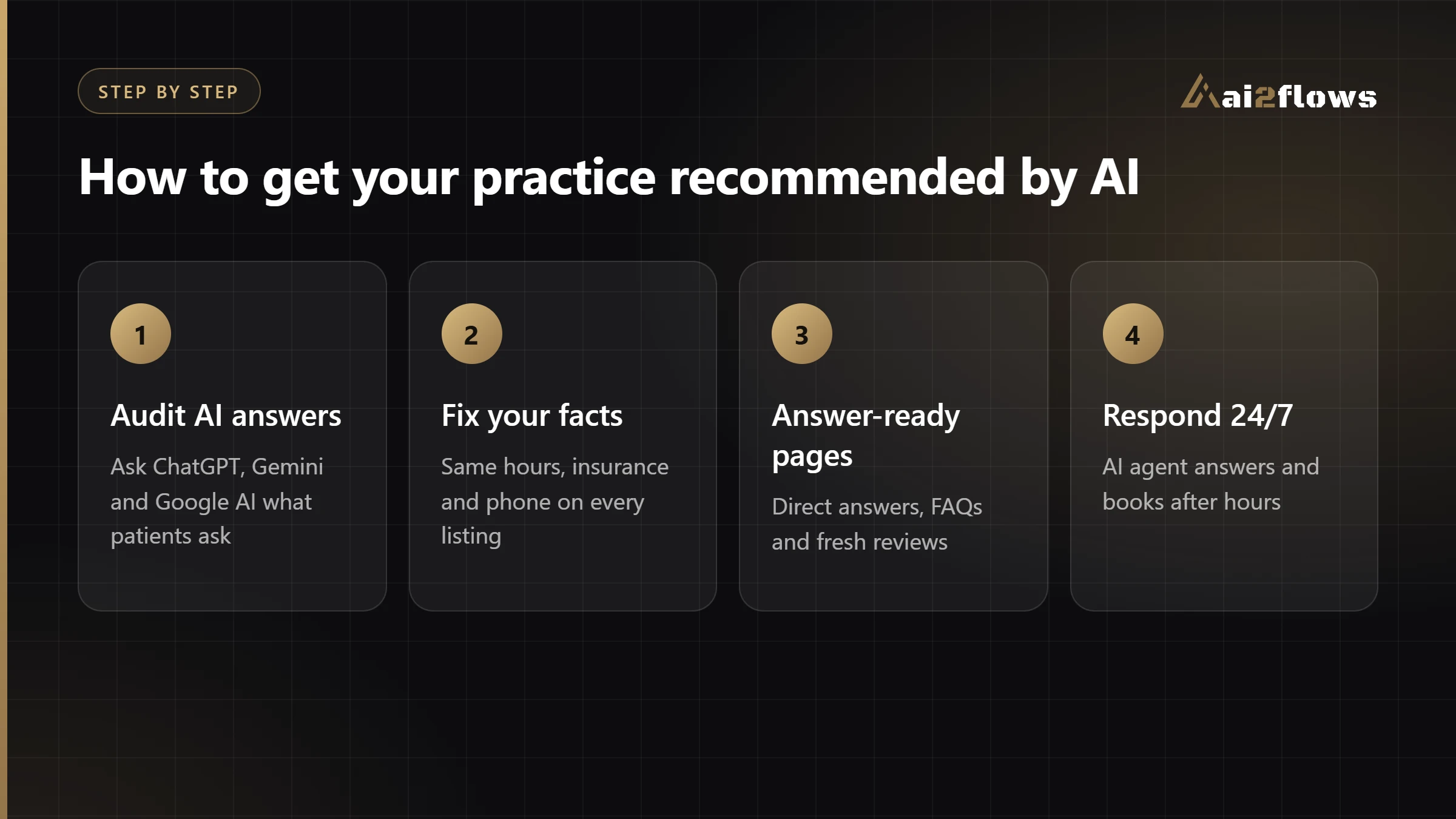
Here is a practical plan any clinic, dental office, med spa or home care agency can follow. Most steps take hours, not months.
Audit what AI says about you. Ask ChatGPT, Gemini, Perplexity and Google AI Mode the questions your patients ask, such as "best [service] near [city] that takes [insurer]." Note where you appear, where you do not, and any wrong facts.
Fix your facts everywhere. Make your name, address, phone, hours, services and accepted insurance identical on your website, Google Business Profile, Apple Maps, Bing Places, Yelp and key healthcare directories. Put insurance and hours in plain text on your site, not only in images or PDFs.
Publish answer-ready pages. Give each core service its own page with a short direct answer at the top, who it is for, what to expect, cost guidance where appropriate, and a short FAQ. Add matching structured data for your business and FAQs. Avoid medical claims you cannot support.
Grow fresh, honest reviews and respond to them. Send a review request by text or email after each visit, reply to every review within a few days, and track your star rating monthly. Never offer incentives for reviews.
Answer every AI-referred inquiry, day or night. Since most health conversations with AI happen after hours, patients often call or message when your front desk is closed. An AI voice and chat agent can answer, check availability and book, then hand complex or clinical questions to staff.
Measure and repeat. Recheck your AI answers monthly, watch Search Console for AI feature traffic in the Web report, and ask new patients "How did you find us?" with "ChatGPT or another AI tool" as an option in your intake form.
Which tasks should a practice automate, and which need a human?
Automation helps most where speed and consistency matter. Human judgment matters most where care, consent and sensitive data are involved.
Task | Good fit for automation | Keep a human involved |
|---|---|---|
After-hours calls and web chats | Answering, collecting contact details, booking open slots | Anything clinical or urgent, routed with clear escalation rules |
Review requests | Timed text or email after each visit | Replies to negative or detailed reviews |
Listing accuracy | Monthly reminders and change tracking | Approving insurance and service changes |
Lead follow-up | Instant replies and reminder sequences in a smart CRM | Consultations and treatment conversations |
Content | Drafting FAQ and service page outlines | Clinical review and final approval |
A smart CRM with automated follow-up ties these pieces together so a patient who found you through an AI assistant gets a reply in minutes, a reminder before the visit, and a review request after it.
What about privacy and compliance?
AI search itself only reads public information, but the tools you use to respond to patients may handle protected health information. KFF found that 77% of adults are concerned about the privacy of medical information shared with AI tools, so patients notice how you handle their data.
Use HIPAA-ready vendors that will sign a Business Associate Agreement (BAA) for any tool that touches patient data.
Keep AI agents to scheduling, intake and general questions, and route clinical questions to licensed staff.
Disclose that patients are speaking with an AI assistant, and check state rules on AI disclosure and call recording.
Keep website content educational and avoid promising outcomes.
Rules vary by state and country, so work with a qualified healthcare compliance advisor before launch. No vendor or setup can guarantee compliance on its own.
Frequently asked questions
Do patients really use ChatGPT to find a doctor or dentist?
Yes. rater8's 2026 Patient Choice Report found that 47% of US patients have used an AI chatbot to find a provider, up from 31% at the end of 2025, with "specialty near me" the most common query.
Is AEO different from SEO for a medical practice?
AEO builds on SEO rather than replacing it. Google states that pages only need to be indexed and eligible for a snippet to appear in AI Overviews or AI Mode, so strong SEO plus clear, direct answers and accurate business facts is the foundation for both.
Do I need special schema or an llms.txt file to show up in AI answers?
Google's Search Central guidance says no special schema, AI text files or new markup are required for its AI features. Standard structured data that matches your visible page content is still useful for understanding your business.
Why does ChatGPT show the wrong hours or insurance for my practice?
AI assistants summarize what they find across the web, including outdated directory listings and old pages. Making your details consistent everywhere and stating them in plain text on your website is the most reliable fix.
How quickly can a clinic see results from AI search work?
Fixing listings and website facts can change some AI answers within weeks as sources are recrawled, while reviews and content build visibility over several months. Results vary by market and competition, so track your AI answers monthly.
Sources
TechTarget: Almost half of patients use AI for online provider search (June 2026)
KFF: 1 in 3 adults are turning to AI chatbots for health information (March 2026)
Becker's Hospital Review: 40M Americans turn to ChatGPT for healthcare (January 2026)
Want to know what ChatGPT and Google's AI say about your practice today? Book a free strategy call with AI2Flows and we will walk through your AI visibility, listings and after-hours response together.