Clinical Super Intelligence Roadmap: What Practices Should Know
Quick answer: The Clinical Super Intelligence Roadmap is an eight-page federal plan from CMS, HHS and FDA, posted on CMS.gov on November 13, 2026, that sets out how the government wants AI in healthcare (which the document calls "clinical Super Intelligence" or SI) to be adopted safely. It does not mandate anything, create new payment rates or change HIPAA. For practice owners, it signals where policy is heading: more patient data access, lighter rules for low-risk tools, and Medicare payment that rewards outcomes over activity.
What is the Clinical Super Intelligence Roadmap?
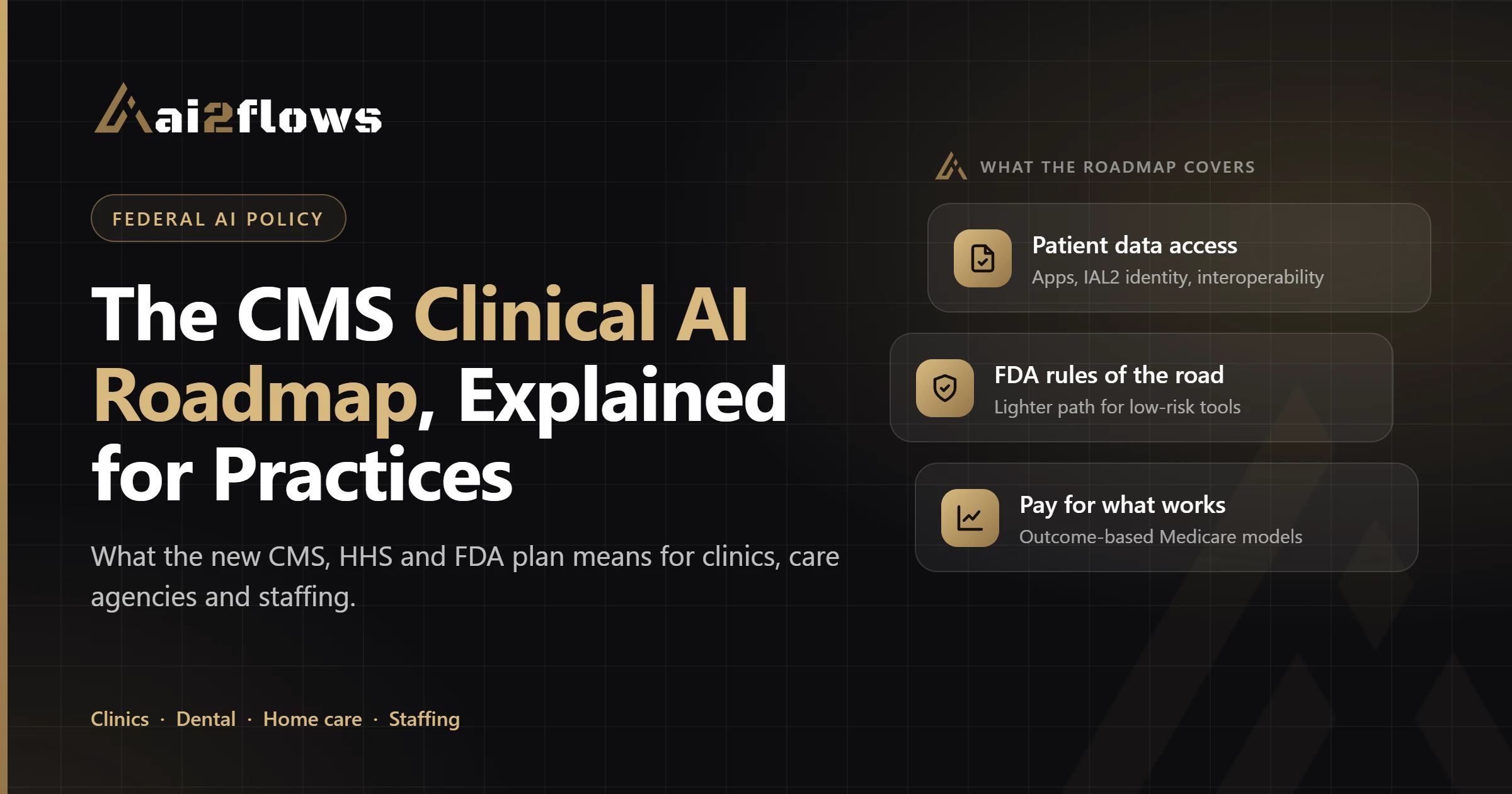
The roadmap is titled "A Clinical Super Intelligence Roadmap: Better Answers, Faster Care, and Lower Costs." According to the CMS landing page, it is a federal roadmap for accelerating safe and reliable AI in healthcare. It recognizes both the promise and the risks of the technology, sets principles for trusted adoption, and defines the role government should play.
The document uses its own vocabulary. It refers to AI as "Super (formerly Artificial) Intelligence," shortened to SI, and describes clinical SI as a secure, evidence-based health companion that patients can use between visits. It states plainly that clinical SI does not replace the doctor-patient relationship.
In short, the roadmap is a statement of direction, not a regulation. Most action items use words such as "anticipates," "explores" or "potentially," and the document gives no implementation deadlines.
What are the five principles and four pillars?
The roadmap is built on five principles and four priority areas. Understanding them helps any healthcare operator predict which AI tools regulators and payers will favor.
Principle | What it means in practice |
|---|---|
Safe and reliable | Tools should beat a "better than today" standard on safety, effectiveness, access and outcomes |
Earned and progressive adoption | Staged rollout, transparent evidence, human oversight and real-world monitoring |
Personal ownership | Patients control their health data and consent to its use in AI |
Affordability driver | Priority for technologies and payment models that lower total cost of care |
Permanent market access | Durable pathways for innovators to reach patients |
The four pillars are:
Earn public trust: staged adoption, transparency and patient choice, led by HHS.
Build the data foundation: interoperability, real-time evidence systems and secure data pathways, built on the CMS Health Tech Ecosystem and CMS Aligned Networks.
Establish clear rules of the road: FDA and CMS actions on regulation, oversight and liability.
Pay for what works: CMS payment models that reward clinical results.
The roadmap also lists what it will not do. It will not mandate AI adoption, will not authorize autonomy that has not cleared the "better than today" bar for its risk tier, and will not create a new agency.
What does the roadmap say about patient data and interoperability?
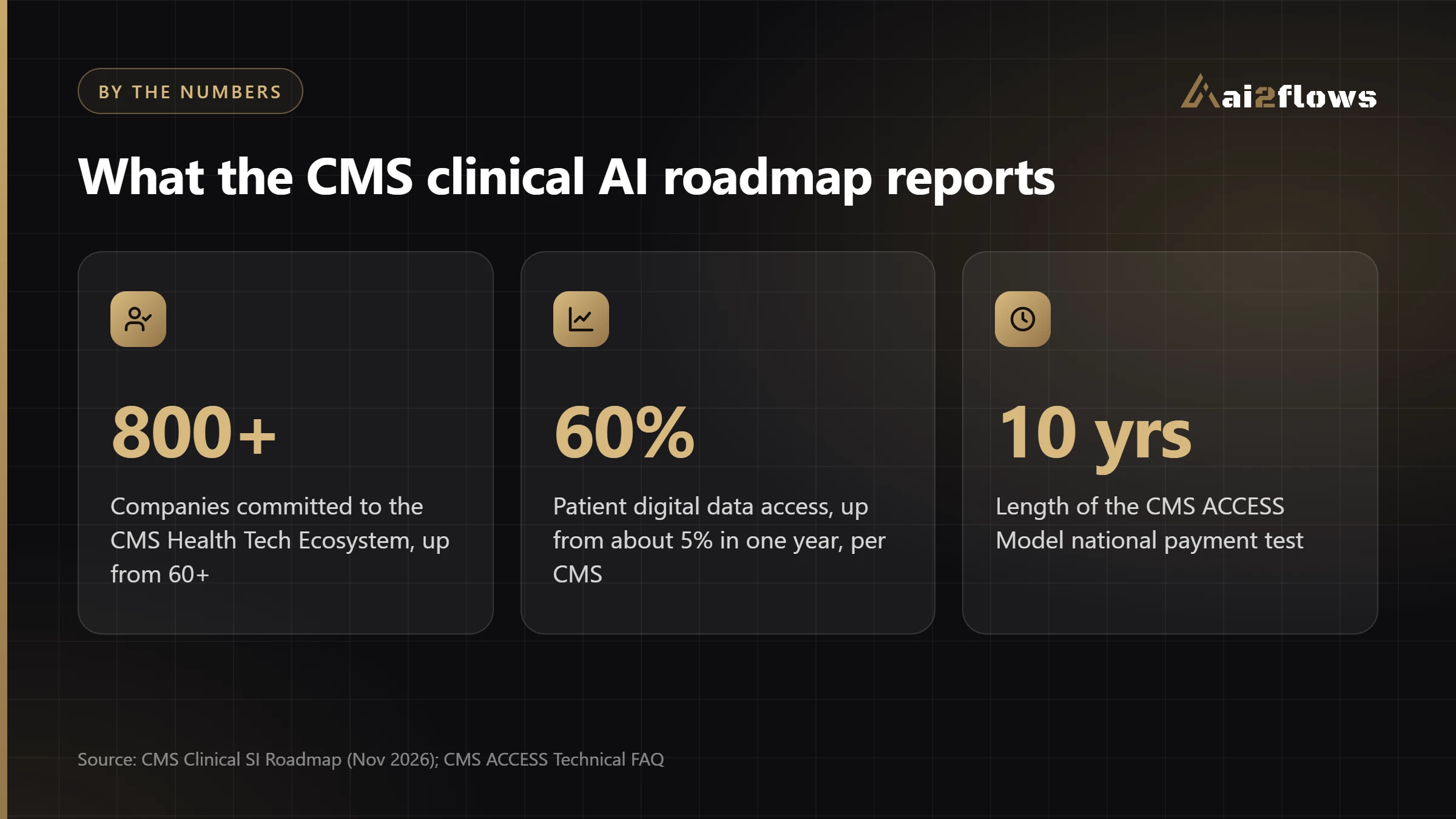
Data access is the area with the most concrete claims. The roadmap states that commitments to the CMS Health Tech Ecosystem grew from more than 60 companies to over 800. It also reports that patient digital data access rose by 55 percentage points, from roughly 5% to 60%, in one year. CMS attributes that jump to a standardized patient matching framework, IAL2 digital identity verification and mandatory provider response requirements. The roadmap does not cite an outside source for these figures, so treat them as CMS's own reporting.
Two definitions help here:
IAL2 (Identity Assurance Level 2): a federal standard for verifying that a person is who they claim to be online. CMS says it has enabled IAL2 verification for all Medicare beneficiaries, so they can pull their claims data into a patient app of their choice.
Medicare App Library: a vetted destination for AI-powered health tools that the roadmap says launched in 2026.
For clinics and home care agencies, the practical takeaway is that patients will increasingly arrive with their own records, summaries and AI-generated questions. Practices that can receive data cleanly, answer quickly and route requests through a smart CRM with automated follow-up will look more modern than those relying on fax and voicemail.
How will FDA treat AI tools under the roadmap?
The FDA section separates low-risk and higher-risk tools. For consumer wellness products and clinical decision support (CDS) software, the roadmap promises a continued rapid path to market, consistent with current FDA guidance.
That guidance was updated on January 6, 2026. According to Covington's analysis, the revised CDS guidance added enforcement discretion for software that gives a single recommendation when only one option is clinically appropriate, and placed more emphasis on usability and well-understood sources. Latham and Watkins notes that the updated General Wellness guidance appears to cover non-invasive sensing products, such as optical sensors estimating blood pressure or heart rate variability, when outputs are intended only for wellness.
Beyond current guidance, the roadmap floats several ideas that are not yet final:
A possible competency-based approach to premarket review of some AI-enabled devices, compared to how physicians are credentialed.
Direct access pathways for bounded, lower-risk diagnostic and therapeutic products.
State "sandboxes" where states can test AI rules.
Federal guidelines on liability and best practices for de-risking innovation.
The roadmap also says some FDA authorizations may trigger express preemption of state or local requirements. That matters because many states have passed their own healthcare AI laws. As DistilINFO points out, the roadmap does not establish a finalized competency-based approval framework, so practices should keep following current state rules.
How might CMS pay for AI-enabled care?
The "pay for what works" pillar leans on the ACCESS Model (Advancing Chronic Care with Effective, Scalable Solutions), which the American Medical Association reported in December 2025. According to the CMS technical FAQ, ACCESS is a 10-year national test of a new payment approach for technology-supported chronic care in Original Medicare. Participating organizations must be enrolled in Medicare Part B and designate a physician Medical Director. The AMA reported that the first performance period began in July 2026, with conditions such as high blood pressure, diabetes, chronic musculoskeletal pain and depression.
The roadmap adds forward-looking intentions:
CMS anticipates extending ACCESS to primary care for more chronic condition payment pathways.
Many parts of the Medicare Annual Wellness Visit could potentially be delivered with AI tools.
CMS anticipates creating structures for AI-led solutions inside Innovation Center models, with LEAD and AHEAD named as possible pathways.
CMS is exploring outcomes-based payment in Original Medicare and AI-led insurance options in the Marketplaces and Medicare Advantage.
DistilINFO's summary is a useful reality check: the roadmap does not announce new reimbursement rates, finalized payment policies or guaranteed coverage.
What does it mean for clinics, dental practices, home care and staffing agencies?
The roadmap does not name small practices, dental offices, home care or staffing. Its effects will be indirect, but they are easy to anticipate.
Business type | Likely impact | Smart move now |
|---|---|---|
Primary care and specialty clinics | Possible ACCESS expansion to primary care; AI-supported wellness visits | Track chronic care outcomes you can already measure |
Dental and aesthetic clinics | Patients using AI apps to research and compare providers | Make services, prices and FAQs clear enough for AI assistants to quote |
Home care agencies | More remote and between-visit care expectations from families | Automate family updates and intake follow-up with human review |
Healthcare staffing agencies | Roadmap frames AI as a response to workforce shortages | Use AI for admin work so recruiters spend time on clinicians |
The common thread is that patients and families are being pushed toward digital, always-available service. Answering every call, text and web inquiry quickly, for example with AI voice and chat agents that hand off to staff, fits the direction federal policy is moving.
How should a practice prepare? A four-step plan
None of this requires action today, but a few steps put a practice in a strong position as the details arrive.
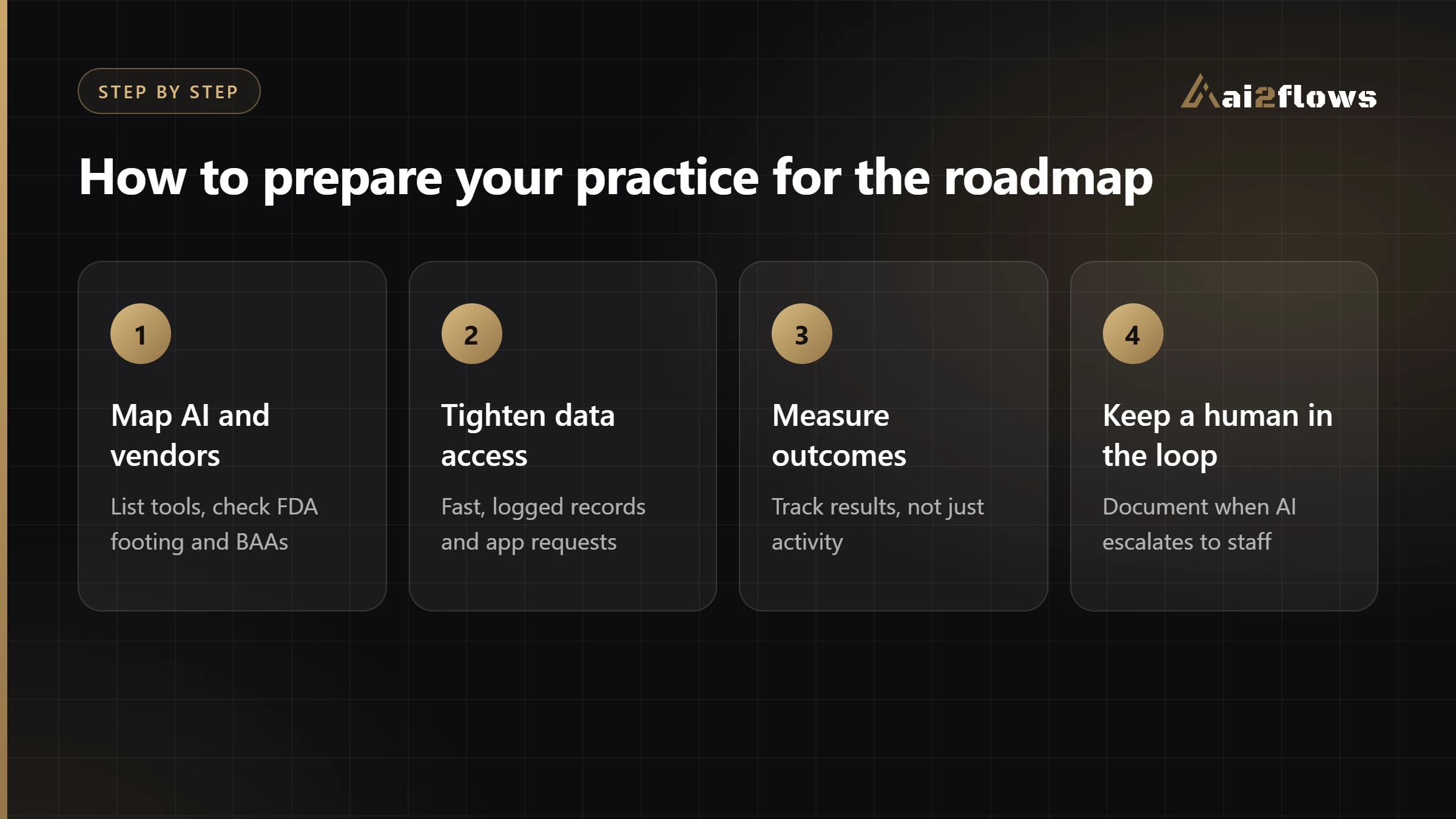
Map your AI and vendors. List every tool that touches patient data or communication, from scheduling bots to ambient scribes. Ask each vendor whether its product falls under FDA wellness or CDS guidance, whether it signs a business associate agreement, and how it monitors errors.
Tighten data access workflows. Make sure records requests, patient app connections and identity checks are handled quickly and logged.
Measure outcomes, not just activity. Start tracking results such as follow-up completion, readmissions or patient-reported improvement, since outcome-based payment is the stated direction.
Keep a human in the loop. Define when AI escalates to a clinician or staff member, and document it so you can show oversight if payers or regulators ask.
What about privacy, HIPAA and human oversight?
The roadmap warns that AI brings heightened privacy and cybersecurity risks and calls for gold-standard frameworks for privacy, data stewardship and patient consent. It does not change HIPAA. Your existing obligations under HIPAA, state privacy laws and state AI disclosure rules still apply.
A sensible baseline is to choose HIPAA-ready tools, sign business associate agreements, limit the data each AI system can see, and keep humans responsible for clinical decisions. Review your setup with a qualified compliance advisor; no software or vendor can guarantee compliance on its own.
Frequently asked questions
Is the Clinical Super Intelligence Roadmap a new regulation?
No. It is a federal policy roadmap from CMS, HHS and FDA that describes principles and intended actions. It does not mandate AI adoption, set new payment rates or create binding requirements for practices.
Why does the roadmap say "Super Intelligence" instead of AI?
The document adopts the term "Super (formerly Artificial) Intelligence," or SI, throughout. In practice it covers the same kinds of AI tools healthcare already uses, such as diagnostic support, patient-facing health apps and chronic care tools.
Does the roadmap change HIPAA rules for AI tools?
No. The roadmap stresses privacy, security and patient consent, but HIPAA is unchanged. Practices should keep using business associate agreements, access controls and risk assessments for any AI tool that handles protected health information.
What is the CMS ACCESS Model?
ACCESS (Advancing Chronic Care with Effective, Scalable Solutions) is a voluntary 10-year Medicare model that pays Part B-enrolled organizations for technology-supported chronic care, with payment tied to patient outcomes such as improved blood pressure.
Should small practices change anything right now?
Nothing is required, but it is wise to inventory AI tools, confirm vendor compliance, speed up patient data and inquiry workflows, and begin tracking outcomes. Those steps align with where federal policy is heading.
Sources
AMA: New voluntary CMS pay model encourages use of health tech
Covington: 5 key takeaways from FDA's revised CDS software guidance
Latham and Watkins: FDA updated guidance on digital health tools
Want help turning federal AI direction into practical wins, such as faster patient response, cleaner follow-up and better visibility in AI search? Book a free strategy call with AI2Flows and we will map the right next step for your practice.