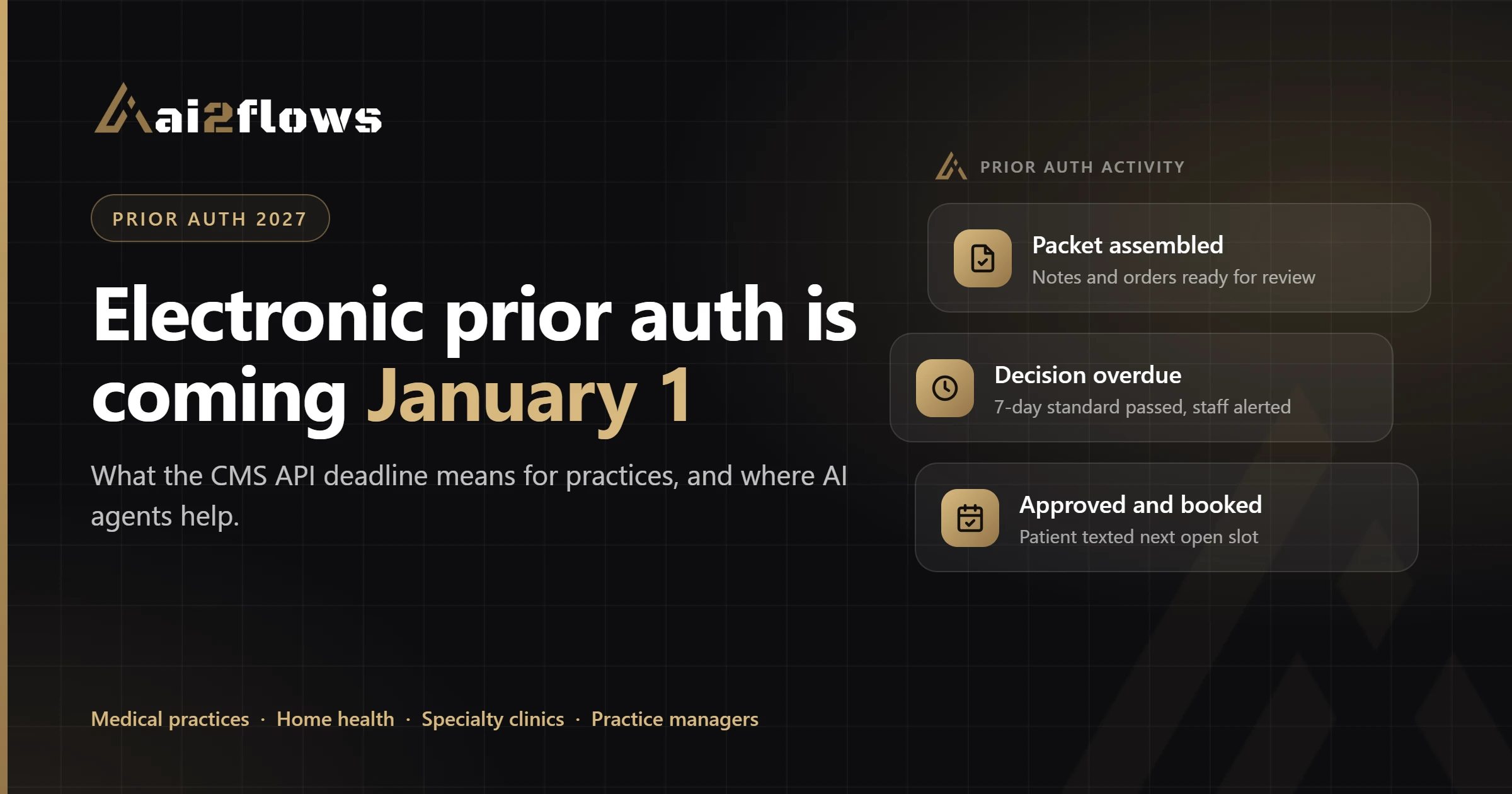
Electronic Prior Authorization 2027: What Practices Must Know
Quick answer: On January 1, 2027, Medicare Advantage plans, Medicaid and CHIP programs, and Marketplace plans on the federal exchange must offer a Prior Authorization API under the CMS-0057-F rule. Practices can then request and track approvals electronically instead of by fax and phone. The catch: a November 2026 WEDI survey found only about 1 in 10 payers fully ready. Practices that map their workflow now, and use AI agents for the paperwork around each request, will feel the benefit first.
What is the CMS electronic prior authorization rule?
The CMS Interoperability and Prior Authorization Final Rule, known as CMS-0057-F, was finalized in January 2024. It is the federal government's main effort to move prior authorization (the insurer approval some services need before they are delivered) off fax machines and phone queues and onto standard digital connections called APIs.
An API (application programming interface) is a secure, structured way for two software systems to exchange data. Under the rule, these APIs use the HL7 FHIR standard, the same modern data format used across much of US health IT.
According to the CMS fact sheet, the rule applies to:
Medicare Advantage organizations
State Medicaid and CHIP fee-for-service programs
Medicaid managed care plans and CHIP managed care entities
Qualified Health Plan issuers on the Federally Facilitated Exchanges
It does not cover every plan your patients carry. Trade coverage from Insurance Business notes that commercial fully insured plans and self-insured employer (ERISA) plans are outside the rule, so many practices will run electronic and manual processes side by side for a while.
What changes on January 1, 2027?
Some parts of the rule already took effect in 2026. The bigger technical shift lands in 2027. Here is the timeline in one place.
Requirement | Who it affects | Date |
|---|---|---|
Decisions within 72 hours (expedited) and 7 calendar days (standard) | Impacted payers, excluding exchange QHP issuers | Starting 2026 |
A specific reason for every denial, however the request was sent | Impacted payers (not drugs) | Starting 2026 |
Public posting of prior authorization metrics | Impacted payers | First report due March 31, 2026, then yearly |
Prior Authorization API (approve, deny with reason, or request more info) | Impacted payers | January 1, 2027 |
Provider Access API (claims, clinical data and prior auth history for in-network providers) | Impacted payers | January 1, 2027 |
Payer-to-Payer API when a patient switches plans | Impacted payers | January 1, 2027 |
"Electronic Prior Authorization" attestation measure in MIPS | MIPS clinicians, hospitals and CAHs | CY 2027 performance period |
The MIPS piece matters for physician groups. Starting with the 2027 performance period, clinicians in the Promoting Interoperability category attest yes or no to having requested at least one prior authorization electronically through a payer's Prior Authorization API, or they claim an exclusion. That is a light requirement, but it signals where CMS expects practices to go.
How big is the prior authorization burden right now?
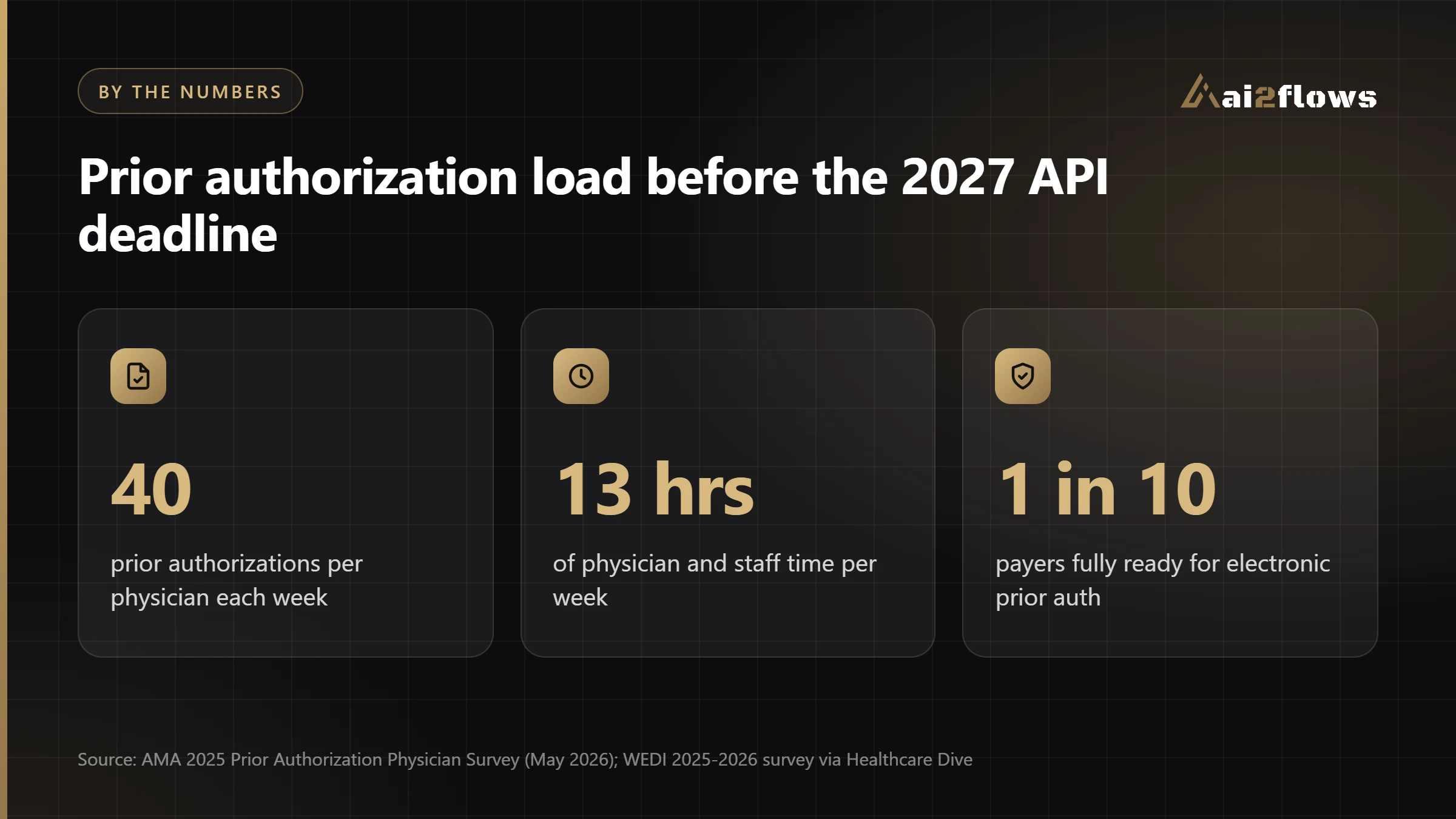
The numbers explain why this rule exists. According to the AMA's 2025 Prior Authorization Physician Survey of 1,000 practicing physicians, published in May 2026:
Physicians complete an average of 40 prior authorizations per week.
Physicians and their staff spend about 13 hours per week on prior authorization.
40% employ staff who work exclusively on prior authorization.
95% say prior authorization delays access to necessary care, and 26% report it led to a serious adverse event for a patient.
94% say it contributes to burnout.
Things have not improved much yet. Insurance Business, citing the MGMA, reports that 90% of practices said prior authorization burden grew over the prior 12 months in MGMA's 2026 Regulatory Burden Report, and 44% of medical group leaders in a September 2026 MGMA poll said turnaround was slower in 2026 than in 2025.
There is a cost angle too. The CAQH Index, as cited in the same coverage, puts a manual prior authorization transaction at $10.97 compared with $5.79 when fully electronic, a reduction of about 47% per transaction.
Are payers and practices ready for the deadline?
Mostly not yet. On November 16, 2026, the Workgroup for Electronic Data Interchange (WEDI) posted results from its 2025-2026 Interoperability and Prior Authorization Survey. As reported by Healthcare Dive:
Only about 1 in 10 payers said they were completely ready for the electronic prior authorization requirements.
Nearly two thirds of health plans were at least halfway there, while 17% had not started.
62% of payers said the project cost more than expected.
On the provider side, roughly a fifth had not started on the APIs and fewer than a tenth had fully implemented them.
Nearly three quarters of providers said it is very or extremely important for payers to deliver electronic prior authorization.
WEDI executive director Robert Tennant described APIs as a completely new approach to data exchange for most stakeholders and urged organizations to find partners for API testing. The practical takeaway: do not expect every payer connection to work smoothly in January. Plan for a mixed year where some plans are live, some are partially live, and fax remains a fallback.
Where do AI agents fit into prior authorization?
The CMS APIs solve the transport problem: how a request travels and how a decision comes back. They do not remove the human work around each request. That surrounding work is where AI agents, meaning software that can read, reason and take defined actions inside your systems, are most useful for a practice or agency.
Useful, low-risk jobs for an AI agent include:
Requirement checks: flagging, at booking, whether a service for a given plan likely needs authorization, so staff start early instead of the day before.
Document gathering: pulling the visit notes, imaging or orders a payer typically asks for and assembling a draft packet for staff review.
Status follow-up: tracking pending requests against the 72-hour and 7-day timeframes and alerting staff when a decision is overdue.
Patient communication: sending SMS or voice updates when an approval arrives, then offering the next available appointment so the approved visit actually gets booked.
Denial routing: reading the now-required denial reason and routing it to the right person for resubmission or peer-to-peer review.
The last two are where a smart CRM earns its keep. An approval that sits in a portal while the patient waits for a call is a lost visit. Automated follow-up through healthcare CRM and automation, paired with AI voice and chat agents that can answer "is my procedure approved yet?" at any hour, closes that gap.
Clinical judgment stays with people. An AI agent should never decide medical necessity or submit a clinical argument without a licensed clinician's review.
What does the Medicare WISeR pilot teach about AI in prior authorization?
Payers are using AI too, and the early results are a caution. CMS's WISeR model (Wasteful and Inappropriate Services Reduction) launched January 1, 2026, in six states: Arizona, New Jersey, Ohio, Oklahoma, Texas and Washington. It adds prior authorization for 13 categories of services in traditional Medicare, run by six technology vendors, with a human clinician required to review any non-affirmation.
According to TechTimes reporting on CMS records released by the Electronic Frontier Foundation in November 2026, four of the six vendors were flagged by CMS in the first weeks for problems such as backlogs, late determination letters and questionable denials. CMS deputy administrator Kimberly Brandt said at an October conference that a lot of things about WISeR were not working.
The lesson for practices is simple: AI speeds things up only when the process, data and human review around it are sound. The AMA survey found six in 10 physicians worry AI may increase denial rates. That is a strong argument for using AI on your side of the process to stay organized, document well and respond fast, while keeping a person accountable for every clinical submission.
How can a practice get ready for electronic prior authorization?
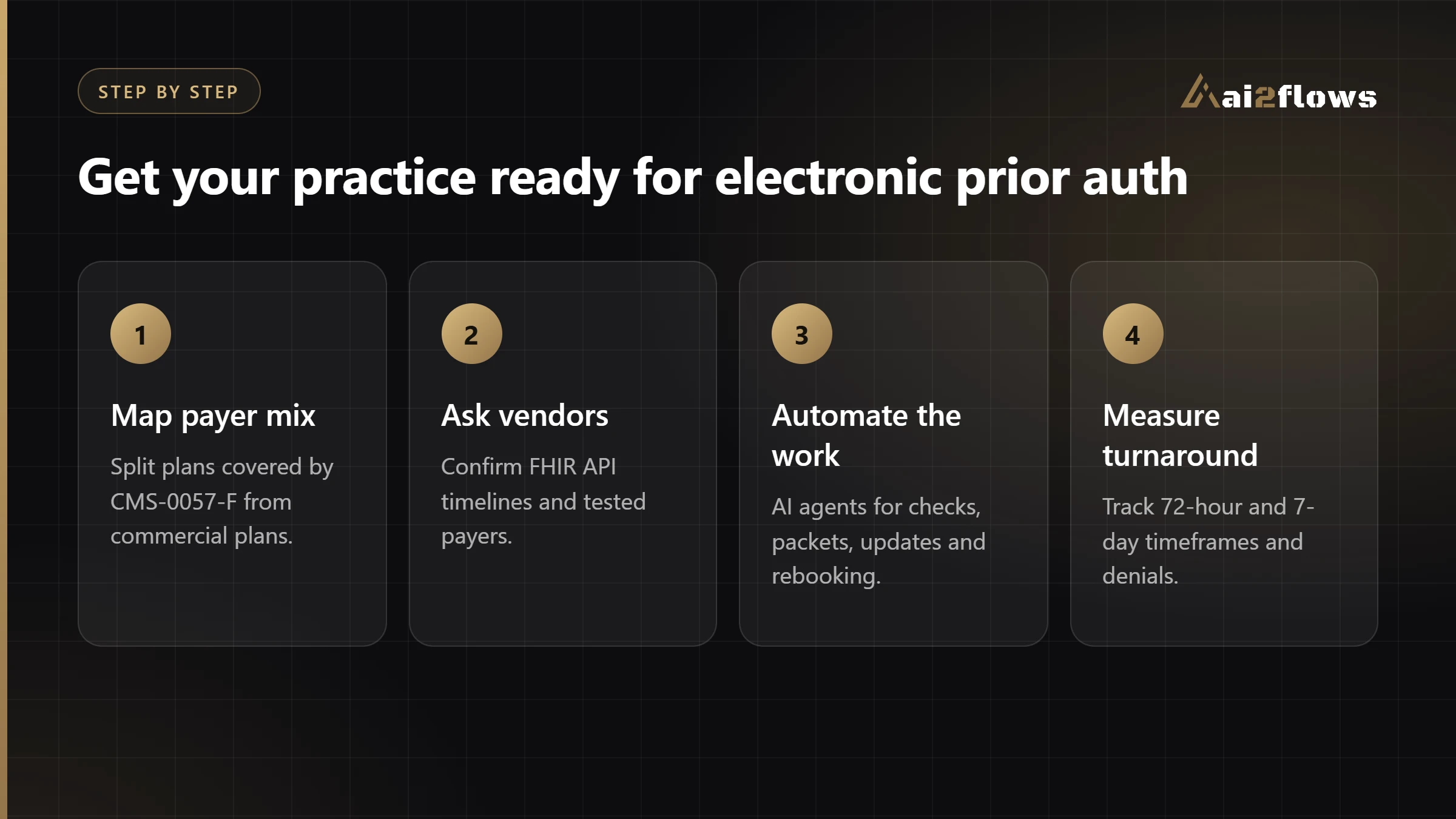
You do not need to build an API yourself. Your EHR, practice management system or clearinghouse will provide the connection. Your job is to make sure your team and workflow can use it. A practical plan:
Map your payer mix. List which of your active plans are Medicare Advantage, Medicaid managed care or exchange plans covered by CMS-0057-F, and which are commercial or employer plans that are not.
Ask your vendors direct questions. Ask your EHR or practice management vendor and clearinghouse when they will support FHIR-based Prior Authorization APIs, which payers they have tested with, and what changes for your staff.
Automate the work around each request. Use a smart CRM and AI agents for requirement checks, document packets, status tracking, patient updates and rebooking, with staff approving anything clinical.
Measure and hold payers to the timeframes. Track turnaround against the 72-hour and 7-day standards, log denial reasons, and compare your numbers with the metrics payers must now post publicly.
Home care and home health agencies that bill Medicare Advantage or Medicaid managed care should run the same checklist. Many of the same delays show up as late starts of care, which is also a family experience problem. Our page on AI for home care agencies covers intake follow-up in more detail.
What about HIPAA and data privacy?
Prior authorization involves protected health information (PHI) at every step, so any AI tool in the workflow needs to be HIPAA-ready:
A signed Business Associate Agreement (BAA) with every vendor that touches PHI.
Access limited to the minimum data each agent needs, with audit logs of what it read and sent.
Human review before any clinical document or appeal goes to a payer.
Clear patient messaging that avoids sharing diagnosis details over unsecured SMS.
No tool makes a practice compliant on its own. Review your setup with your compliance advisor or healthcare attorney before going live.
Frequently asked questions
When is the CMS prior authorization API deadline?
Impacted payers must implement the Prior Authorization API, Provider Access API and Payer-to-Payer API by January 1, 2027, under the CMS Interoperability and Prior Authorization Final Rule (CMS-0057-F).
Does the rule apply to commercial insurance plans?
No. It covers Medicare Advantage, Medicaid and CHIP programs and managed care plans, and Qualified Health Plan issuers on the federal exchanges; commercial fully insured and self-insured employer plans are not covered.
Do practices have to build their own API?
No. Practices typically connect through their EHR, practice management system or clearinghouse, so the key step is confirming your vendors' timelines and which payers they have already tested with.
Can AI submit prior authorizations on its own?
AI agents can check requirements, assemble documents and track status, but a qualified staff member or clinician should review and approve every clinical submission, appeal and medical necessity argument.
What is the MIPS Electronic Prior Authorization measure?
It is a yes or no attestation in the Promoting Interoperability category, starting with the 2027 performance period, confirming a clinician requested at least one prior authorization electronically through a payer's Prior Authorization API, or claimed an exclusion.
How fast must payers decide prior authorization requests now?
Since 2026, impacted payers (other than exchange QHP issuers) must decide expedited requests within 72 hours and standard requests within 7 calendar days, and must give a specific reason for every denial.
Sources
CMS: Interoperability and Prior Authorization Final Rule (CMS-0057-F) fact sheet
CMS: CMS Interoperability and Prior Authorization Final Rule overview
AMA: Prior authorization reform pledge falls short with physicians (May 13, 2026)
Insurance Business: Health plans have 10 weeks to meet the prior auth API deadline (Oct 21, 2026)
TechTimes: Medicare's AI prior authorization pilot had 4 of 6 vendors flagged (Nov 3, 2026)
Want help automating the follow-up, patient updates and rebooking around prior authorization? Book a free strategy call with AI2Flows and we will map where AI agents and a smart CRM can save your team hours each week.