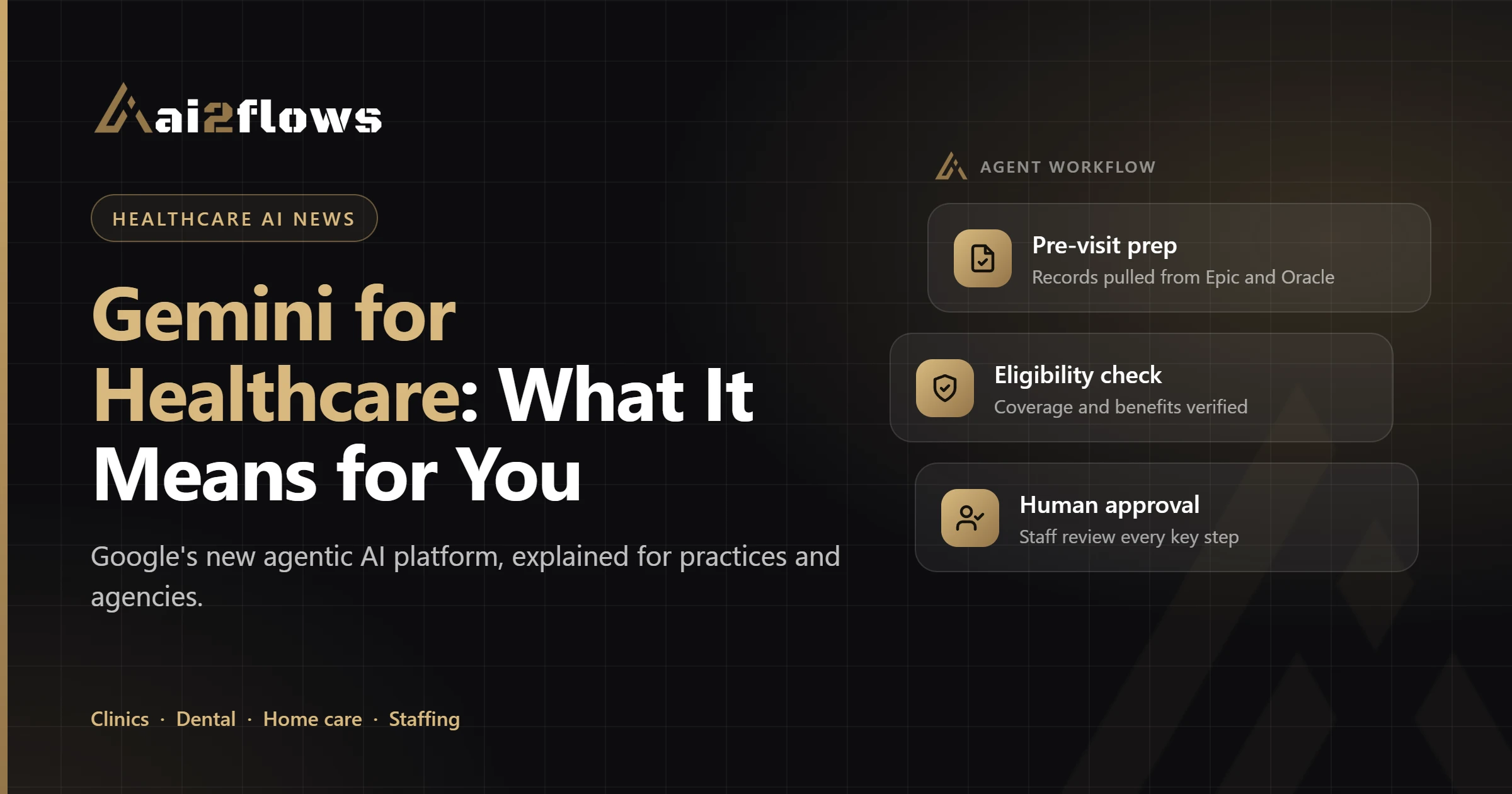
Gemini for Healthcare Explained: What It Means for Practices
Quick answer: Gemini for healthcare is an agentic AI platform Google Cloud launched in preview on November 10, 2026. It connects Gemini agents to EHRs like Epic and Oracle Health, CMS coverage data, billing tools and office software so teams can automate multi-step admin work such as pre-visit prep, eligibility checks and prior authorization support, with human oversight. Today it targets large health systems and payers, but it signals where every practice's software is heading.
What is Gemini for healthcare?
Gemini for healthcare is a version of Google's Gemini agent built specifically for healthcare providers and health plans. Google Cloud announced it on November 10, 2026, describing it as a purpose-built agentic AI solution that unifies clinical, operational and administrative systems.
An agentic AI platform is software where AI does more than answer questions. It reads information from several systems, decides on next steps and carries out multi-step tasks within rules that the organization sets. In plain terms, it is the difference between a chatbot that explains a coverage policy and an agent that pulls the patient's record, checks the policy and drafts the paperwork for a staff member to review.
According to Google Cloud's announcement, the platform is in preview, and launch customers include Blue Cross Blue Shield of Massachusetts, Hartford HealthCare, HCA Healthcare, Highmark Health, Northwell Health, Optum and Stanford School of Medicine.
Why is Google launching it now?
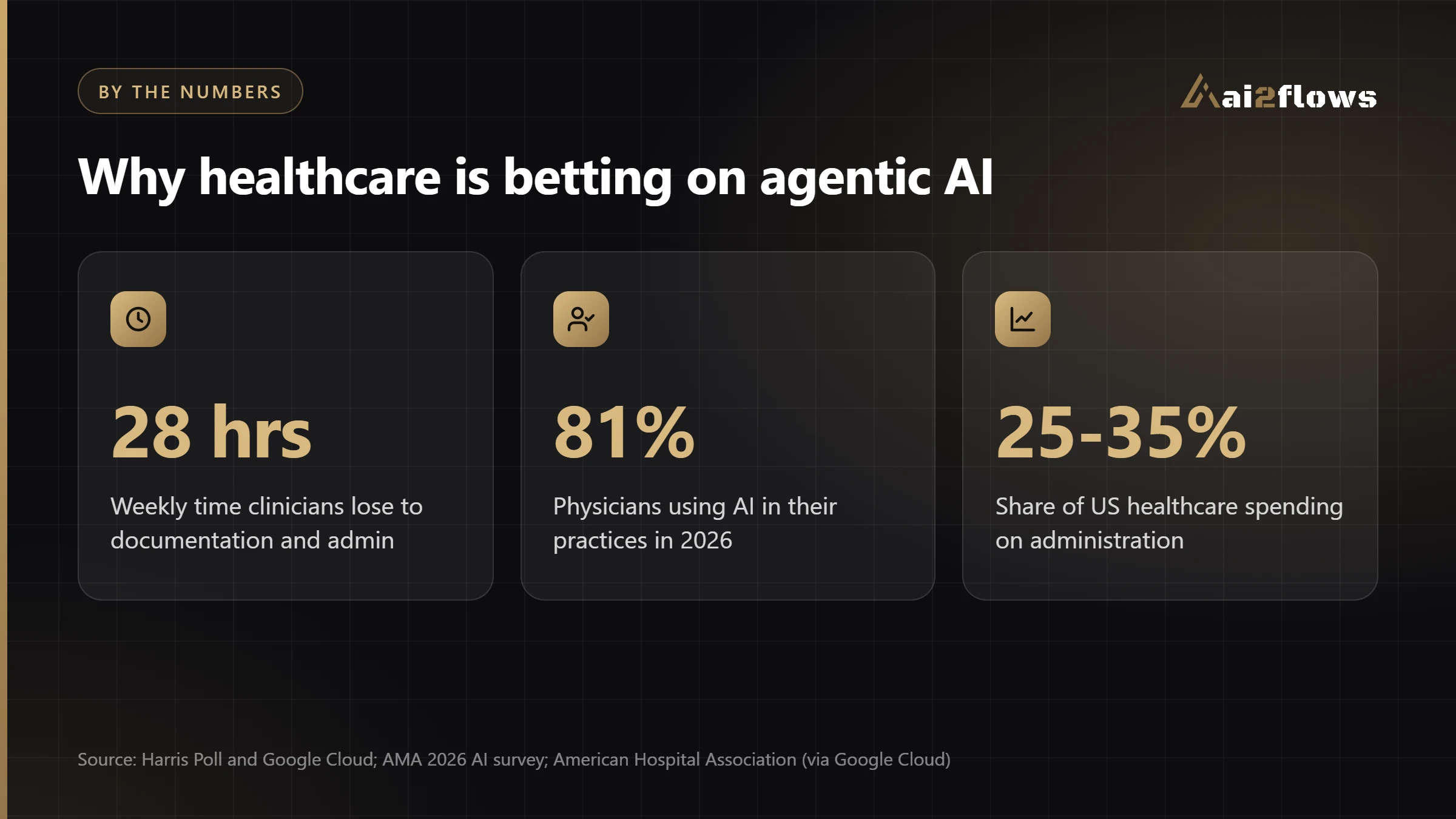
The short answer is administrative burden. Google's announcement cites several figures that explain the pressure on healthcare teams:
Clinicians lose nearly 28 hours each week to documentation and administrative requirements, according to a study from The Harris Poll and Google Cloud.
Burnout affected 41.9% of physicians in a 2025 American Medical Association report.
Administrative costs account for an estimated 25% to 35% of total US healthcare spending, according to the American Hospital Association.
Physicians are also ready for AI tools. The AMA's 2026 Physician Survey on Augmented Intelligence found that 81% of physicians now use AI in their practices, up from 38% in 2023, and about 70% believe AI can help automate tasks that contribute to burnout. That survey covered 1,692 physicians and was fielded in January and February 2026.
Competition is the other driver. Healthcare Dive noted that Anthropic, OpenAI and now Google have all launched healthcare-specific AI tools in 2026. Anthropic introduced Claude for Healthcare and OpenAI launched OpenAI for Healthcare in January 2026, so Google's release completes a three-way race among the largest AI labs.
What can Gemini for healthcare actually do?
Google describes the platform around skills, connectors and governance. Here is what each piece means for a working healthcare team.
Specialized skills: pre-built, multi-step instructions for tasks such as medical records synthesis, pre-appointment preparation, coverage and policy review and payer benefit determination. Organizations can also build custom skills.
EHR connectors: secure read access to Epic (via open.epic APIs) and Oracle Health (via FHIR APIs). Google says the agent does not write back to the EHR, which protects clinical data integrity. NextGen Healthcare connectivity is in development.
Administrative and coding data: lookups into CMS coverage data, the NPI Registry, RxNorm and ICD-10, plus partner tools for eligibility verification, benefit verification and prior authorization support.
Workflow partners: integrations with vendors such as Suki for ambient documentation, UiPath for chart summaries, and GoodRx for prescription pricing.
Office systems: connections to Google Workspace, Microsoft 365, ServiceNow and Salesforce Health Cloud.
Governance: access controls, audit logging and verifiable citations, plus a choice of models from Google, Anthropic and OpenAI, with routine tasks routed to faster, lower-cost models.
The multi-model detail matters. Google is positioning the product as a governed workspace for agents rather than a single model, which is a sign that buyers care more about integrations and controls than about which model sits underneath.
How does it compare with OpenAI and Anthropic healthcare offerings?
All three platforms aim at the same problem, but their launch messages differ. The table below summarizes what each company announced, based on Google Cloud's press release and InfoQ's January 2026 coverage of the OpenAI and Anthropic launches.
Platform | Launched | Main focus at launch | Notable data connections |
|---|---|---|---|
Claude for Healthcare (Anthropic) | January 2026 | Connectors and agent skills for providers, payers and life sciences | CMS Coverage Database, ICD-10, NPI Registry, FHIR skills, prior authorization review templates |
OpenAI for Healthcare (OpenAI) | January 2026 | ChatGPT for Healthcare plus a HIPAA-configured API with enterprise controls | Curated medical sources, internal documents, optional Business Associate Agreements |
Gemini for healthcare (Google Cloud) | November 2026 (preview) | Agentic workflows across clinical and admin systems under one governance layer | Epic and Oracle Health read access, CMS data, NPI, RxNorm, ICD-10, eligibility partners |
For buyers, the pattern is clear. The leading AI vendors have converged on the same building blocks: connectors to trusted healthcare data, reusable skills for admin tasks, audit trails and HIPAA-oriented deployment options. The differences will show up in which systems each one connects to and how much it costs at your size.
Can smaller practices and agencies use it?
Not easily, at least not yet. Healthcare Dive reported that Gemini for healthcare is in preview with select early adopters. Google says it will eventually be available to enterprise customers through per-user subscriptions or pay-as-you-go pricing, but it has not shared a date for broader launch.
The launch customers are large health systems and payers with IT teams, Epic or Oracle Health environments and the budget for systems integrators. A five-chair dental office, a med spa, a home care agency or a healthcare staffing firm usually runs on different software: practice management systems, scheduling tools, phone systems and a CRM.
That does not make the news irrelevant for smaller organizations. It shows what will soon be standard everywhere:
Practice software vendors will add agent features that read across scheduling, billing and patient records.
Insurance and eligibility tasks will increasingly be handled by agents, with staff approving the final step.
Patients and referral partners will expect faster answers, because large systems will be able to respond in minutes.
Smaller teams can get many of the same benefits today with focused tools. A voice AI agent can answer calls, book visits and handle routine questions, and a smart CRM with automated follow-up can manage reminders, recalls and lead response without an enterprise contract.
What should healthcare leaders watch for in privacy and oversight?
Google says the platform supports HIPAA compliance and keeps consequential decisions in qualified hands. Those are useful design choices, but no vendor can make your organization compliant on its own. HIPAA responsibilities depend on how you configure the tool, what data you connect and who has access.
Before using any healthcare AI agent, check these points:
Business Associate Agreement: confirm the vendor will sign a BAA before any protected health information flows through the tool.
Read versus write access: Google's EHR connectors are read only at launch. Know exactly what any agent is allowed to change.
Audit logs: make sure you can see what the agent accessed and did, and who approved it.
Human review: keep a person in the loop for anything clinical, financial or patient-facing.
Staff training: the AMA survey found 92% of physicians want more AI education and 27% had received no training on AI use cases.
A HIPAA-ready setup is a combination of the right vendor terms, sensible permissions and clear internal policies. We recommend reviewing any AI rollout with a qualified compliance advisor.
How can your practice prepare for agentic AI?
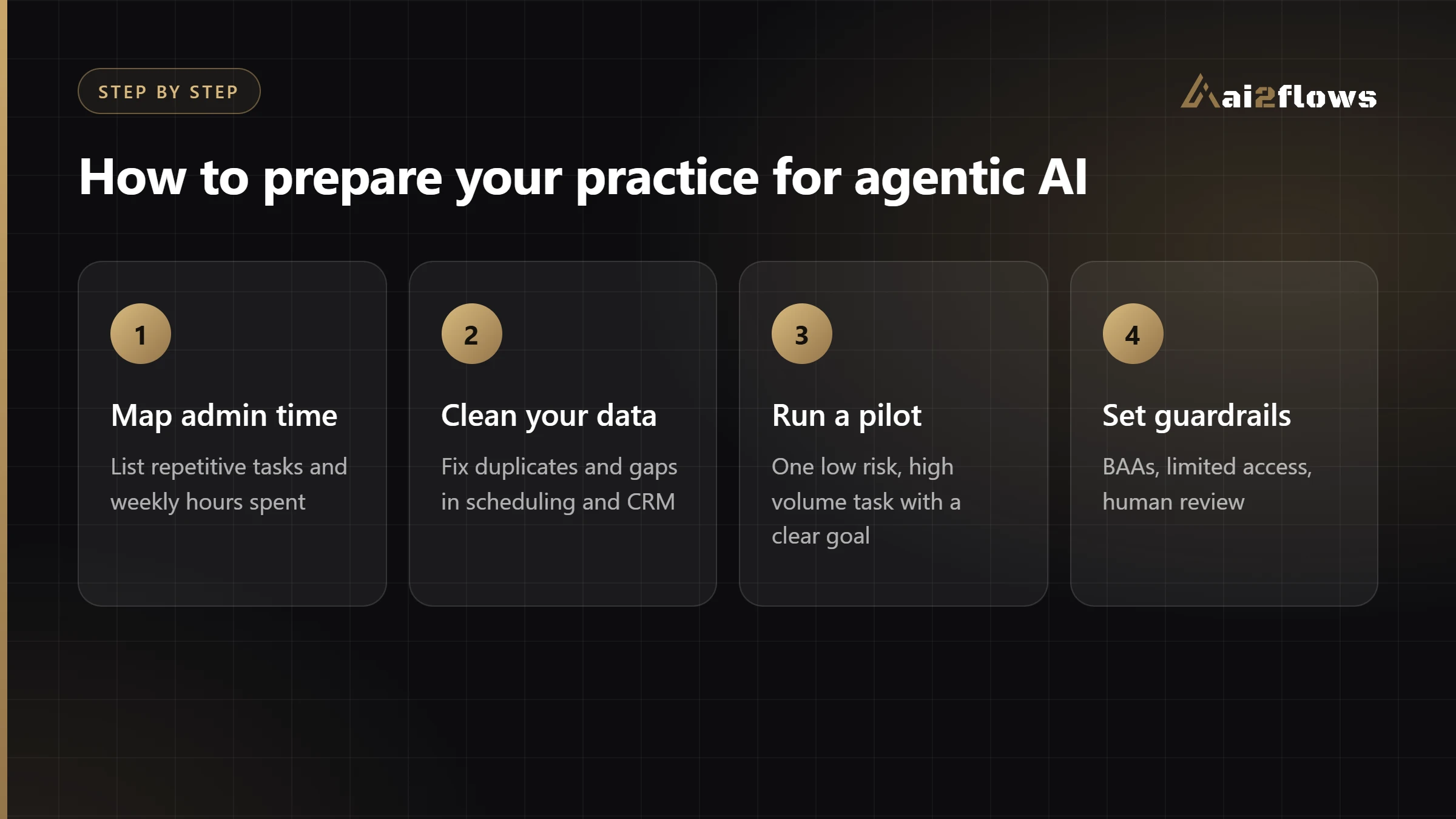
You do not need to wait for Gemini for healthcare to reach your market. The same groundwork will help you adopt any agent platform, whether it comes from Google, your practice software vendor or a focused tool you add today.
Map your admin time. List the repetitive tasks that eat staff hours, such as phone intake, scheduling, eligibility checks, reminders and follow-up. Estimate weekly hours for each.
Clean up your data. Agents are only as good as the systems they read. Fix duplicate contacts, missing fields and inconsistent appointment types in your scheduling system and CRM.
Pick one workflow to pilot. Start with a low-risk, high-volume task, such as after-hours call answering or appointment reminders, and set a clear measure of success.
Set guardrails and review. Sign BAAs, limit permissions, keep humans approving sensitive steps, and review results every two weeks before expanding.
Teams that follow these steps now will be able to evaluate enterprise agent platforms on their merits later, instead of starting from scratch.
What does this mean for patient acquisition and marketing?
Agentic AI is not only changing back-office work. Patients increasingly use AI assistants to research symptoms, compare providers and check coverage. The AMA survey found that 30% of physicians believe at least half of their patients use AI chatbots.
When AI assistants answer questions like "which clinic near me takes my insurance," they pull from clear, structured, trustworthy information. Practices that publish accurate service pages, FAQs and insurance details are easier for these systems to cite. That is the goal of answer engine and generative engine optimization (AEO and GEO), and it is becoming as important as traditional SEO.
Frequently asked questions
What is Gemini for healthcare?
Gemini for healthcare is an agentic AI platform from Google Cloud, announced November 10, 2026, that connects Gemini agents to EHRs, CMS data, billing tools and office software to automate clinical and administrative workflows with human oversight.
Is Gemini for healthcare available to all practices?
No. As of November 2026 it is in preview with select early adopters such as HCA Healthcare, Northwell Health and Optum. Google says it will eventually offer per-user and pay-as-you-go pricing to enterprise customers but has not shared a broader launch date.
Does Gemini for healthcare write to the EHR?
Not at launch. Google says its Epic and Oracle Health connectors provide read access only, so agents can pull records such as conditions, medications and labs without writing back to the EHR.
Is Gemini for healthcare HIPAA compliant?
Google says the platform supports HIPAA compliance, but compliance always depends on your own setup, including a Business Associate Agreement, access controls and internal policies. Review any rollout with a qualified compliance advisor.
How is it different from Claude for Healthcare or OpenAI for Healthcare?
All three offer healthcare data connectors and enterprise controls. Anthropic and OpenAI launched in January 2026, while Google's November 2026 preview emphasizes direct Epic and Oracle Health read access and a governance layer that supports models from Google, Anthropic and OpenAI.
What can a small clinic or home care agency do now?
Start with focused tools for high-volume tasks, such as an AI voice agent for calls and scheduling and a smart CRM for reminders and follow-up, while cleaning up data and setting guardrails so you are ready for larger agent platforms later.
Sources
Google Cloud: Google Cloud Launches Gemini for Healthcare (November 10, 2026)
Healthcare Dive: Google Cloud debuts Gemini for healthcare (November 11, 2026)
The ASCO Post: AMA Survey Finds Rapid Growth in Physician AI Adoption (March 2026)
InfoQ: OpenAI and Anthropic Introduce Healthcare-Focused AI Platforms (January 2026)
Want the benefits of agentic AI without an enterprise contract? AI2Flows sets up HIPAA-ready AI agents and smart CRM automation for clinics, home care agencies and healthcare staffing firms. Book a free strategy call and we will map the first workflow worth automating in your business.