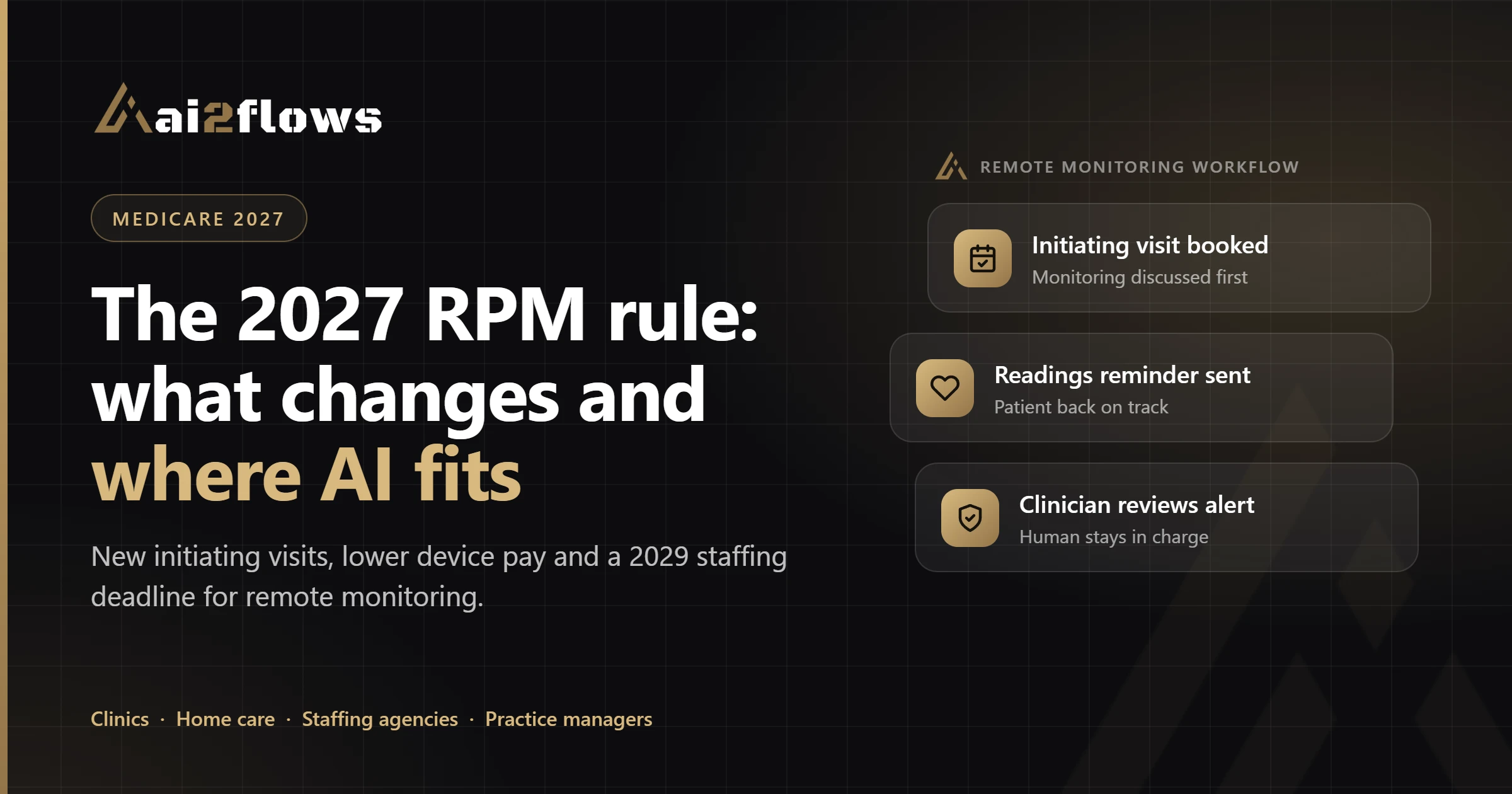
2027 Medicare RPM Rule: What Changes and Where AI Fits
Quick answer: On November 4, 2026, CMS finalized the CY 2027 Medicare Physician Fee Schedule. Starting January 1, 2027, remote patient monitoring (RPM) and remote therapeutic monitoring (RTM) must begin with a face-to-face or telehealth initiating visit, RTM is limited to established patients, and device supply codes are revalued downward. A rule limiting payment to clinical staff employed by the practice was finalized but delayed to January 1, 2029, which gives practices two years to bring monitoring workflows in house. AI agents and a smart CRM can help with enrollment, reminders and documentation, but licensed clinicians must stay in charge of care.
What did CMS finalize for remote monitoring in the 2027 fee schedule?
Remote patient monitoring is a Medicare service where a patient uses a connected device, such as a blood pressure cuff or glucose meter, that sends readings to their care team, who review the data and talk with the patient about it. Remote therapeutic monitoring is a close cousin that tracks non-physiologic data, such as therapy adherence or pain response.
According to the CMS fact sheet for the CY 2027 Physician Fee Schedule final rule, published November 4, 2026, CMS had proposed four remote monitoring policies and finalized all four, with one delayed:
Established patients only for RTM. RTM now matches the existing RPM rule. The National Law Review explains that CMS uses the standard definition: the patient received professional services within the past three years from the practitioner or a same-specialty colleague in the same group.
A required initiating visit. RPM and RTM must start during a face-to-face visit, in person or by telehealth, where remote monitoring is discussed.
Updated valuation. CMS revalued the remote monitoring codes, though legal analysts describe the final change as narrower than first proposed.
Employed clinical staff only, from 2029. Medicare will pay for RPM and RTM clinical staff time only when that staff is employed by the practice, effective January 1, 2029 instead of the proposed 2027 start.
CMS did not finalize its proposal to replace the current RPM and RTM CPT codes with four new HCPCS G-codes, and said it may revisit the idea in future rulemaking.
Why is Medicare tightening remote patient monitoring now?
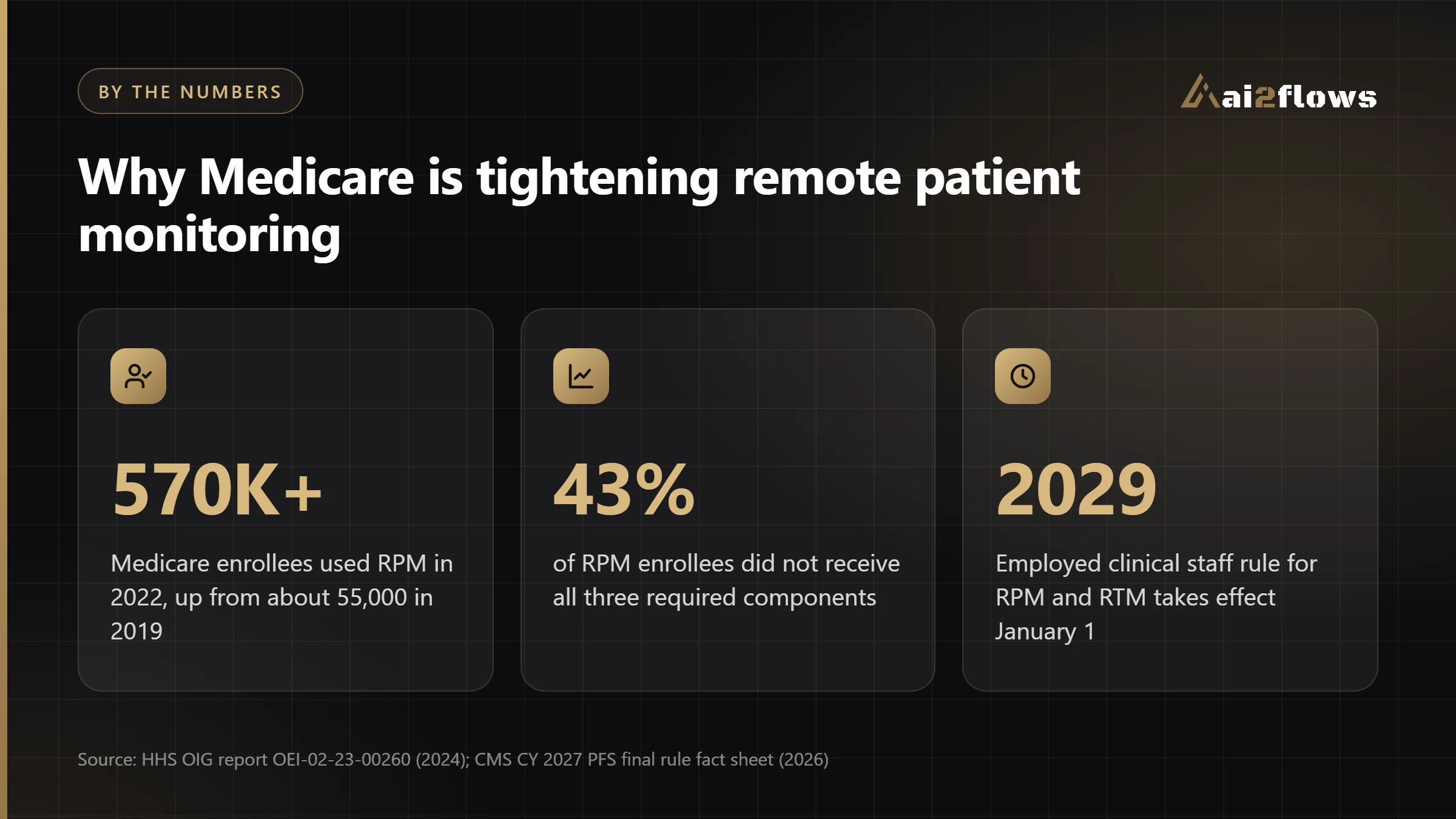
The short answer is fast growth and weak oversight. In its September 2024 report (OEI-02-23-00260), the HHS Office of Inspector General found that Medicare RPM use grew from about 55,000 enrollees in 2019 to more than 570,000 in 2022, while payments rose from about $15 million to roughly $300 million over the same period.
The same OIG review found that about 43% of enrollees who received RPM did not receive all three required components: education and device setup, device supply, and treatment management. OIG also noted that CMS lacked basic data such as who ordered the monitoring and what condition was being tracked.
The 2027 rule responds directly to those findings. The initiating visit ties monitoring to a real clinical relationship, and the employed staff requirement targets arrangements where outside companies run the program with little involvement from the billing practitioner.
What changes on January 1, 2027?
Three things take effect for services on or after January 1, 2027.
The initiating visit. According to the National Law Review summary, the visit does not need to be dedicated only to RPM or RTM, there is no fixed deadline between the visit and device activation, and a new visit is not needed for a device change or a change of billing practitioner within the same practice. Patients already receiving RPM or RTM before January 1, 2027 do not need one. CMS also discouraged enrolling patients early just to avoid the new requirement. Sources differ slightly on who may perform the visit, so confirm the details with your billing advisor.
RTM for established patients only. New patients must have an established relationship before RTM can be billed.
New valuation. RPM vendor Prevounce published early estimates on November 5, 2026, based on the non-APM conversion factor and proposed-rule data, so treat these as directional rather than final:
CPT code | What it covers | Estimated 2026 | Estimated 2027 |
|---|---|---|---|
99453 | Setup and patient education | $21.71 | $19.90 |
99454 | Device supply, 16 to 30 days | $52.11 | $41.11 |
99445 | Device supply, 2 to 15 days | $52.11 | $41.11 |
99457 | Treatment management, first 20 minutes | $51.77 | $51.55 |
99458 | Each additional 20 minutes | $41.42 | $41.11 |
99470 | Treatment management, first 10 minutes | $26.05 | $26.43 |
The pattern is clear: device payments fall by roughly a fifth, while time spent actually managing the patient holds steady. Medicare is paying for clinical attention, not for hardware. The overall conversion factor also drops. CMS lists the 2027 non-qualifying APM participant conversion factor at $32.63, down 2.31% from 2026.
What does the 2029 employed staff rule mean for outsourced RPM?
From January 1, 2029, Medicare will pay for RPM and RTM clinical staff time only when it is furnished by a direct employee of the practitioner or practice, under general supervision. The National Law Review notes that staff do not need to be physically in the office, so remote employees can still qualify.
Several important points remain open:
CMS has not yet defined "direct employee" and has committed to issue guidance before 2029.
The rule does not address W-2 status, professional employer organizations or staffing agencies.
Until December 31, 2028, practices may keep contracting with third parties, but CMS expects the billing practitioner to stay meaningfully involved.
Technology vendors are not banned. Practices can still buy devices, software, connectivity, data hosting, cybersecurity and implementation support from outside companies. The restriction targets outsourced clinical staff time, not the tools. The American Telemedicine Association's advocacy arm called the delay a two-year reprieve and said significant work remains.
How does this affect clinics, home care agencies and staffing firms?
The impact depends on how your organization touches remote monitoring today.
Organization | Main 2027 to 2029 impact | Practical focus |
|---|---|---|
Primary care and specialty clinics | Initiating visits and lower device payments | Fold the RPM discussion into routine visits and track it in the chart |
Practices using an outsourced RPM vendor | Clinical staff time must be employed staff by 2029 | Plan which nurses or medical assistants will own monitoring |
Home care agencies | Partner practices may change how they run monitoring | Coordinate device education and readings with the patient's physician |
Healthcare staffing agencies | Questions about whether placed staff will count as direct employees | Watch for CMS guidance before offering RPM staffing models |
For home care leaders, remote monitoring is often where your caregivers see the patient most. Our guide for home care agencies covers how intake and follow-up automation can support those referral relationships.
Where do AI agents and automation help in a compliant RPM program?
The new rules reward practices that run monitoring themselves with tight clinical oversight. That raises the workload on in-house staff, which is where automation earns its place. Used well, AI handles the routine administrative steps so nurses can spend their billable minutes with patients.
Enrollment and initiating visit scheduling. A smart CRM can flag eligible patients and book the visit where monitoring is discussed, so no one starts a device without that step.
Device setup reminders. SMS and voice reminders can prompt patients to unbox, pair and start their device, which supports the education component OIG found was often missed.
Reading adherence nudges. Medicare device codes depend on enough days of readings, so automated check-ins when readings stop can keep patients on track.
Time and task tracking. Workflow tools can log staff time and tasks so documentation matches what was billed.
Escalation routing. Out-of-range readings can be routed to the right clinician fast, with the clinician deciding what happens next.
An AI voice agent can handle reminder calls and simple patient questions about the device, and a healthcare CRM automation setup can keep each patient's enrollment status, visit date and follow-ups in one place. None of this replaces the clinician. AI should never interpret readings for the patient or make treatment decisions.
How should your practice prepare? A step plan
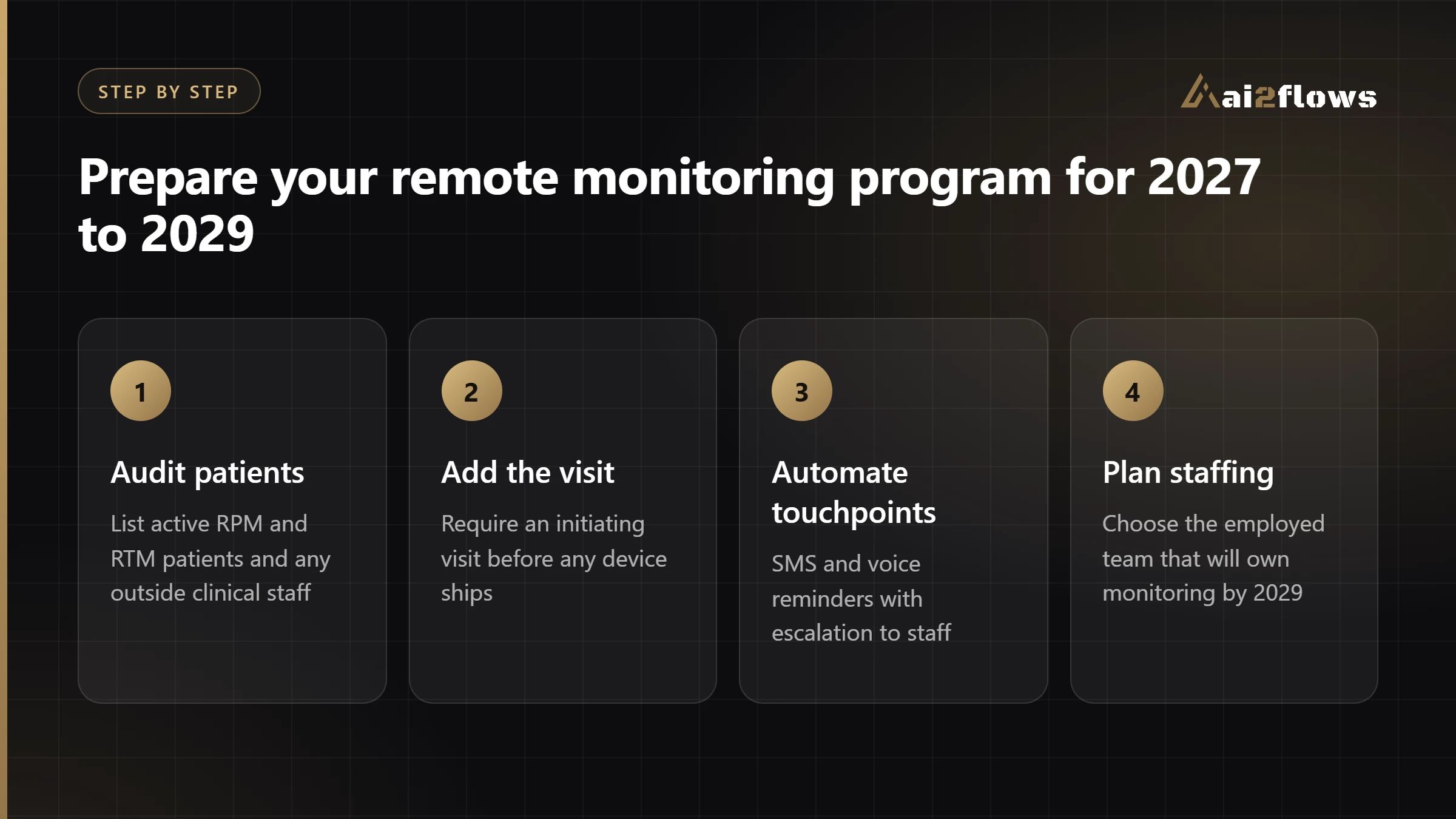
Here is a practical sequence you can start this month and finish well before 2029.
Audit your current RPM and RTM patients. List who is active before January 1, 2027, who orders their monitoring, and whether any services rely on outside clinical staff.
Build the initiating visit into your workflow. Add a visit type or template for the monitoring discussion and make the CRM require it before a device ships.
Automate patient touchpoints. Set up reminder and adherence sequences by SMS, voice and email, with clear opt-outs and escalation to staff.
Plan your 2029 staffing model. Decide which employed nurses or medical assistants will own monitoring, then measure their capacity with automation in place.
What about HIPAA and human oversight?
Remote monitoring data is protected health information. Any AI or automation tool that touches it should come from a vendor willing to sign a business associate agreement, with access controls, audit logs and encryption in place. A HIPAA-ready setup is a starting point, not a guarantee of compliance.
Keep a licensed clinician responsible for every clinical decision, and be transparent with patients when they are interacting with an automated system. Several states now have disclosure rules for AI in patient communication, covered in our guide to AI disclosure laws for healthcare chatbots and voice agents. Because the 2029 "direct employee" definition is still pending, review your contracts and staffing model with a healthcare compliance advisor or attorney before making major changes.
Frequently asked questions
When do the new Medicare RPM rules take effect?
The initiating visit requirement, the established patient rule for RTM and the updated payment values apply to services on or after January 1, 2027, while the employed clinical staff requirement starts January 1, 2029.
Do current RPM patients need a new initiating visit?
No, according to analyses of the final rule, patients already receiving RPM or RTM before January 1, 2027 do not need an initiating visit, though CMS discouraged enrolling patients early just to avoid the requirement.
Can the initiating visit happen by telehealth?
Yes, the final rule allows the initiating visit to be in person or by telehealth, as long as remote monitoring is discussed during that visit.
Can practices still use outside RPM vendors?
Yes, practices can keep buying devices, software and support from vendors, and can contract for clinical staff time until December 31, 2028, after which Medicare pays only for staff time from employees of the practice.
Can AI agents run a remote monitoring program?
AI agents can automate scheduling, reminders, adherence check-ins and task tracking, but clinical review of readings and treatment decisions must stay with licensed clinicians who are accountable for the care.
Sources
CMS: Calendar Year 2027 Medicare Physician Fee Schedule Final Rule fact sheet (November 4, 2026)
ATA Action: statement on the CY 2027 PFS final rule (November 5, 2026)
Prevounce: 2027 Physician Fee Schedule final rule, what is changing for RPM (November 5, 2026)
Rebuilding your remote monitoring workflow before 2027 and 2029? AI2Flows helps healthcare teams set up HIPAA-aware reminders, scheduling and smart CRM follow-up so clinicians can focus on patients. Book a free strategy call to map out your plan.