AI Disclosure Laws for Healthcare Chatbots and Voice Agents
Quick answer: Several US states now require healthcare businesses to tell patients when AI is involved in their care or communication. California requires a disclaimer and a path to a human on AI-generated clinical messages, Texas requires providers to disclose AI used in patient care, and new laws in states such as Rhode Island and Louisiana cover AI scribes and chatbots. If your clinic or agency uses AI voice, SMS or chat agents, the safe default is simple: say it is AI, offer a human, keep clinical decisions with licensed staff, and log what the AI said.
What counts as an AI disclosure law in healthcare?
An AI disclosure law is a rule that requires a business to tell people when artificial intelligence is generating a message, holding a conversation, documenting a visit or influencing a decision about them. In healthcare, these laws usually sit on top of HIPAA rather than replacing it. HIPAA governs how protected health information is used and secured. Disclosure laws govern whether patients know a machine is in the loop.
For a healthcare staffing agency, home care agency, dental office or med spa, the practical question is narrower: when your AI voice agent answers the phone, when an AI drafts a text about test results, or when an ambient scribe records a visit, does a state law require you to say so? Increasingly, the answer is yes, and the rules differ by state, by channel and by whether the content is clinical or administrative.
Generative AI (GenAI): software that writes or speaks new content, such as a chatbot reply or a drafted patient letter.
Clinical communication: a message about a patient's health status, as opposed to scheduling or billing.
Ambient scribe: an AI tool that listens to a visit and drafts the clinical note.
Why are states regulating AI in patient communication?
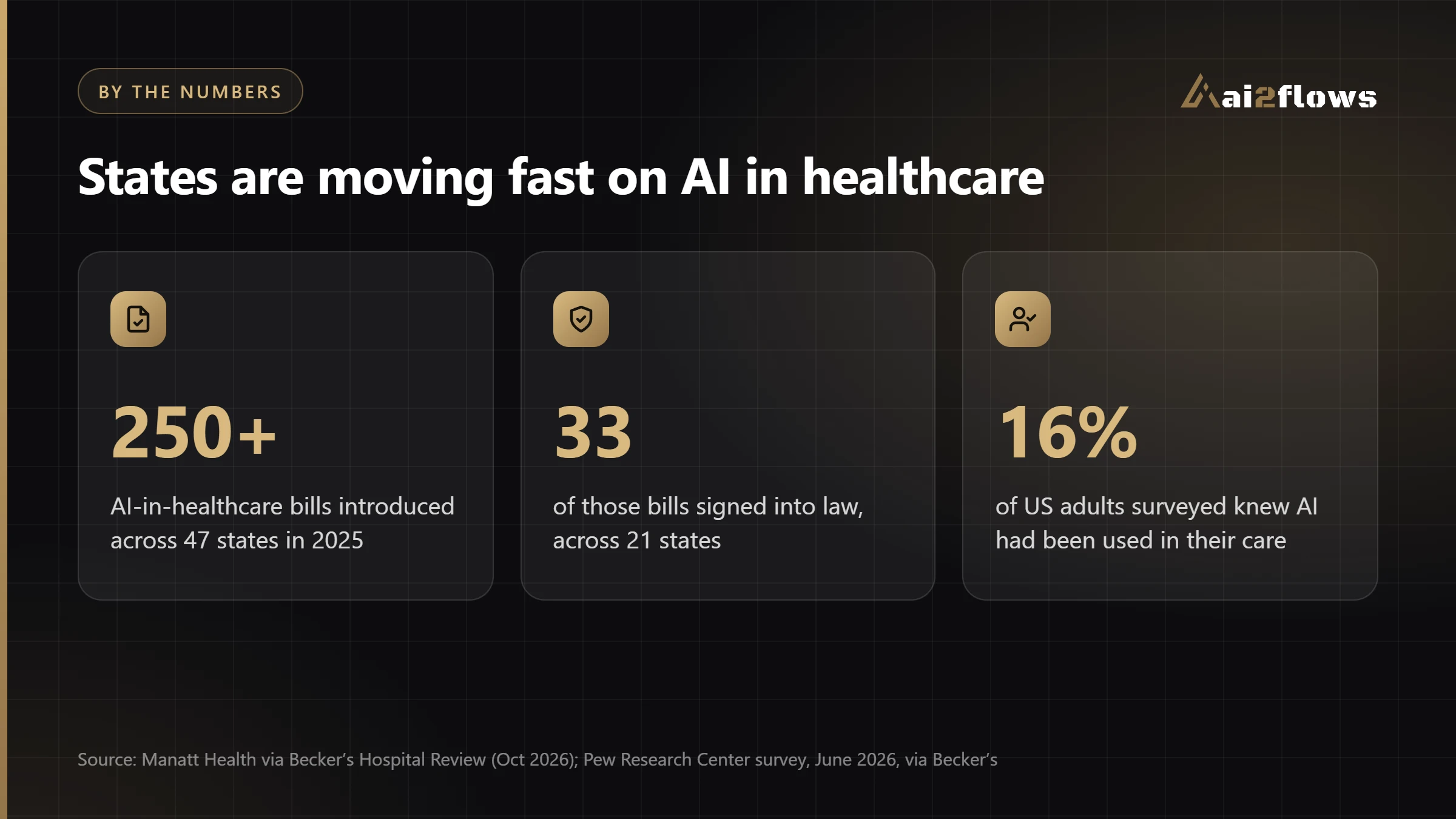
Legislative activity has been heavy. According to a Manatt Health analysis cited by Becker's Hospital Review in October 2026, lawmakers in 47 states introduced more than 250 bills on AI in healthcare during 2025, and 33 of them were signed into law across 21 states. In 2026, states kept going: a May 2026 review by the law firm Holland and Knight describes new laws on insurer use of AI, AI in mental health care, and public-facing chatbots.
Patients are a big reason. Pew Research Center surveyed US adults from June 22 to 28, 2026 and published the results in August 2026. Across every racial and ethnic group Pew reported, clear majorities said a provider should tell them if AI is used to make a diagnosis, analyze medical scans or explain lab results. Becker's coverage of the same survey reported that only 16% of respondents knew AI had been used in their care, while 46% were not sure. That gap between what patients expect and what they know is exactly what disclosure laws try to close.
Which state laws matter most for clinics and care agencies?
The table below summarizes laws most relevant to front office AI, patient messaging and documentation. It is a starting map, not a complete list, and details can change. Always confirm current text with counsel.
State and law | What it asks of providers or operators | Effective |
|---|---|---|
California AB 3030 | Disclaimer on GenAI-generated messages about clinical information, plus instructions to reach a human. Exempt if a licensed provider reads and reviews the message. | January 1, 2025 |
California AB 489 | AI may not use titles or wording that falsely suggest a licensed human professional is providing care. | January 1, 2026 |
California SB 243 | Companion chatbot operators must disclose AI and keep self-harm response protocols. | January 1, 2026 |
Texas HB 149 (TRAIGA) | Providers using AI in patient care must disclose it no later than when the service is first provided, or as soon as reasonably possible in an emergency. | January 1, 2026 |
Texas SB 1188 | Practitioners may use AI for diagnosis and treatment support but must disclose it and review AI-generated records. | September 1, 2025 |
Rhode Island H 7538 and S 2570 | Notify patients when AI documents in-person or telehealth visits, and review AI documentation for accuracy. | Signed June 22, 2026 |
Rhode Island S 2195 and H 7350 | Chatbot users must be told they are not talking to a human at the start of each session and at least every three hours. | January 1, 2027 (per Live Compliance tracker) |
Louisiana Act 649 | Disclose AI transcription before a visit is recorded. | August 1, 2026 (per Live Compliance tracker) |
Utah HB 452 | Mental health chatbots must clearly disclose that they are AI and not human. | May 7, 2025 |
Mental health is the strictest area. Illinois HB 1806, Nevada AB 406, Maine LD 2082 and Tennessee SB 1580 all limit AI from acting as, or being marketed as, a therapist. If your practice offers behavioral health services, treat AI as administrative support only and get written consent before using recording tools.
How does California AB 3030 apply to AI voice and chat agents?
California AB 3030 is the most detailed disclosure rule for patient messaging, so it is a useful model even outside California. According to an October 2024 analysis by the law firm ArentFox Schiff, it applies to health facilities, clinics and physician practices that use GenAI to create communications about a patient's clinical information. Messages about appointment scheduling and billing are outside its scope.
The disclaimer placement depends on the channel:
Written messages such as letters and emails: prominently at the beginning.
Audio such as an AI phone call: spoken at both the start and the end.
Chat and video in a continuous online interaction: displayed prominently throughout.
Every covered message also needs clear instructions for reaching a human. The main exemption is human review: if a licensed or certified provider reads and reviews the AI draft before it goes out, the disclaimer rules do not apply. That makes a "draft, then clinician approves" workflow attractive for result explanations and care instructions.
For a typical AI voice agent that books appointments, AB 3030 may not technically apply. But the moment the agent starts answering questions about symptoms, medications or results, it moves into clinical territory. Many practices simply disclose on every call, which is easier to manage and matches what patients told Pew they want.
What do Texas and other states require when AI is used in care?
Texas took a broader approach. Under the Texas Responsible Artificial Intelligence Governance Act (HB 149), in effect since January 1, 2026, providers that use AI in patient care must tell the patient or their representative no later than when the service is first provided. Texas SB 1188, effective September 1, 2025, adds that practitioners must review AI-generated records. Becker's reports civil penalties under SB 1188 of up to $5,000 per negligent violation and $25,000 per knowing violation.
Documentation is the fastest-growing area. Rhode Island now requires notice when AI documents a visit, Louisiana requires disclosure before AI transcription records a visit, and Maine requires consent before mental health professionals use ambient listening tools. If your clinic is piloting an ambient scribe, build the notice into intake forms and the start of each visit.
Colorado is also worth watching. According to the Live Compliance regulation tracker, updated October 29, 2026, Colorado replaced its original AI Act with SB 26-189, which takes effect January 1, 2027.
What is happening at the federal level?
There is no single federal AI disclosure law for healthcare yet, and federal policy is moving in two directions at once.
Preemption pressure: Executive Order 14365, issued December 11, 2025, directs federal agencies to challenge state AI laws seen as onerous. A February 2026 analysis by Husch Blackwell notes that only Congress can truly preempt state law, so state rules still apply today.
Lighter health IT rules: ONC's HTI-5 final rule, published October 28, 2026, removes some AI "model card" transparency requirements for certified health IT, effective December 28, 2026, according to Live Compliance.
HIPAA security update pending: the proposed HIPAA Security Rule overhaul from December 2024 had not been finalized as of October 2026.
The takeaway for operators: do not wait for Washington to simplify things. Build to the strictest state you serve.
How do you make your AI agents disclosure-ready?
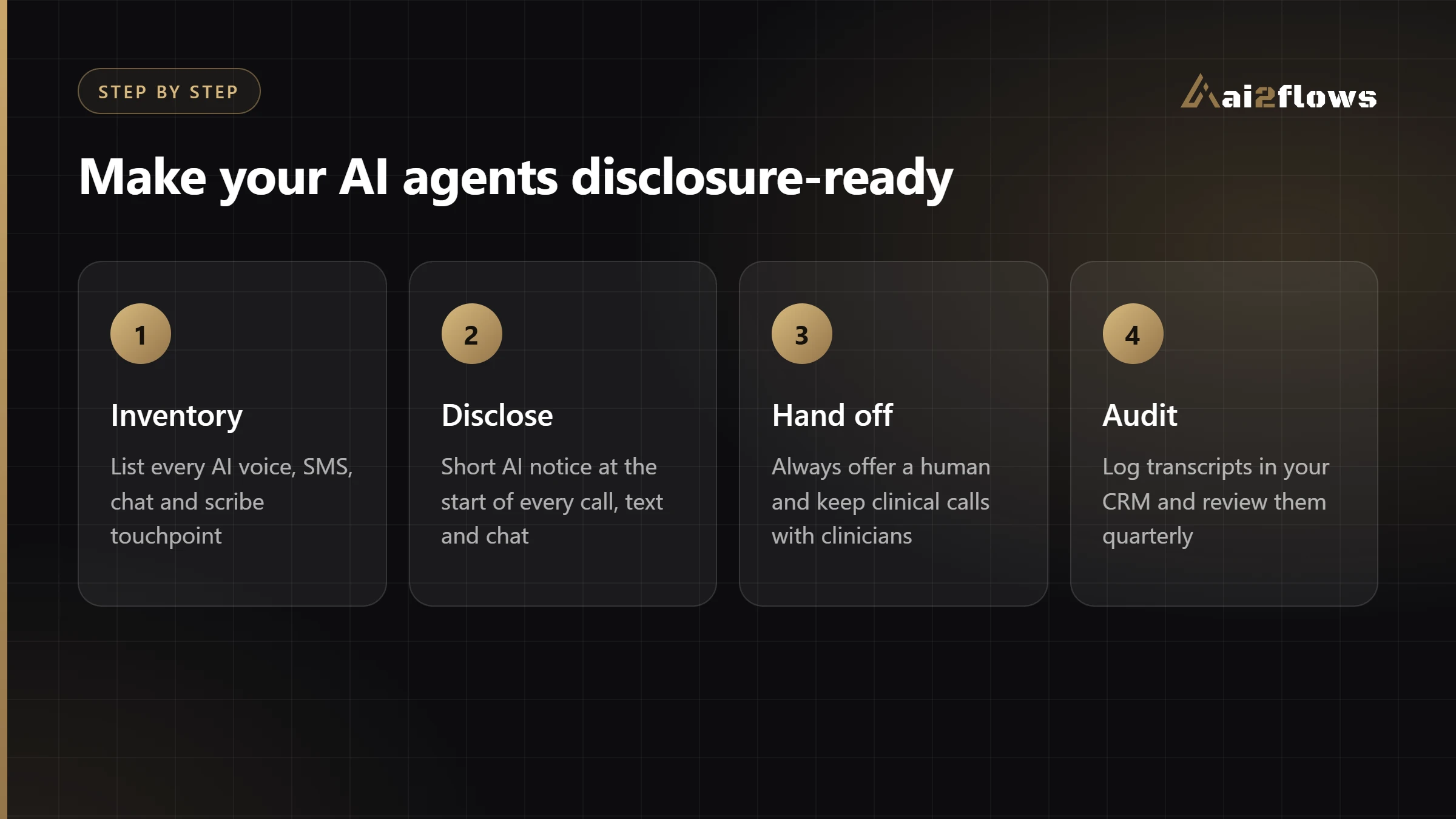
A disclosure-ready setup is mostly about scripts, routing and records. Here is a practical plan that works for clinics, dental offices, med spas and care agencies.
Inventory every AI touchpoint. List each voice agent, SMS flow, website chat, email drafter and scribe, and note whether it handles administrative or clinical content.
Map patients by state. Use your CRM to see where patients and clients live, since multi-state practices and telehealth reach can trigger several laws.
Write channel-specific disclosures. Open and close calls with a short AI notice, start texts and emails with one, and keep a visible label in chat.
Offer a human every time. Give a clear way to reach staff, such as "press 0" or "reply STAFF", and route it to a real person during business hours.
Review agent names and personas. Avoid names or titles like "Nurse" or "Doctor" that suggest a licensed human, in line with California AB 489.
Keep clinical content with clinicians. Let AI draft, but have a licensed provider review result explanations and care instructions before they send.
Get consent for recording and scribes. Add AI recording notice to intake paperwork and confirm verbally at the start of the visit.
Log and audit quarterly. Store transcripts and disclosure timestamps in your smart CRM and review a sample every quarter as laws change.
Human oversight and privacy note: choose vendors that will sign a Business Associate Agreement, keep protected health information in HIPAA-ready systems, and ask a healthcare compliance advisor to review your scripts for each state you serve. No AI setup can guarantee compliance on its own, and this article is general information, not legal advice.
What does a good AI disclosure sound like?
Good disclosures are short, early and friendly. Patients do not need a legal paragraph. They need to know who they are talking to and how to reach a person.
Voice: "Hi, this is the virtual assistant for [Practice Name], an AI system. I can help with booking, or you can say 'staff' at any time to reach our team." Close with a similar reminder.
SMS: "AI assistant for [Agency Name]. Reply STAFF to talk with a coordinator."
Chat: a persistent label such as "AI assistant, not a clinician" plus a visible "Talk to a person" button.
Clinical drafts: "This message was drafted with AI and reviewed by your provider." Use only when a licensed provider has actually reviewed it.
Disclosure also helps conversion more than many owners expect. When patients know they can reach a human, they are more willing to let the AI finish simple tasks like booking. For examples of how this fits a front desk, see our page on AI for clinics and dental practices.
Frequently asked questions
Do I have to tell patients my phone receptionist is AI?
It depends on the state and the content, but disclosure is the safest default. Texas requires disclosure when AI is used in patient care, California requires it for AI-generated clinical communications, and several chatbot laws require AI disclosure regardless of topic.
Does California AB 3030 cover appointment reminders?
According to ArentFox Schiff's analysis, AB 3030 covers communications about patient clinical information and excludes administrative topics such as scheduling and billing. Many practices still disclose on reminders because the same agent often handles clinical questions too.
Is a HIPAA Business Associate Agreement enough for AI compliance?
No. A BAA addresses how a vendor protects health information, while state AI laws address whether patients are told AI is involved. You generally need both, along with consent for recording where required.
Can my AI agent use a human name?
A friendly name is common, but avoid professional titles such as "Nurse" or "Doctor" and avoid implying the agent is a licensed person. California AB 489 specifically prohibits AI wording that falsely suggests a licensed human is providing care.
Will federal law override these state rules?
Not today. A December 2025 executive order targets some state AI laws, but legal analysts note that only Congress can preempt state law, so current state requirements remain in force.
Do these laws apply to healthcare staffing agencies?
Most disclosure laws focus on patient care and patient communication, so staffing agencies are less directly covered. However, chatbot disclosure laws and general AI laws can still apply to candidate-facing bots, so disclose AI in recruiting conversations as well.
Sources
Becker's Hospital Review: 13 state healthcare AI laws to know (October 2026)
Holland and Knight: States Continue Efforts to Regulate AI in Healthcare (May 2026)
Pew Research Center: Americans want transparency when AI is used in their healthcare (August 2026)
Becker's Physician Leadership: Patients want a say over AI in their care (August 2026)
Live Compliance: AI Healthcare Regulations 2026 tracker (updated October 2026)
Want AI agents that disclose clearly, hand off to your team smoothly and keep a clean record of every conversation? Book a free strategy call with AI2Flows and we will map a HIPAA-ready setup for your practice or agency.