AI-Informed Patients in 2026: How Clinics Should Prepare
Quick answer: Patients now arrive at clinics after asking AI first. KFF found that 32% of US adults used an AI chatbot for health information in the past year, and OpenAI says more than 300 million people ask ChatGPT health questions every week. Practices that prepare with AI-aware intake, clear answer-ready web content, fast scheduling and strict privacy rules turn these better-informed patients into smoother visits instead of longer, more confusing ones.
What is an "AI-informed patient"?
An AI-informed patient is someone who has used a conversational AI tool, such as ChatGPT, Gemini, Claude or a health-specific assistant, to research symptoms, explain lab results, compare treatment options or prepare questions before contacting a provider. They may have uploaded their own records, connected a wearable, or saved a list of questions the chatbot suggested.
This is different from the "Dr. Google" era. A search engine returned links. A modern chatbot returns a confident, personalized summary, sometimes based on the patient's own data. That summary may be helpful, incomplete or wrong, and it shapes what the patient expects when they call, book or walk in.
For owners and managers of clinics, dental practices, med spas and home care agencies, the question is no longer whether patients use AI. It is how to design the front door, the visit and the follow-up so that AI-shaped expectations are met safely and efficiently.
How many patients are using AI for health in 2026?
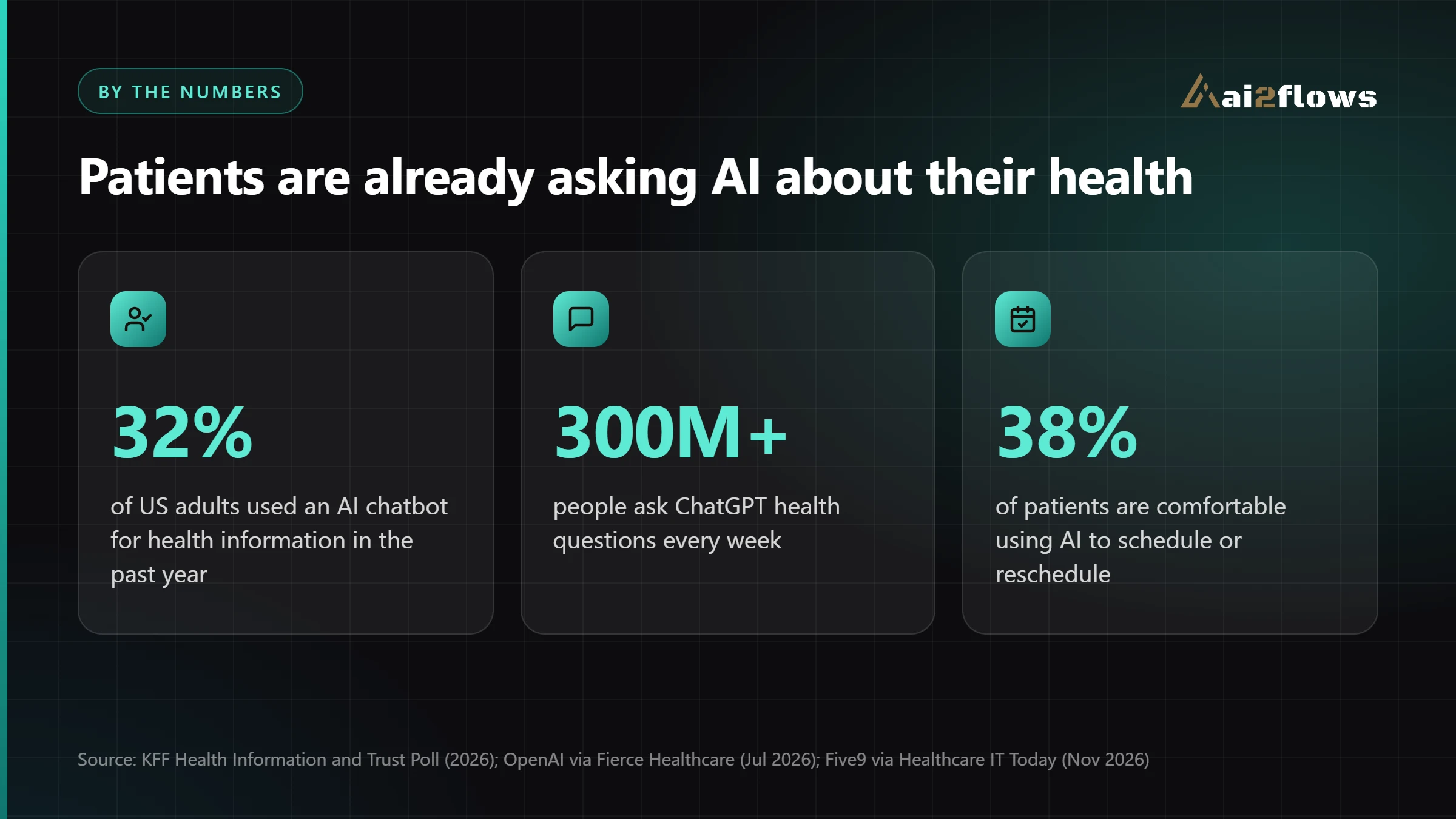
The data from the past year points in one direction. According to the KFF Tracking Poll on Health Information and Trust, conducted February 24 to March 2, 2026 among 1,343 US adults, about a third (32%) of adults turned to AI chatbots for health information in the past year. That is roughly the same share that uses social media for health information.
Physical health: 29% of adults sought physical health information from AI.
Mental health: 16% sought mental health information from AI.
Younger adults: adults under 30 were about three times as likely as adults 50 and older to use AI for mental health information (28% vs. 8%).
On the platform side, Fierce Healthcare reported in July 2026 that OpenAI made its Health in ChatGPT feature broadly available in the US. OpenAI said more than 300 million people turn to ChatGPT with health questions every week, up from 230 million in January 2026. The feature lets users connect Apple Health data and supported medical records, including records from hospital systems on Epic and Oracle Health.
Apple is also studying this behavior directly. On November 15, 2026, Apple announced the Apple Health AI Usage Study, built with the clinical AI platform OpenEvidence. It is open to up to 200,000 eligible US participants age 21 and older and will examine trust, comprehension and how health AI can help people prepare for visits with their own doctors.
Why are patients asking AI before they call you?
The reasons matter because each one points to a fix inside your practice. In the KFF poll, people who used AI for health information gave these major reasons:
Reason patients gave (KFF, 2026) | Share of AI health users | What it tells a practice |
|---|---|---|
Quick or immediate information or support | 65% | Slow callbacks and voicemail push people to AI first |
Looking up information before deciding whether to see a provider | 41% | AI is now a step in the decision to book |
More comfortable looking things up privately | 36% | Private, low-pressure channels like text and chat matter |
Could not afford to see a health professional | 19% | Clear pricing and payment options reduce friction |
No regular doctor or could not get an appointment | 18% | Access and availability drive AI use |
Two other KFF findings deserve attention. First, many users did not follow up with a health professional afterward, including 42% of those who asked about physical health and 58% of those who asked about mental health. Second, 41% of AI health users said they had uploaded personal medical information, such as test results or doctors' notes, into an AI tool. That equals 13% of the public.
In plain terms: a meaningful share of potential patients are using AI as a triage step, and some of them never make it to your schedule.
What changes when AI-informed patients arrive?
AI-informed patients are not a problem to manage. Many arrive more engaged and better prepared. Still, they change daily operations in predictable ways.
More specific questions at intake. Patients may ask about a named treatment, device or dental procedure the chatbot mentioned.
Printed or pasted AI summaries. Staff may be handed a chatbot explanation of a lab result or a list of "questions to ask your doctor."
Higher expectations for speed. If an AI answers instantly at 11 pm, a 48-hour callback feels slow.
Price and option comparisons. Med spa and dental patients often arrive having compared treatments and price ranges.
Misinformation to correct. Consumer chatbots can be incomplete or unclear. Apple's own announcement notes that LLM-powered consumer health tools may at times give incomplete or unclear responses.
Patients also show clear limits on what they want AI to do. A Five9 survey, reported by Healthcare IT Today in November 2026, found that 38% of patients are comfortable using AI to schedule or reschedule an appointment, but only 12% are comfortable using it for medical advice about symptoms, a diagnosis or treatment. That split is a useful design rule: let AI handle access and logistics, and keep clinical judgment with your clinicians.
Where do AI agents fit in a practice's front door?
An AI agent is software that can understand a request, take approved actions in your systems and hand off to a person when needed. In a practice, the most practical agent roles are administrative, not clinical.
Front-door task | Good fit for an AI agent? | Human role |
|---|---|---|
Answering after-hours calls and texts | Yes, with clear scripts and escalation | Review flagged calls each morning |
Booking, rescheduling and reminders | Yes, synced to your scheduling system | Handle exceptions and complex bookings |
Collecting pre-visit questions and goals | Yes, as structured intake | Clinician reviews before the visit |
Answering pricing, insurance and hours FAQs | Yes, from approved content only | Keep the source content current |
Interpreting symptoms or lab results | No | Clinicians only |
An AI voice agent can answer the "quick information" need that KFF identified, while a smart CRM with automated follow-up makes sure people who researched with AI and then contacted you do not fall through the cracks.
How should your website and content change for AI search?
If patients ask AI before they book, your practice needs to be a source those assistants can understand and cite. This is the work of AEO (answer engine optimization) and GEO (generative engine optimization): structuring content so AI assistants can extract accurate, attributable answers about your services.
Publish clear service pages with plain-language answers to the questions patients actually ask: what a treatment involves, who it suits, typical recovery and what a first visit looks like.
State hours, locations, accepted insurance, price ranges where appropriate and how to book, in text rather than only in images.
Add FAQ sections and structured data so answers are easy to parse.
Keep every page accurate and dated. An outdated page can be repeated by an AI assistant long after you changed the policy.
Our AEO and GEO services page explains how this works for healthcare businesses. For clinic-specific setups, see AI for clinics and dental practices.
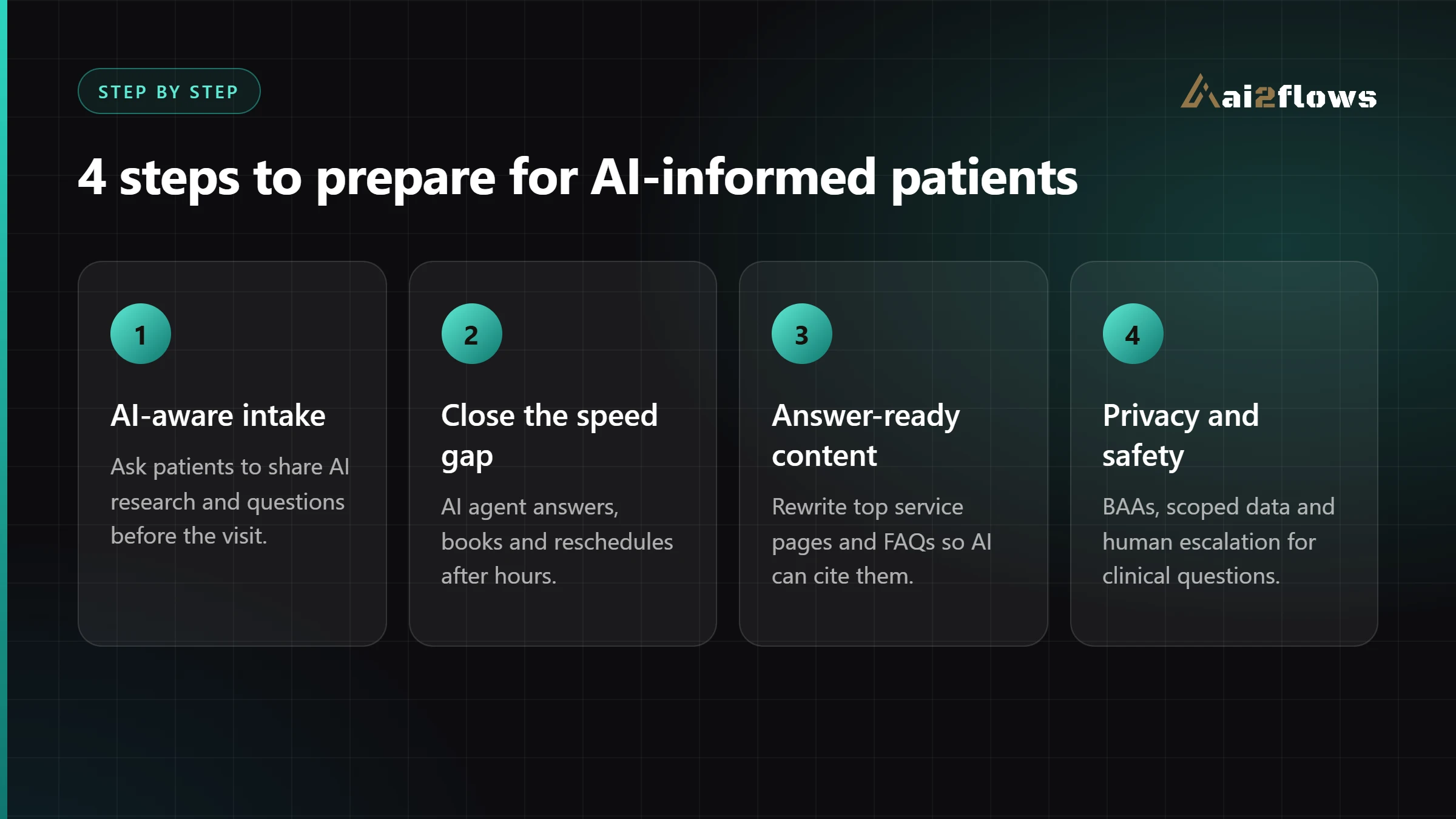
How can a practice prepare in four steps?
You do not need a large technology project to adapt. A focused plan over a few weeks covers most of the value.
Add an AI-aware intake question. In your booking form or pre-visit text, ask: "Did you research this with an AI tool or website? Share any questions you want us to cover." This turns chatbot output into a structured agenda your clinician can review in advance.
Close the speed gap. Set a response target for new inquiries and use an AI agent for after-hours calls, texts and web chat that books, reschedules and answers approved FAQs, with clear escalation to staff.
Publish answer-ready content. Rewrite your top 10 service pages and FAQs so they directly answer common patient questions, with accurate details AI assistants can cite.
Set privacy and safety rules. Decide what your AI tools may and may not say, route any symptom or urgent question to a human, sign business associate agreements with vendors that handle PHI, and train staff on how to respond to patient-provided AI summaries.
Home care agencies can apply the same plan to family caregivers, who often research care options with AI before calling. Our home care agency solutions cover intake and follow-up for that audience.
What about privacy, HIPAA and human oversight?
There are two separate privacy questions, and it helps to keep them apart.
The patient's own AI use. According to HHS, the HIPAA Rules apply to covered entities, such as health care providers, health plans and clearinghouses, and to their business associates. When a patient uploads their own records to a consumer chatbot on their own, that is the patient's choice and generally happens outside your practice's HIPAA relationship. KFF found that 77% of the public is concerned about the privacy of medical information given to AI tools, so patients appreciate it when a practice explains how it protects their data.
Your practice's AI use. When your practice uses an AI agent, CRM or scheduling tool that creates, receives or maintains protected health information, that vendor typically acts as a business associate and you need a written business associate agreement. Choose HIPAA-ready tools, limit the data each agent can access, log conversations and review them regularly.
Human oversight is not optional. AI agents should never diagnose, recommend treatment or tell a patient that a symptom is safe to ignore. Build clear escalation paths for urgent or clinical questions, and consult a qualified healthcare compliance advisor before going live. No tool makes a practice automatically compliant; your policies and oversight do.
Frequently asked questions
Should my staff discourage patients from using AI for health questions?
No. A better approach is to welcome patients' questions, including ones that came from AI, and give them a clear channel to share them before the visit. Clinicians can then confirm, correct or add context, which builds trust and keeps care decisions with qualified professionals.
Can an AI agent answer patients' medical questions for my practice?
An AI agent should handle administrative tasks such as booking, reminders, directions, hours and approved FAQs, not diagnosis or treatment advice. Patients themselves draw this line: a Five9 survey reported by Healthcare IT Today found 38% are comfortable using AI to schedule, but only 12% for medical advice.
Is it a HIPAA issue if a patient brings a ChatGPT summary to their visit?
A patient sharing their own AI summary with you is similar to a patient bringing printed notes. Once it becomes part of your records, treat it like any other patient information under your normal HIPAA policies. Confirm your specific obligations with a compliance advisor.
What is Health in ChatGPT?
Health in ChatGPT is an OpenAI feature, made broadly available to US users in July 2026, that lets people connect medical records and wellness apps such as Apple Health to ChatGPT. OpenAI states it is not intended for diagnosis or treatment and does not replace qualified medical professionals.
How do I get my practice recommended by AI assistants?
AI assistants rely on clear, accurate and consistent information. Publish detailed service pages, FAQs, accurate business listings and structured data, keep details current, and earn genuine reviews. This approach is called answer engine optimization (AEO) or generative engine optimization (GEO).
Which practices benefit most from preparing for AI-informed patients?
Any practice with a high volume of new inquiries benefits, but clinics, dental practices, med spas and home care agencies see the most impact because patients and families often research options, prices and procedures before they ever call.
Sources
KFF: Poll: 1 in 3 Adults Are Turning to AI Chatbots for Health Information (March 25, 2026)
Fierce Healthcare: OpenAI makes Health in ChatGPT widely available (July 24, 2026)
Healthcare IT Today: Bonus Features, November 15, 2026 (Five9 patient survey)
Want your practice ready for patients who ask AI first? AI2Flows sets up HIPAA-ready AI agents, smart CRM follow-up and AEO content for clinics, dental practices, med spas and home care agencies. Book a free strategy call and we will map the quickest wins for your front door.