Patient No-Shows in 2026: How AI Prediction Cuts Missed Visits
Quick answer: AI helps reduce patient no-shows in two ways: it predicts which appointments are most likely to be missed, and it triggers the right outreach (a text, a call from a voice agent, or an easy reschedule link) before the slot is lost. Published research shows prediction models can rank no-show risk well, and studies of targeted reminders report meaningful drops in missed visits. The biggest gains come when predictions are tied to a simple, human-reviewed workflow, not when a model runs on its own.
Why are patient no-shows a bigger problem in 2026?
A no-show is a scheduled appointment the patient does not attend and does not cancel in time for the slot to be refilled. A late cancellation is similar, but the patient cancels too close to the visit for the practice to use the time.
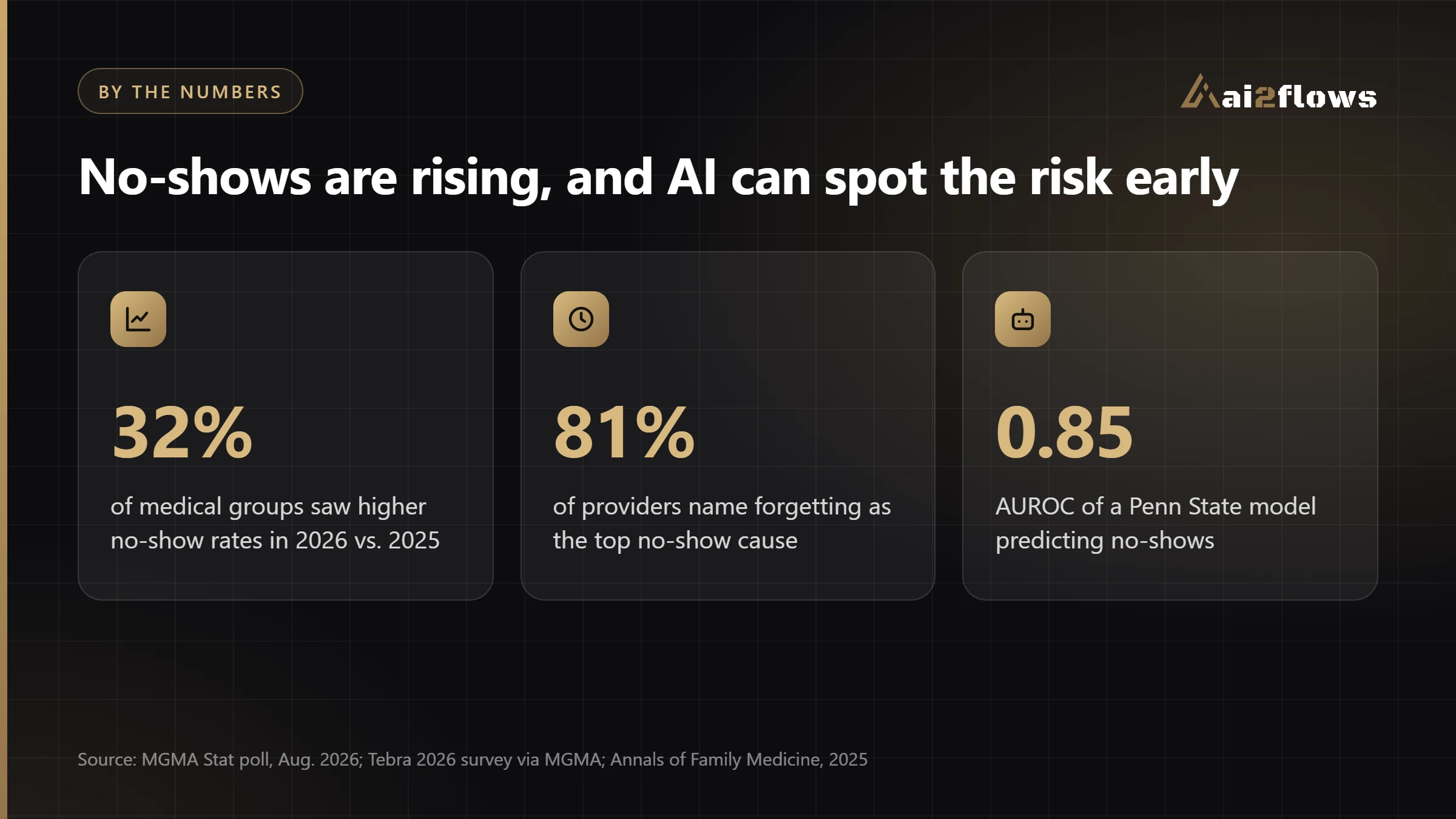
According to an MGMA Stat poll from August 11, 2026, 32% of medical group leaders said their no-show rates were higher so far this year than in 2025, 58% said about the same, and 10% said lower (190 responses). That "higher" share was 5 points above MGMA's August 2025 poll, when 27% reported an increase.
MGMA linked part of the pressure to patient costs. The same article cites KFF data showing average Marketplace deductibles rising 37% to $3,786 in 2026, which can make patients hesitate before a visit. In MGMA's December 2025 poll, reducing no-shows was the top patient access priority for practices, at 27%, ahead of online scheduling and phone access.
Forgetting is still the leading cause. A 2026 Tebra survey, cited by MGMA, found 81% of providers named patients forgetting as the main reason for no-shows.
Life gets in the way. Patients in the same survey cited work conflicts (31%), weather (30%) and emergencies (27%).
Patients want self-service. 69% of patients said they wanted to reschedule online without calling.
Those three findings point to the same fix: reach the right patients at the right time, and make rescheduling effortless.
How does AI predict which patients will miss an appointment?
A no-show prediction model is a machine learning model that scores each upcoming appointment by its likelihood of being missed, using patterns from past appointments. Practices then use the score to decide who gets extra outreach.
The strongest recent example comes from Penn State researchers, published in the Annals of Family Medicine in July 2025. The team analyzed more than 1 million appointments for more than 109,000 patients across 15 family medicine clinics in Pennsylvania, combining clinical, geographic, social and environmental data.
A gradient boosting model performed best of the four model types tested.
It reached an AUROC of 0.85 for no-shows and 0.92 for late cancellations. AUROC measures how well a model ranks higher-risk appointments above lower-risk ones, where 0.5 is a coin flip and 1.0 is perfect ranking.
Lead time was the top predictor: appointments booked more than 60 days out carried higher risk of being missed.
Other signals included prior no-show history, patient age, distance to the clinic, area deprivation and even daily temperature.
The researchers reported no significant performance bias across sex or racial and ethnic groups, while noting the model still needs validation outside a single academic health system.
The practical lesson for smaller clinics: you do not need a research team to use the core insight. Lead time, prior missed visits and distance are data points most practice management systems already hold.
Does AI-targeted outreach actually reduce no-shows?
Prediction only matters if it changes what staff do. Here is what published and reported results show when risk scores or better-designed reminders are put into action.
Setting | What was done | Reported result | Evidence type |
|---|---|---|---|
Outpatient MRI, single institution (American Journal of Roentgenology study, via Healthcare Finance News) | XGBoost model flagged the top 25% highest-risk patients for phone reminders | No-show rate of 15.9% after six months vs. 19.3% in the prior 12 months | Pre-post comparison |
Children's Specialized Hospital, 14 New Jersey locations (SAS, August 2026) | Risk score embedded in scheduling workflows | 8.5% fewer no-shows in the first three months | Vendor-reported |
Four outpatient clinics, NSW Health, Australia (Behavioural Insights Unit) | Rewritten SMS reminders using behavioral science, including the cost of a missed visit | Missed appointments fell by about 34% | Pre-post comparison |
VA primary care and mental health (Journal of General Internal Medicine, 2023) | Brief "nudge" wording added to mailed appointment letters | No significant improvement in attendance | Cluster randomized trial |
Read together, these results suggest that timely, targeted, two-way contact works better than passive one-way messages. The VA trial is a useful caution: tweaking letter wording alone did not move attendance, while targeted calls and well-designed text messages were linked to fewer missed visits.
Also note what these studies are and are not. Pre-post and vendor-reported results can be influenced by other changes happening at the same time, so treat them as encouraging signals rather than guarantees.
What does an AI no-show workflow look like in a clinic or dental practice?
For an independent clinic, med spa or dental office, the workflow usually has four layers that connect your scheduling system, your smart CRM and an AI agent.
Risk flags: rules or a model mark appointments with long lead times, prior misses or first visits as higher risk.
Tiered reminders: low-risk patients get a standard text sequence; higher-risk patients also get a call from an AI voice agent that can confirm, cancel or rebook in one conversation.
Two-way rescheduling: patients reply to a text or tap a link to move their visit, which matches the 69% who prefer to reschedule without calling.
Waitlist backfill: when a slot opens, the CRM automatically offers it to patients on a waitlist, so a cancellation becomes a filled appointment instead of lost time.
A smart CRM with automated follow-up ties these layers together, logging every confirmation, reschedule and no-show so the front desk can see what is working.
How do you set up AI no-show reduction step by step?
Most practices can stand up a first version in a few weeks. Start simple, measure honestly, and add sophistication only where it pays off.
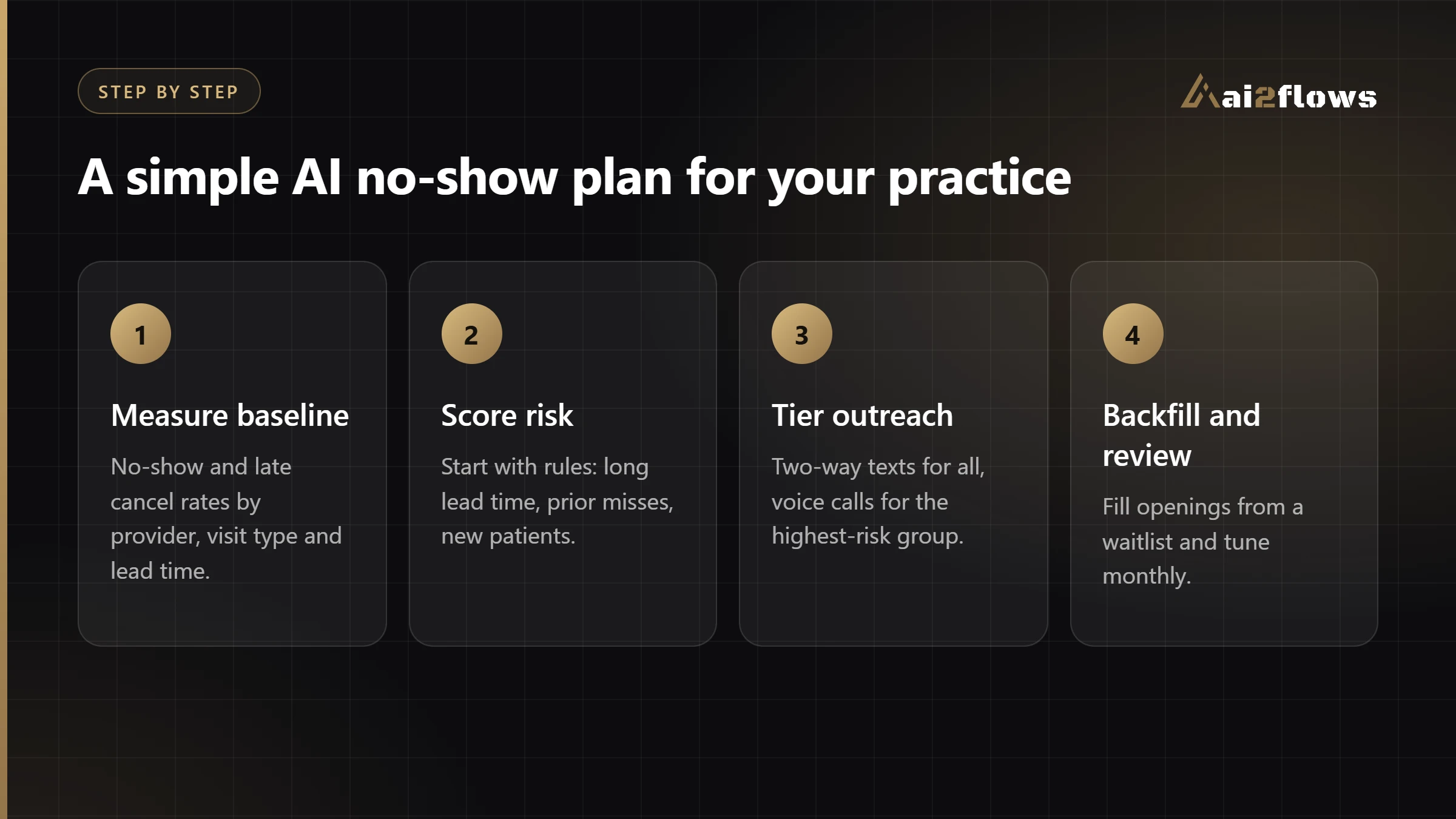
Measure your baseline. Pull 6 to 12 months of appointment data and calculate no-show and late cancellation rates by provider, visit type, day of week and lead time.
Score risk with simple rules first. Flag appointments booked more than 60 days out, patients with a prior no-show and new patients. Move to a predictive model once you have enough clean data.
Tier your outreach. Send all patients a clear reminder with a one-tap confirm or reschedule option. Add an AI voice call or staff call for the highest-risk group, such as the top quarter of scores.
Backfill and review monthly. Connect cancellations to a waitlist, then review results each month by segment and adjust message timing, wording and thresholds.
Keep the human in the loop. Front desk staff should be able to see why an appointment was flagged, override the system, and handle any patient who asks for a person.
Which metrics should practice managers track?
Choosing the right measures keeps the project honest and makes it easy to show return on investment.
Metric | What it tells you | How often |
|---|---|---|
No-show rate | Share of booked visits missed without notice | Weekly |
Late cancellation rate | Share cancelled too late to refill | Weekly |
Confirmation rate | How many patients actively confirm after reminders | Weekly |
Backfill rate | Share of open slots refilled from the waitlist | Monthly |
Reschedule within 30 days | Whether cancelled patients come back | Monthly |
For context, MGMA's 2024 DataDive data for single-specialty practices showed a 19.95% appointment cancellation rate, with only 27.40% of canceled visits rescheduled within 30 days. Lifting that rebooking rate is often the fastest win.
What about fairness, privacy and HIPAA?
No-show prediction uses patient data, so it needs the same care as any other clinical or operational tool.
Use risk scores to help, not penalize. A high score should trigger more support, such as a reminder call or a telehealth option, never a lower priority for booking. Signals like distance and area deprivation can reflect transportation and cost barriers.
Check for bias. The Penn State team tested performance across sex and racial and ethnic groups. Practices should review outcomes by patient group in the same way.
Keep messages minimum necessary. Reminders should confirm time and location without exposing sensitive clinical details in a text or voicemail.
Use HIPAA-ready vendors. Work with tools that sign a business associate agreement and support access controls and audit logs, and confirm your setup with a compliance advisor. No tool makes a practice compliant on its own.
Patient consent for texts and automated calls also matters under US telecommunications rules, so document opt-ins and honor opt-outs promptly.
Frequently asked questions
What is a normal patient no-show rate?
Rates vary widely by specialty and patient population; in the VA trial above, missed-appointment rates ranged from about 10.5% to 12.1% in primary care and 18.0% to 21.9% in mental health, so compare yourself to your own baseline and specialty.
Can a small practice use AI no-show prediction without a data scientist?
Yes, most small practices start with rules based on lead time, prior no-shows and new patient status, then use a smart CRM and AI agent to act on those flags before considering a custom model.
Are text reminders enough on their own?
Text reminders help, especially when they are clear and allow two-way replies, but research suggests adding live or AI voice calls for the highest-risk patients produces stronger results than one-way messages alone.
Should practices charge a no-show fee?
MGMA reported that 42% of practices used a no-show fee in January 2025, but the improvement data was self-reported, so many practices pair any fee policy with better reminders and easier rescheduling.
Is AI no-show prediction HIPAA compliant?
It can be used in a HIPAA-ready way when vendors sign a business associate agreement, data access is limited and messages avoid sensitive details, but compliance depends on your full setup, so confirm it with a compliance advisor.
Sources
MGMA Stat: Patient no-shows in 2025: What's changing and what to do about it (August 2025)
Medical Economics: Can AI predict no-shows before they happen? (July 2025)
Healthcare Finance News: Artificial intelligence helps cut down on MRI no-shows
SAS Voices: Turning patient no-show predictions into action (August 2026)
Want fewer empty chairs without adding front desk workload? AI2Flows builds HIPAA-ready reminder, voice agent and waitlist workflows for clinics and dental practices. Book a strategy call and we will map a no-show plan around your current scheduling system.