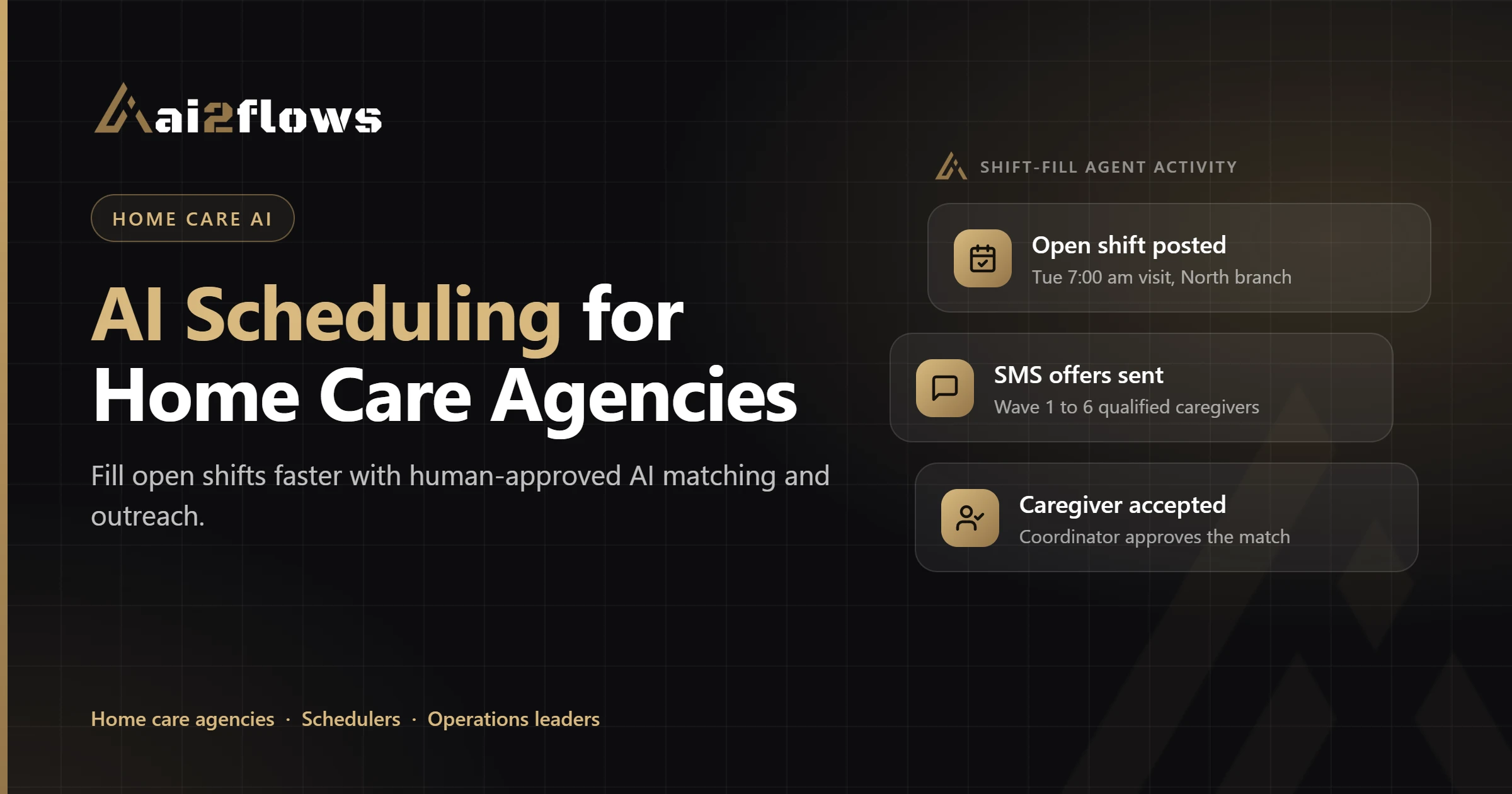
AI Scheduling for Home Care Agencies: 2026 Data and Setup
Quick answer: AI scheduling for home care uses software and AI agents to match caregivers to clients, fill open shifts and handle call-outs faster than manual phone trees. In AxisCare's 2026 industry survey, 64% of home care leaders said shift matching and automatic scheduling is where AI will have the biggest impact. The safest way to start is to clean your caregiver and client data, automate shift-fill outreach by SMS and voice, and keep a human scheduler approving every final match.
What is AI scheduling in home care?
AI scheduling in home care means using software that recommends or automates caregiver assignments based on rules and data: client needs, caregiver skills, location, availability, overtime limits, continuity of care and payer requirements such as electronic visit verification (EVV).
It usually has two layers:
Matching and optimization: the system ranks which caregivers fit a visit best, often inside your home care software.
Outreach and communication: an AI agent (a program that can send messages, answer replies and take actions) texts or calls qualified caregivers about an open shift, collects yes or no answers and updates the schedule or alerts a coordinator.
The goal is not to remove schedulers. It is to remove the hours they spend calling down a list at 6 a.m. when a caregiver calls out.
Why are home care agencies prioritizing AI for scheduling in 2026?
Two forces are pushing scheduling to the top of the list: a long-running workforce gap and tighter margins.
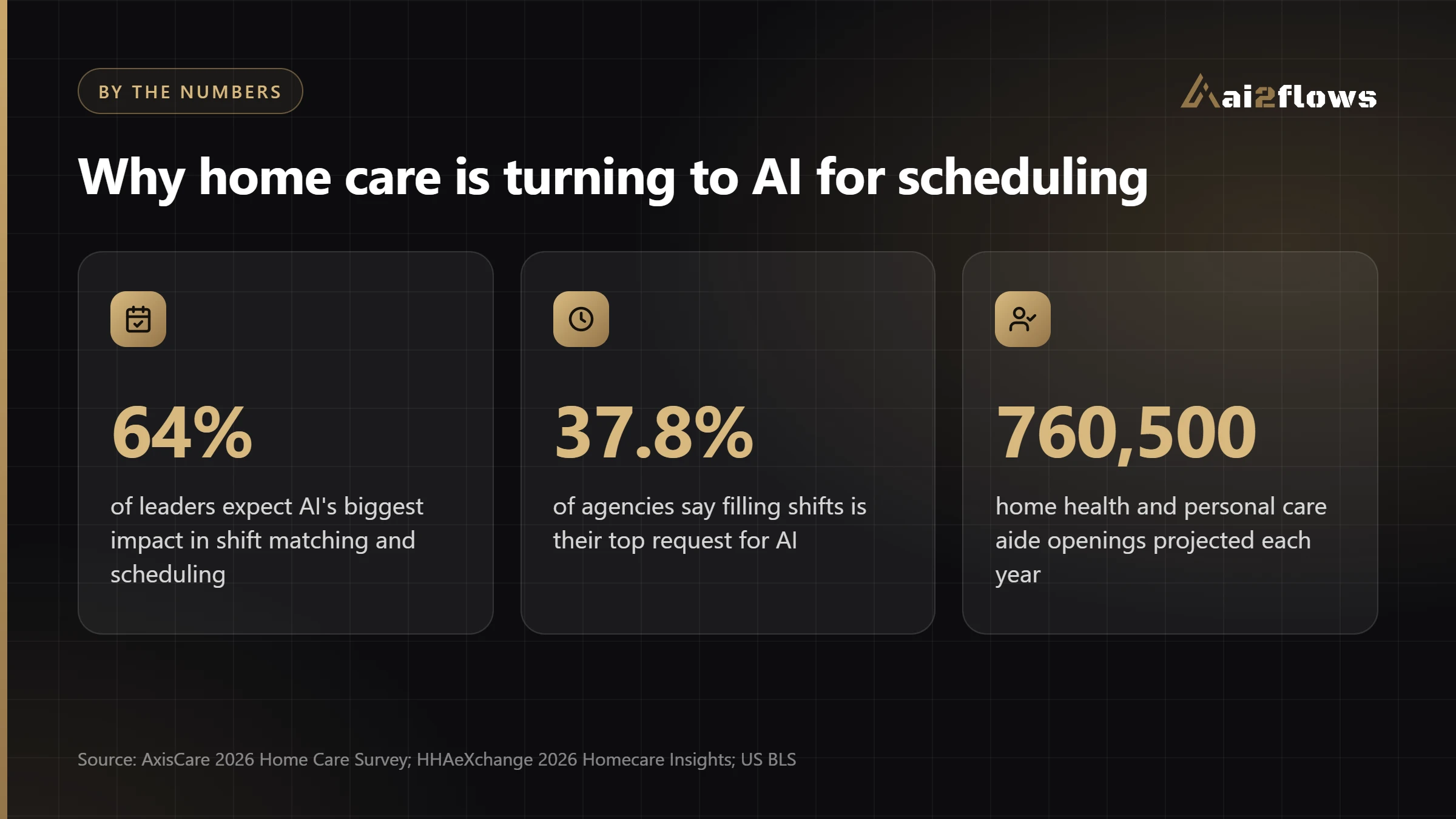
According to the US Bureau of Labor Statistics, employment of home health and personal care aides is projected to grow 18% from 2025 to 2035, with about 760,500 openings projected each year on average. More openings mean more shifts to fill and more turnover to manage.
Industry surveys point the same way:
AxisCare's 2026 survey of 310 home care leaders, conducted by Leading Home Care, found caregiver shortages were still the top pain point (53%), while profitability concern rose from 13% to 34%.
In the same survey, 64% expect AI's biggest impact to come from client and caregiver shift matching and automatic scheduling, and 54% named matching and scheduling as the most important system to refine.
HHAeXchange's 2026 Homecare Insights survey of 465 agencies found that help filling shifts and building caregiver schedules was the top request for AI (37.8%).
In that HHAeXchange survey, 31.9% of agencies listed scheduling gaps and call-outs as a workforce challenge, and 45.6% use flexible scheduling as a retention action.
In short, scheduling sits where staffing pressure, client satisfaction and cost all meet. That makes it a practical first use case for AI.
Where does AI help most in the scheduling workflow?
Most agencies see value in a few specific moments rather than in one big system change.
Scheduling task | Manual approach | With AI support | Human role |
|---|---|---|---|
Open shift fill | Coordinator calls caregivers one by one | AI agent texts ranked caregivers in waves and collects replies | Approves the final assignment |
Same-day call-outs | On-call staff scramble early morning | Instant outreach to nearby, qualified caregivers | Handles sensitive clients and escalations |
Client and caregiver matching | Based on memory and spreadsheets | Ranking by skills, distance, preferences and continuity | Checks fit and family preferences |
Availability updates | Phone calls and paper forms | Caregivers update availability by SMS or chat | Reviews conflicts |
Client and family notices | Coordinator calls each family | Automated confirmation of caregiver changes | Calls families when changes are sensitive |
AxisCare's survey shows leaders see related gains too: 62% expect AI impact on workforce utilization, 56% on caregiver engagement and retention, and 54% on client and family communication.
How do AI voice and SMS agents fill open shifts?
A shift-fill agent follows rules you set. A typical flow looks like this:
A shift opens in your scheduling system, or a caregiver texts that they cannot make a visit.
The system builds a shortlist of caregivers who are qualified, available, within travel range and not near overtime.
The agent sends a short SMS to the first group: date, time, general area and pay details, without client health details.
Caregivers reply "yes" or "no." If no one accepts within a set window, the agent contacts the next group or places a voice agent call.
The first qualified "yes" is held, and a coordinator confirms it with one click.
The same tools handle the caregiver side of communication, such as reminders the night before a visit, which ties scheduling to retention. If you are also working on hiring, our guide on AI caregiver recruiting for home care covers the top of the funnel.
How can a home care agency set up AI scheduling step by step?
You do not need to replace your home care software. Most agencies start by adding automation around the system they already use.
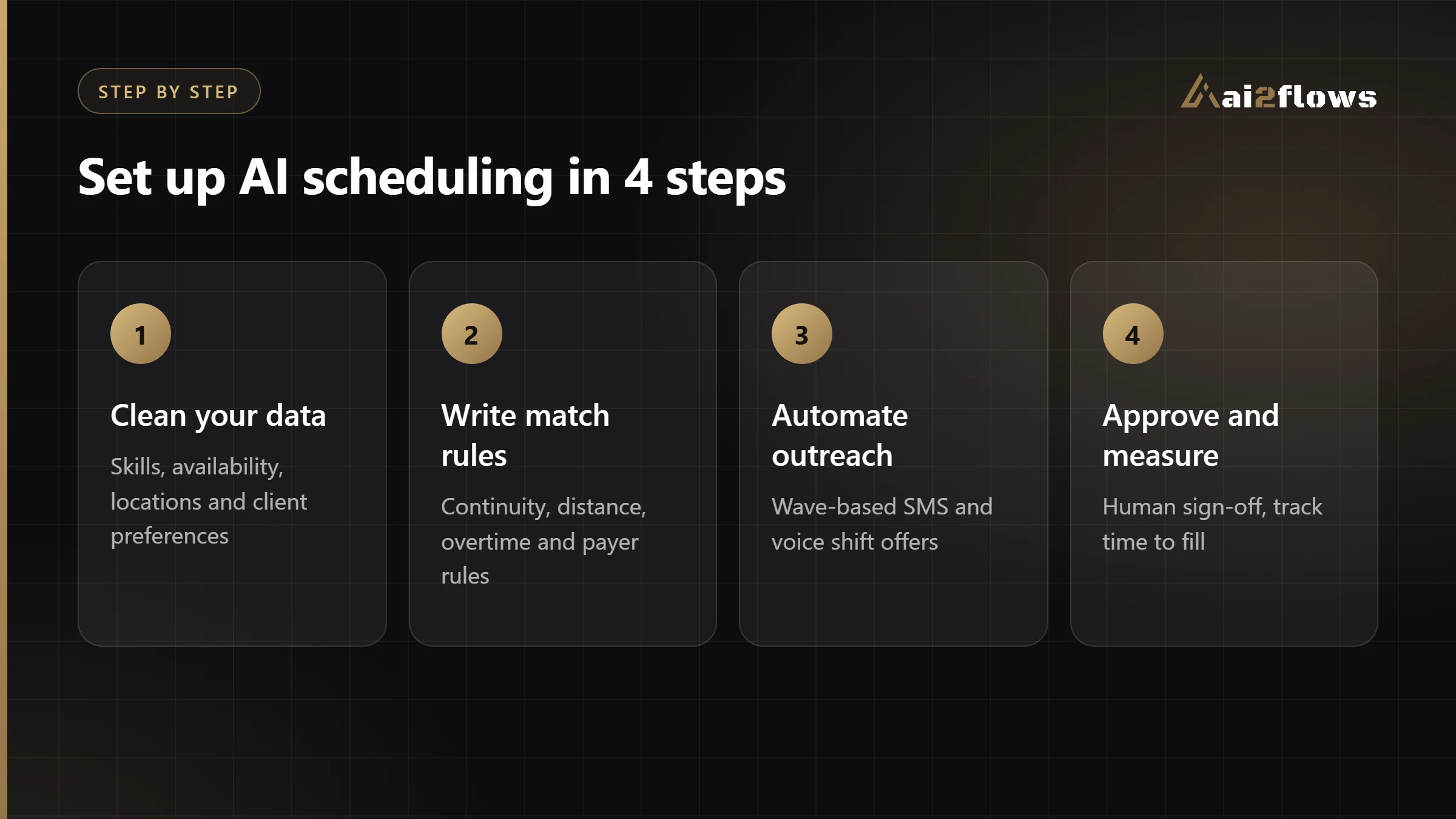
Clean your scheduling data. Make sure caregiver skills, certifications, availability, zip codes and client preferences are accurate. AI can only match on data it has.
Write your matching rules. Decide what matters most: continuity with the same caregiver, travel distance, overtime limits, language, gender preference and payer rules. Put them in writing before you automate.
Automate shift-fill outreach. Connect a smart CRM or messaging layer to send wave-based SMS and voice offers, collect replies and log every response, starting with one branch or one shift type.
Keep humans on approval and measure. Have coordinators approve every final match, then track time to fill, unfilled shifts, overtime and caregiver feedback for 60 to 90 days before expanding.
This approach keeps risk low and gives you your own before and after numbers rather than relying on vendor claims.
What should you watch for with privacy, EVV and compliance?
Scheduling data often includes protected health information (PHI), such as a client's address and care needs. Treat any AI tool that touches it as part of your HIPAA program.
Sign a business associate agreement (BAA) with every vendor that stores or processes PHI.
Keep shift offers minimal. Share the general area and time by text, and reveal client details only after a caregiver is confirmed and inside a secure app.
Protect EVV accuracy. Automation should not change visit times or verification records. AxisCare's survey found more than 77% of leaders say ease of use, consistency and integration are the most important factors for successful EVV implementation.
Get SMS consent. Caregivers should opt in to text messages, and every message should include a clear way to opt out.
Keep an audit trail. Log who was offered a shift, who accepted and who approved it.
A HIPAA-ready setup is a combination of vendor contracts, access controls, staff training and your own policies. Review your design with a healthcare compliance advisor; no tool guarantees compliance on its own.
What concerns do home care leaders have about AI, and how do you address them?
Adoption is real but still early. HHAeXchange's 2026 survey found 57.1% of agencies are engaging with AI, yet only 13.3% are actively using it, while 31% are still evaluating.
The worries are reasonable. In AxisCare's separate survey of home care agency leaders on AI, reported by the Home Care Association of America, 57% expressed concern that AI could reduce the human connection with clients, and three quarters said they face barriers to adoption, including ethics concerns (41%) and employee resistance to change (30%).
Practical ways to address them:
Use AI for logistics, not for care conversations. Families should still reach a person when something is sensitive.
Involve schedulers early. Let them shape the rules and show them the hours saved.
Explain the change to caregivers. Fast, fair shift offers by text are often welcomed when they respect preferences and do not flood phones.
Start small and share results with the team before expanding.
How do you measure whether AI scheduling is working?
Pick a few metrics before launch and track them weekly:
Time to fill an open shift, from posting to confirmed caregiver.
Unfilled or missed visits per week.
Overtime hours as a share of total hours.
Continuity of care: how often clients see their regular caregivers.
Coordinator hours spent on phone outreach.
Caregiver opt-outs and feedback on message volume.
Data habits matter here. HHAeXchange found 42.2% of agencies were not using reporting data for business decisions in 2026, up from 22% in 2025. Building a simple dashboard in your smart CRM closes that gap and shows whether the automation pays off.
Frequently asked questions
Can AI fully replace a home care scheduler?
No. AI handles repetitive outreach, ranking and reminders, but a human scheduler should approve final matches, manage sensitive clients and handle exceptions that rules cannot predict.
Do I need new home care software to use AI scheduling?
Not always. Many agencies keep their current home care platform and add a smart CRM or messaging layer for shift-fill outreach, as long as the tools can share data securely.
Is texting caregivers about open shifts HIPAA compliant?
It can be part of a HIPAA-ready process if shift offers avoid client health details, vendors sign a BAA, caregivers consent to texts and access is controlled; confirm your setup with a compliance advisor.
How fast can an agency see results from AI shift filling?
Results vary by agency size and data quality, so measure your own baseline for time to fill and unfilled shifts, then compare after a 60 to 90 day pilot on one branch or shift type.
What data does AI need to match caregivers and clients well?
It needs accurate caregiver skills, certifications, availability and location, plus client care needs, schedules and preferences such as language, continuity and gender preference.
Sources
US Bureau of Labor Statistics: Home Health and Personal Care Aides, Occupational Outlook Handbook
AxisCare and Leading Home Care: The Future of Home Care, A 2026 Survey of the Home Care Industry
HomeCare Magazine: Survey Reveals 2026 Homecare Agency Trends
Home Care Association of America: What 400+ Home Care Leaders Said About AI and Why It Matters
Want help setting up AI shift filling, caregiver texting and a smart CRM for your agency? See how we support home care agencies, or book a free strategy call and we will map a safe, human-approved scheduling workflow with you.