Patient Access Friction in 2026: Data and AI Fixes for Clinics
Quick answer: Patient access friction is the effort it takes a patient to book, reschedule, get a question answered or sort out a bill. According to a Five9 survey fielded by Dynata in September 2026, 44% of US consumers delayed care, gave up, or switched providers in the past year because dealing with a provider was too hard. Patients are comfortable letting AI handle administrative tasks like scheduling, as long as a human is easy to reach, so the fastest win for most practices is AI on the front desk, not in the exam room.
What is patient access friction?
Patient access friction covers every obstacle between a patient wanting care and actually getting it scheduled, confirmed and paid for. It includes long hold times, phones that go to voicemail after hours, confusing online booking, repeating the same details to three different staff members, and slow answers on refills or billing.
It matters because friction does not show up as a complaint. It shows up as a lead that never books, a recall patient who quietly goes elsewhere, or an empty chair at 2 pm. For dental practices, med spas, aesthetic clinics and home care agencies, that silent loss is often bigger than any marketing gap.
How many patients give up because service is too hard?
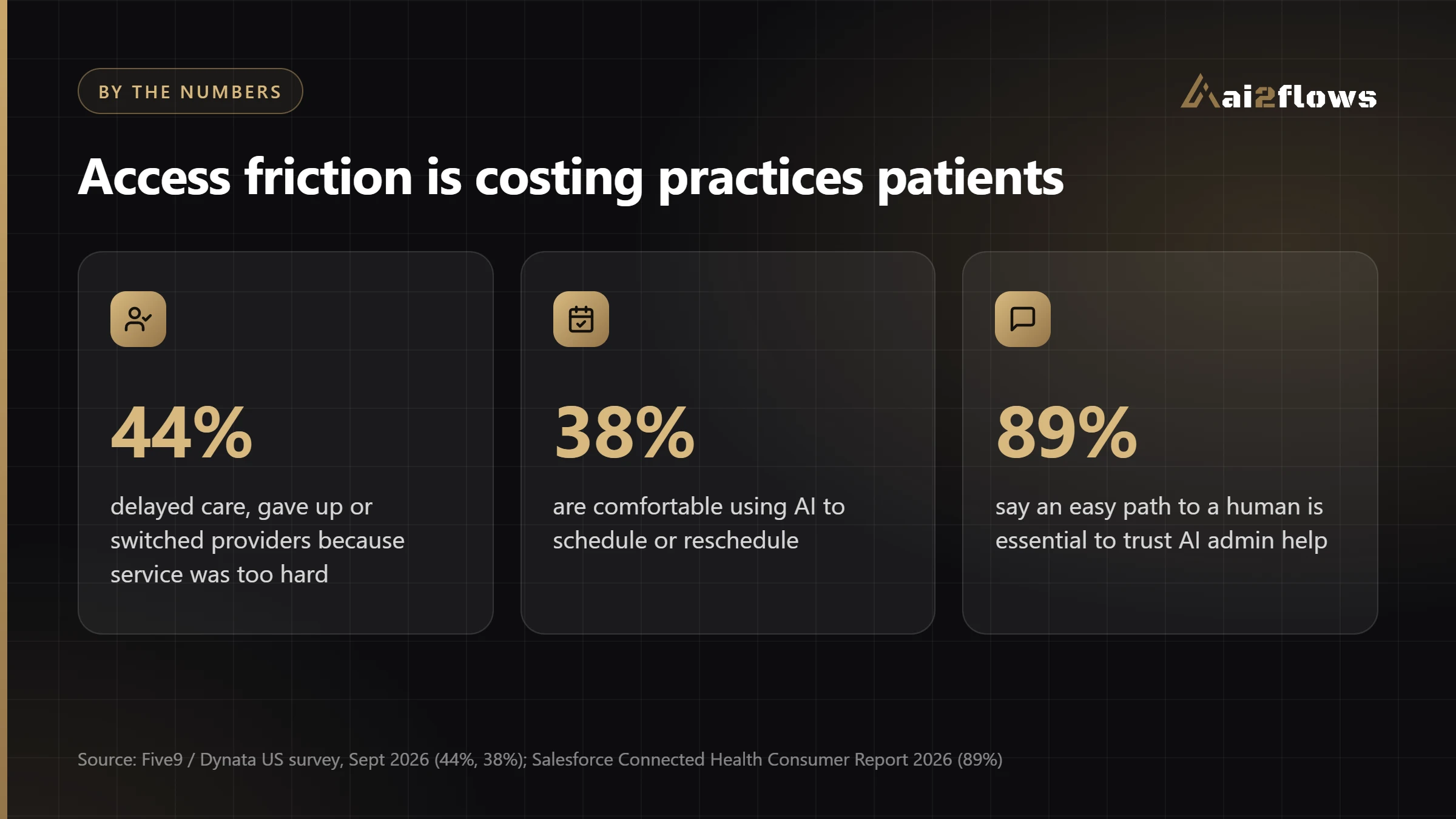
Two large 2026 surveys point in the same direction. Five9's Care Completion Gap research, released on November 10, 2026, surveyed 1,000 US adults and found that 44% had delayed care, stopped trying to schedule or resolve a billing issue, or switched providers in the previous 12 months because the experience was too difficult or time consuming.
Salesforce's 2026 Connected Health Consumer Report, which surveyed 3,200 health consumers across eight countries including the US, Canada, the UK and Australia between March and April 2026, found that 58% delay or skip necessary care because scheduling is too difficult. The same report found that 49% will hang up after 10 minutes on hold and look for care elsewhere or avoid it altogether.
Repeating information is common: Five9 found 53% of respondents at least sometimes have to repeat details their provider should already know.
First contact often fails: only 46% said their issue was fully handled the first time they reached out.
Younger patients feel it most: just 26% of Gen Z respondents said their issue was resolved on first contact, compared with 74% of Baby Boomers.
Both studies were commissioned by companies that sell customer service and AI software, so treat them as strong directional signals rather than precise market measurements. Still, the pattern is consistent: patients leave when access is slow.
Which tasks are patients comfortable handing to AI?
Patients draw a clear line between administrative help and medical judgment. In the Five9 survey, 38% said they are comfortable using AI to schedule or reschedule an appointment, while only 12% were comfortable using AI for advice on symptoms, diagnosis or treatment.
Openness grows when AI saves time. Five9 reported that 58% are open to AI in some form, including 33% who will use it to avoid longer waits. Salesforce found 67% would rather get 24/7 AI help than wait for someone to pick up during office hours.
Front office task | Patient comfort with AI | Recommended approach |
|---|---|---|
Booking and rescheduling | High (38% comfortable, Five9) | Automate with an AI voice, SMS and chat agent |
Reminders and confirmations | High (administrative and expected) | Automate through a smart CRM |
After-hours calls and new inquiries | High when faster than waiting (67% prefer 24/7 AI, Salesforce) | AI answers, captures details, books or routes |
Billing and insurance questions | Moderate | AI handles simple status questions, staff handle disputes |
Symptoms, diagnosis, treatment | Low (12% comfortable, Five9) | Always route to licensed staff |
What makes patients trust an AI agent?
Trust depends on three things: a visible path to a human, data security and accurate answers. In Five9's survey, the top factor that would raise trust in an AI healthcare interaction was being able to easily reach a person (39%), followed by knowing personal and health information is secure (29%) and confidence that answers are accurate (29%).
Salesforce's research reinforces this. It found 89% of respondents say a clear option to escalate to a human is essential for trusting AI administrative support. It also found patients are three times more likely to trust an AI agent built into their own provider's secure systems than a public chatbot or general health website.
That second point is important for smaller practices. Patients do not want a generic bot. They want your practice's assistant, one that knows your services, hours, providers and policies, and hands them to your team when needed.
Where does friction cost practices the most?
Friction concentrates in a few predictable moments. Fixing these first gives the biggest return for the least disruption.
Missed and after-hours calls: new patient inquiries that hit voicemail often book with whoever answers first. An AI voice and chat agent can answer every call and text, 24/7.
Hold queues at peak times: Monday mornings and lunch hours overload front desk staff, which is exactly when callers give up.
Rescheduling: patients who cannot easily move an appointment often simply do not show up.
Repeated intake: asking for the same details twice signals disorganization. Five9 found 85% of respondents expect agents to see at least some of their previous interactions.
Recall and follow-up: Salesforce found 70% of respondents say proactive AI check-ins would help them stay on track between visits.
How can a practice reduce access friction with AI?
The goal is not to replace your front desk. It is to make sure no patient waits, repeats themselves or gets lost between steps, while your team focuses on people in the building. Here is a practical plan.
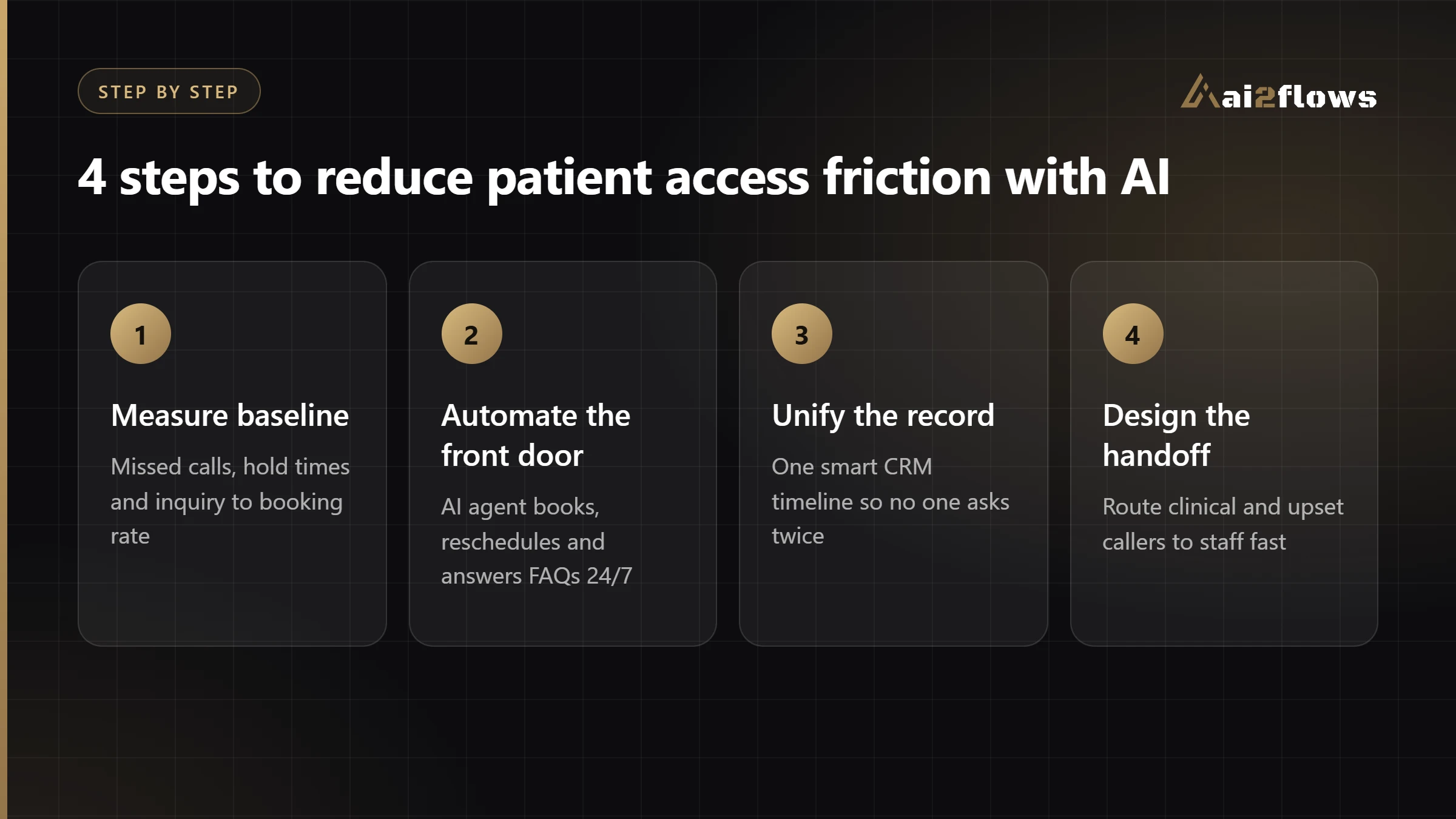
Measure your friction baseline. Pull 30 days of call data: missed calls, after-hours calls, average hold time, and how many new inquiries became booked appointments. This becomes your before and after benchmark.
Automate the administrative front door. Deploy an AI agent on phone, SMS and web chat that answers FAQs, books and reschedules, and captures new patient details directly into your calendar and smart CRM.
Connect every conversation to one record. Use a smart CRM with automated follow-up so calls, texts, forms and staff notes live on one patient timeline, and nobody has to ask twice.
Design a clear human handoff. Tell patients they can reach a person at any time, route clinical questions and upset callers to staff immediately, and review transcripts weekly to improve the agent.
Most practices can complete steps one and two in a few weeks, then expand into reminders, recall campaigns and review requests once the core flow is stable.
What about HIPAA, privacy and human oversight?
Any AI agent that handles patient names, appointment details or insurance information touches protected health information. That means the setup has to be HIPAA-ready from day one.
Business associate agreements: confirm that every vendor in the chain that stores or processes patient data will sign a BAA.
Clear scope: limit the agent to administrative tasks. It should never diagnose, give treatment advice or interpret symptoms.
Disclosure: tell patients they are speaking with an AI assistant. Some US states now require AI disclosure in healthcare, as covered in our guide to healthcare AI disclosure laws, and transparency also builds trust.
Human review: keep staff in the loop for escalations, and audit conversations regularly for accuracy.
Salesforce found 90% of respondents want medical AI to have human oversight. Regulations differ by state and country, so work with a qualified healthcare compliance advisor before going live. No AI tool makes a practice compliant on its own; compliance comes from how it is configured, documented and supervised.
How should practices measure success?
Pick a small set of numbers and track them monthly against your baseline.
Answer rate: the share of inbound calls and messages answered live by staff or AI.
Speed to first response: how quickly a new inquiry gets a real reply.
Inquiry to booking rate: how many new contacts become scheduled appointments.
First contact resolution: how often a patient's request is fully handled in one interaction.
Escalation rate and reasons: how often the AI hands off, and why, which shows where to improve scripts.
Visibility matters too. When patients research providers through AI assistants, practices with clear service pages and consistent information are easier to recommend. Our AI search optimization services cover that side of access.
Frequently asked questions
What is patient access friction?
Patient access friction is any obstacle that makes it hard for patients to book, reschedule, get answers or resolve billing, such as long hold times, voicemail after hours, confusing online booking or repeating information to multiple staff members.
Are patients comfortable with AI scheduling appointments?
Many are. A September 2026 Five9 survey of 1,000 US adults found 38% are comfortable using AI to schedule or reschedule, compared with only 12% for medical advice, so administrative tasks are the natural starting point.
Will an AI receptionist replace my front desk staff?
No. A well designed AI agent handles repetitive calls, after-hours inquiries and booking so staff can focus on patients in the practice, complex questions and anything clinical, with a clear handoff whenever a person is needed.
Can an AI agent give patients medical advice?
It should not. Practices should restrict AI agents to administrative tasks and route any question about symptoms, diagnosis or treatment to licensed clinical staff, which also matches what most patients say they prefer.
Is an AI phone agent HIPAA compliant?
An AI agent can be part of a HIPAA-ready setup when vendors sign business associate agreements, data is secured, access is limited and staff supervise it, but compliance depends on configuration and policies, so review it with a healthcare compliance advisor.
How fast can a practice see results?
Most practices can launch a focused booking and FAQ agent within a few weeks and start comparing answer rates and inquiry to booking rates against their baseline within the first month.
Sources
Salesforce: Patients trust their doctor's AI agents 3x more than public AI (June 24, 2026)
Salesforce: 5 hard truths about healthcare patient experience in the age of AI (2026)
Want to see where patients are slipping through the cracks at your practice? AI2Flows builds HIPAA-ready AI voice, SMS and chat agents and smart CRM follow-up for clinics, dental practices, med spas, home care and staffing agencies. Book a free growth strategy call and we will map your biggest access gaps together.