AI for Dental Practices in 2026: What the New ADA Data Shows
Quick answer: According to the ADA Health Policy Institute's July 2026 survey, 43.3% of US dentists now use AI for at least one task, mostly for scheduling, imaging, insurance verification and front desk work rather than treatment decisions. With only 60% of dentists reporting enough hygienists on staff, the practical opportunity in 2026 is to let AI agents and a smart CRM absorb phone calls, recall, reminders and insurance checks so a smaller team can keep the schedule full. Clinical judgment stays with the dentist.
How many dental practices are using AI in 2026?
AI has moved from trade show demos into everyday dental operations. In its July 2026 HPI Perspectives brief, the American Dental Association's Health Policy Institute (HPI) reported results from its quarterly national panel of US dentists:
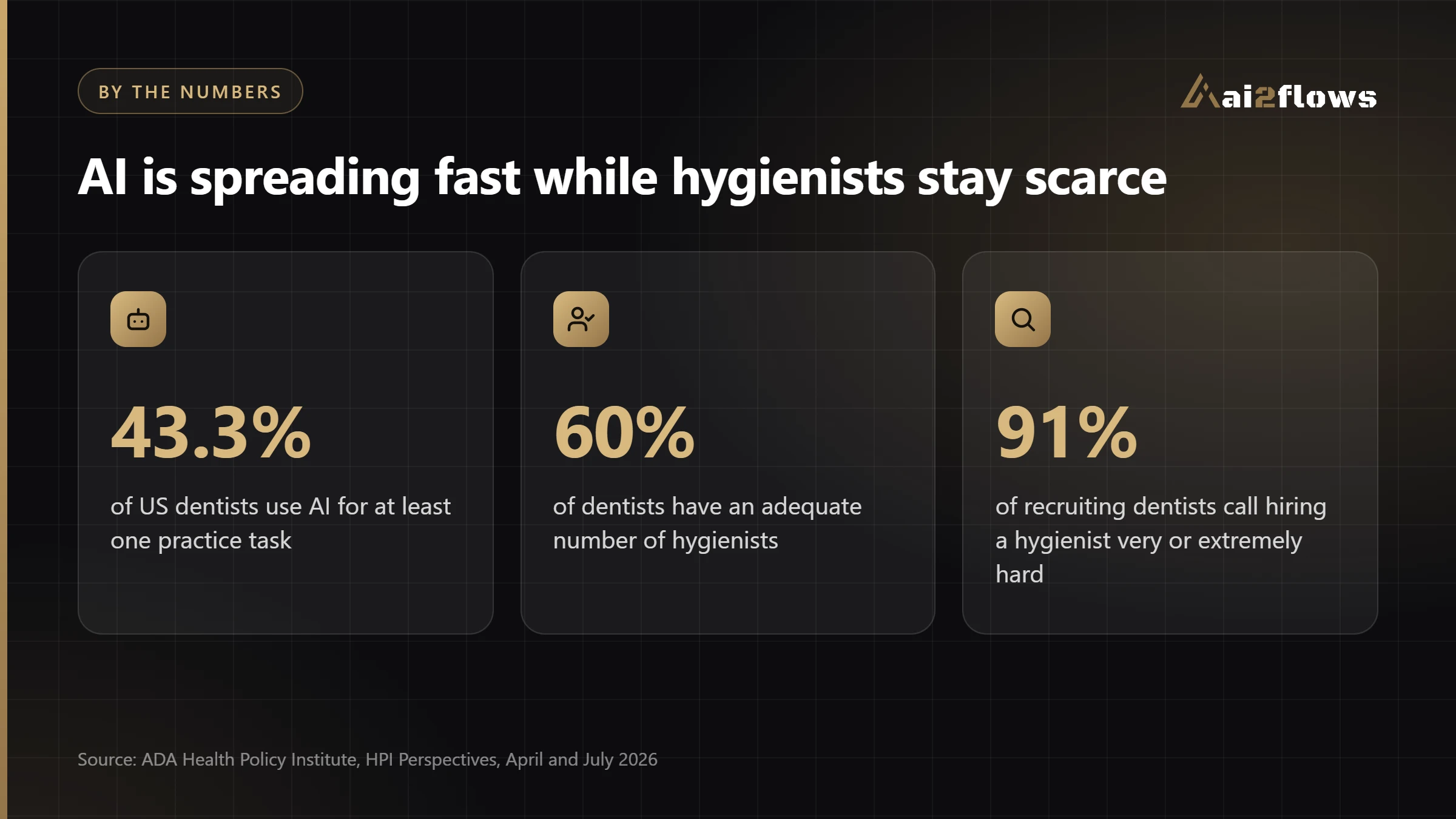
43.3% of responding dentists use AI for at least one task in their practice.
Another 26.4% say they plan to start using AI in the future.
22.8% use AI for imaging and diagnostics, the single most common use.
13.6% use it for insurance verification and 13.2% to help explain clinical findings to patients.
About one in ten use AI for business analytics (10.1%), social media (10.7%) and reception or front desk check-in (10.1%).
Fewer than 5% use AI for patient treatment recommendations.
The headline for practice owners is simple: AI adoption in dentistry is real, it is growing, and it is concentrated on administrative and efficiency work. HPI described the pattern as dentists using AI to make appointments more efficient while drawing the line at clinical decision making.
Why is the dental staffing shortage pushing practices toward AI?
The staffing picture explains much of the interest. In an April 2026 HPI Perspectives analysis, the ADA reported that only 60% of dentists have an adequate number of dental hygienists on staff. Among dentists who were recruiting or had recently recruited a hygienist, 91% said it was very or extremely challenging. Staffing tied with dental insurance issues as the top challenge dentists named heading into 2026.
The pipeline is growing, but slowly. HPI noted that first-year enrollment in dental hygiene programs rose 16% from 2020 to 2025, and 2025 produced the most hygiene graduates on record. Even so, total staff working in US dental offices has stayed flat, and inflation-adjusted wages for dental office staff are down from a few years ago, which HPI links to a "fiscal squeeze" of rising costs and stagnant reimbursement.
Federal data point the same way. The US Bureau of Labor Statistics projects employment of dental hygienists to grow 8% from 2025 to 2035, much faster than average, with about 15,000 openings each year on average.
The ADA's July 2026 brief also found that 32.4% of dentists report being overworked, and it suggested some dentists may view AI tools as a workaround to ongoing staffing problems. AI cannot clean teeth, but it can take repetitive phone, text and paperwork tasks off the plates of the people who can.
Which dental tasks are best suited to AI agents?
An AI agent is software that can hold a conversation by voice, SMS or chat, follow a defined workflow, and take actions such as booking an appointment or updating a patient record. A smart CRM is the system that stores every lead and patient interaction and triggers automated follow-up. Together they suit tasks that are high volume, rules based and time sensitive.
Task | What AI can handle | What staff should keep |
|---|---|---|
Inbound calls and after-hours | Answer every call, answer common questions, book or request appointments | Emergencies, complex billing, upset patients |
New patient inquiries | Instant text or call back to web and ad leads, intake questions | Treatment plan conversations |
Recall and reactivation | Automated hygiene recall sequences by SMS, email and voice | Patients with special scheduling needs |
Reminders and confirmations | Two-way confirmations, easy rescheduling, waitlist fill | Final call on overbooking rules |
Insurance verification | Collecting plan details before the visit, flagging gaps | Benefit interpretation and patient cost conversations |
Reviews and reputation | Post-visit review requests and routing feedback | Responding to negative reviews |
These map closely to where the ADA found current and planned AI use: front desk, insurance verification, scheduling and business analytics. For more on how voice agents handle calls, see our overview of AI voice agents for healthcare.
Where do dentists draw the line on AI?
The ADA data shows clear limits. Four out of five dentists (82.6%) do not plan to use AI for treatment recommendations, and 68.3% do not plan to use it to explain clinical findings to patients. Dentists in the survey cited fears of AI replacing human judgment and the risk of errors leading to overtreatment or misdiagnosis.
That boundary is useful for any practice planning an AI rollout. Patient-facing agents should be scoped to scheduling, logistics, intake and general practice information. They should never diagnose, recommend treatment or interpret x-rays for a patient. When a caller describes pain, swelling or bleeding, the agent's job is to route them quickly to a team member or an emergency slot.
The ADA Standards Program is also developing a standard for AI model fact labels in dentistry, which would describe an AI system's intended use, training data, validation and limitations. That is a sign that transparency expectations for clinical AI tools are rising.
What does AI change for the dental front desk day to day?
In a typical general or cosmetic practice, the front desk juggles live phone calls, patients at the window, insurance calls and recall lists at the same time. When the team is short one person, the first casualty is usually the phone, and unanswered calls often mean lost new patients.
A well designed setup changes the flow in a few ways:
No call goes unanswered. The AI voice agent picks up overflow and after-hours calls, books into open slots or captures a callback request with full details.
Speed to lead improves. New patient forms and ad leads get a text within a minute instead of a call back the next day.
Recall runs on autopilot. Overdue hygiene patients receive a sequence of friendly reminders with a direct booking link, and replies land in one inbox.
The team works from context. When a staff member does call, the CRM shows the full conversation history so the patient does not repeat themselves.
Our clinic and dental growth systems are built around exactly these handoffs between AI and staff.
How do you roll out AI in a dental practice step by step?
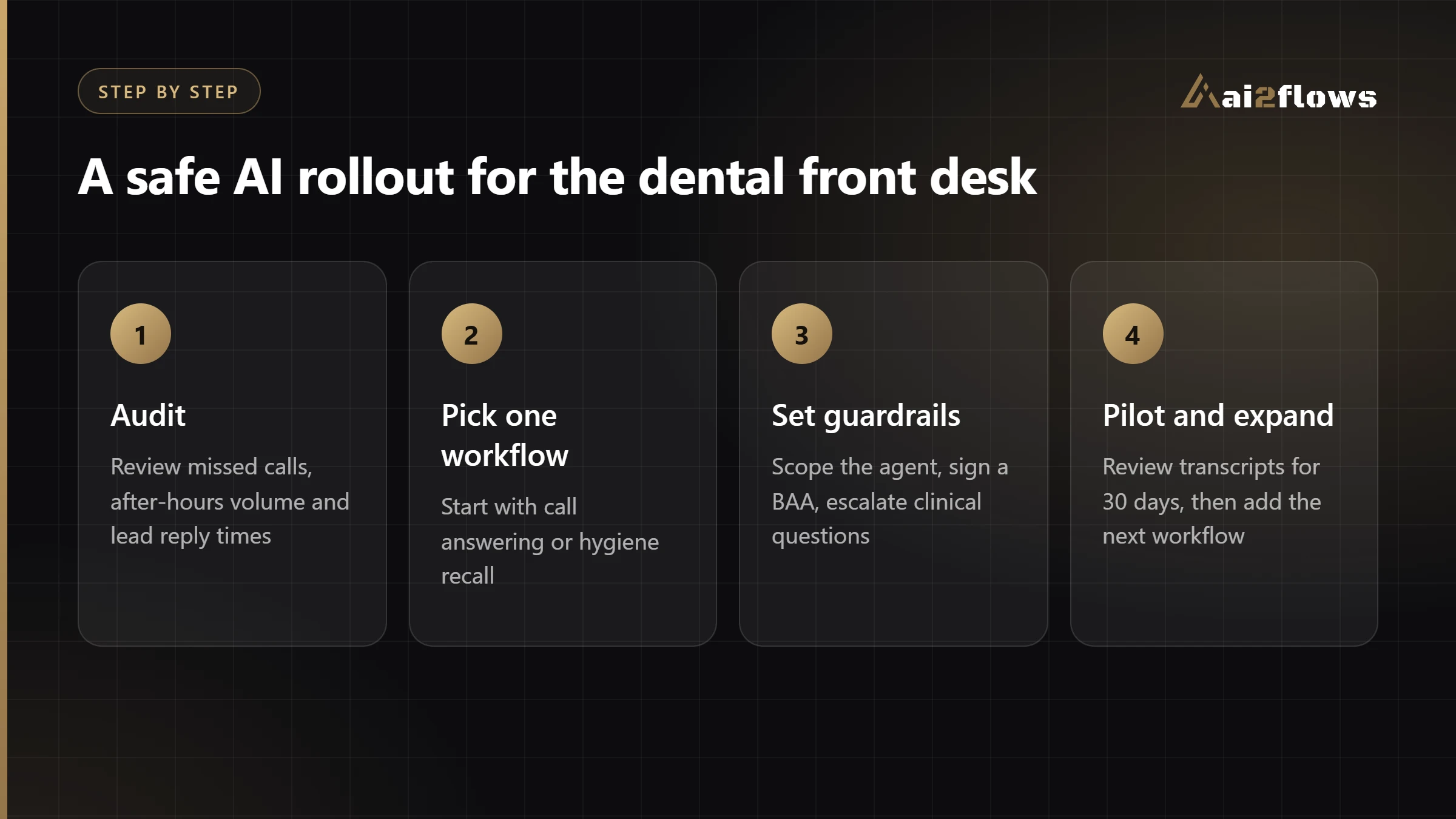
Start small, measure, and expand only what works. A practical sequence for most single or multi-location practices:
Audit your phones and leads. Pull a few weeks of call logs and web leads. Note missed calls, after-hours volume and how long new leads wait for a reply.
Pick one workflow to automate first. After-hours and overflow call answering or hygiene recall usually deliver the clearest early benefit.
Write the rules and the guardrails. Define what the agent can book, which questions it may answer, and clear escalation triggers for emergencies and clinical questions.
Connect your smart CRM and calendar. Make sure every conversation, booking and opt-out is logged in one place your team already checks.
Confirm privacy and disclosure. Sign a business associate agreement with any vendor that handles patient information and check your state's AI disclosure rules.
Pilot for 30 days with human review. Have a team member review transcripts daily at first, then weekly, and adjust scripts based on what patients actually ask.
Measure and expand. Compare answered calls, booked appointments and recall response against your baseline, then add the next workflow such as confirmations or review requests.
Practices that already have a CRM can often reuse existing contact lists and pipelines. If yours does not, our healthcare CRM automation page explains how the pieces fit together.
What about HIPAA, privacy and AI disclosure?
Under HIPAA, a vendor that creates, receives, maintains or transmits protected health information on behalf of a dental practice is generally a business associate, and HHS guidance explains that covered entities generally need a business associate contract with such vendors. That applies to AI voice, SMS and chat platforms that handle patient names, appointments or health details.
Before going live, check these points:
A signed business associate agreement with each vendor in the chain that touches patient data.
Clear limits on what patient information the agent collects, and where recordings and transcripts are stored.
Consent and opt-out handling for texts and automated calls.
Disclosure that patients are talking with an AI assistant where state law requires it. Our guide to AI disclosure laws for healthcare chatbots and voice agents covers the state landscape.
Human oversight: a named team member who reviews conversations and owns escalations.
A HIPAA-ready setup reduces risk, but no tool guarantees compliance on its own. Work with your compliance advisor or healthcare attorney to review your configuration and policies.
Frequently asked questions
What percentage of dentists use AI in 2026?
According to the ADA Health Policy Institute's July 2026 survey of US dentists, 43.3% use AI for at least one task in their practice and another 26.4% plan to start, with the most common uses being imaging and diagnostics, insurance verification and front desk work.
Can an AI receptionist replace dental front desk staff?
No. An AI receptionist is best used to handle overflow and after-hours calls, reminders, recall and intake so existing staff can focus on in-person patients, financial conversations and anything that needs judgment or empathy.
Is it safe to let AI answer patient questions in a dental office?
It can be when the agent is limited to scheduling, logistics and general practice information, escalates clinical or urgent questions to a human, runs under a business associate agreement and is reviewed regularly by a team member.
Which AI workflow should a dental practice automate first?
Most practices start with after-hours and overflow call answering or automated hygiene recall, because both target revenue that is often lost today and are easy to measure against a baseline of missed calls and overdue patients.
Does AI help with the dental hygienist shortage?
AI cannot perform hygiene care, but by taking phone, recall and paperwork tasks off the team it can help a short-staffed practice keep the hygiene schedule full and protect the time of the hygienists it has.
Sources
ADA Health Policy Institute: We Have a Major Dental Hygienist Shortage (April 2026)
US Bureau of Labor Statistics: Occupational Outlook Handbook, Dental Hygienists
Want to see how AI agents and a smart CRM could answer every call and keep your hygiene schedule full? Book a free strategy call with AI2Flows and we will map the first workflow with you.