AI Scribes for Small Practices in 2026: Evidence, Cost, Setup
Quick answer: An ambient AI scribe listens to a patient visit (with the patient informed) and drafts the clinical note for the provider to review and sign. In 2026 the evidence is solid but modest: a randomized trial in NEJM AI found one tool cut note time by about 9.5% and a five-site JAMA study found clinicians spent 16 fewer minutes on documentation per 8 hours of patient care. For small clinics, dental offices and med spas, the win comes from choosing carefully, disclosing clearly and keeping a human review step on every note.
What is an ambient AI scribe?
An ambient AI scribe is software that captures the conversation between a clinician and a patient, transcribes it, and uses a large language model to turn it into a structured draft note, such as a SOAP note, a visit summary or patient instructions. The clinician then edits and signs the note in the EHR or practice software.
"Ambient" means the tool works in the background. Nobody dictates to it. The provider talks to the patient normally, and the draft appears minutes later. Most products run on a phone, tablet or laptop, and many now plug directly into major EHRs.
It is worth separating three things that often get lumped together:
Ambient scribes draft clinical documentation from a live visit.
AI voice agents answer phones, book appointments and handle front-desk calls. Our AI voice agents page covers that side.
Dictation tools convert speech the provider deliberately speaks into text, without understanding the visit.
How many clinicians use AI scribes in 2026?
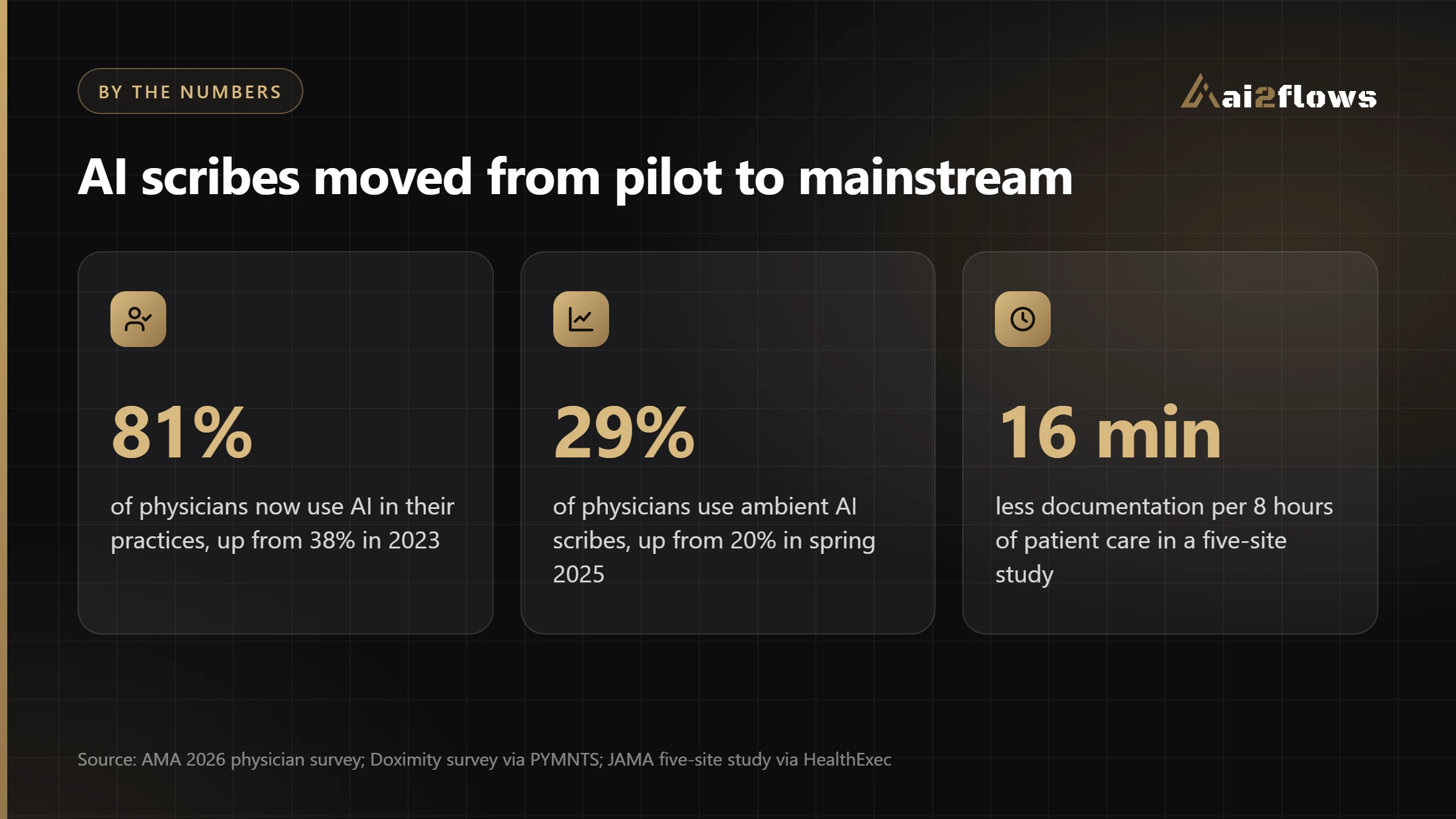
Adoption has moved from pilot to mainstream in large health systems, and smaller practices are following.
According to the American Medical Association's 2026 physician survey, reported by Healthcare Innovation in March 2026, 81% of physicians now use AI in their practices, up from 38% in 2023. Clinical documentation is one of the most common uses.
A Doximity survey of 3,151 physicians, cited by PYMNTS in November 2026, found ambient listening or AI scribe use rose from 20% to 29% between spring 2025 and early 2026.
Medical Economics reported in March 2026 that 70% of UCSF physicians use AI scribes, and that Kaiser Permanente logged more than 2.5 million scribe-assisted encounters across 7,260 physicians in 14 months.
PYMNTS, citing Fortune, reported that Abridge is used in more than 300 health systems.
The takeaway for an independent practice: patients are increasingly used to hearing "I use an AI assistant to take notes," and providers who trained in large systems may expect the tool when they join you.
Do AI scribes actually save time and reduce burnout?
Yes, but the gains are smaller and more uneven than vendor marketing suggests. The best evidence so far:
Study | Setting | Key finding |
|---|---|---|
NEJM AI randomized trial (UCLA, published November 2025) | 238 outpatient physicians, 14 specialties, two tools vs usual care | Nabla cut time in notes by 9.5% vs control; Microsoft DAX did not show a significant change. Both groups saw about 7% improvement in burnout measures. |
JAMA five-site study (Rotenstein et al.) | 8,500+ clinicians at five academic centers, about 1,800 adopters | 16 fewer minutes on documentation per 8 hours of scheduled care; 1.7% more weekly visits |
JAMA Network Open (August 2025), as reported by Medical Economics | 1,400+ clinicians at Mass General Brigham and Emory | Burnout at Mass General Brigham fell from 52.6% to 30.7% over 84 days |
JMIR simulated study (January 2025), as reported by Medical Economics | Two commercial products in a simulated setting | Errors appeared in 70% of notes, mostly omissions |
Two practical lessons come out of this research. First, the tool you pick matters: in the UCLA trial two well-known products produced different results. Second, usage drives value. The JAMA study found clinicians who used a scribe in at least half of visits saw roughly three times the documentation-time reduction of lighter users.
What do AI scribes cost, and is there an ROI?
Medical Economics reported in March 2026 that stand-alone scribe apps start around $40 per clinician per month, some popular tools run upward of $100, and enterprise platforms cost several hundred dollars per clinician per month.
On the revenue side, the JAMA five-site study estimated a conservative lower bound of $167 per clinician per month in additional evaluation and management revenue, mainly from slightly higher visit volume. A UCSF study of more than 1.2 million encounters, published in JAMA Network Open in January 2026, estimated about $3,044 in added annual revenue per physician, according to Medical Economics.
For a small practice, a simple way to frame ROI:
Time: minutes saved per day multiplied by clinician hourly cost, or by the value of one extra appointment slot.
Retention: what it costs to replace a burned-out provider or hygienist.
Quality: more complete notes can support accurate coding, but only if a human reviews them.
If you want to run numbers for your own team, our ROI calculator is a quick starting point for automation planning.
Are AI scribes useful for dental practices and med spas?
Most published research comes from physician practices, so dental offices, aesthetic clinics and med spas should treat the evidence as directional. The same workflow applies, though: a provider talks, a draft is produced, and a human signs off.
Where these businesses often see more immediate value is the work around the visit. Consultation summaries, treatment plan explanations, post-procedure instructions and follow-up messages are all text-heavy and repetitive. Pairing a documentation tool with a smart CRM with automated follow-up means the plan discussed in the chair turns into a reminder, a recall message or a review request without staff retyping it. See how we approach this for clinics and dental practices.
Before buying, ask any vendor whether its model has been trained or tuned for your specialty's vocabulary, such as periodontal charting terms or injectable product names, and test it on real (consented) visits.
What are the privacy and consent rules for AI scribes?
HIPAA does not include a specific patient-notice rule for AI scribes, according to PYMNTS, but states are filling the gap. This is a fast-moving area, so confirm current rules with a healthcare compliance advisor.
Louisiana Act 649, effective August 1, 2026, requires licensed professionals to verbally disclose the use of any recording device or service before recording an appointment that will be transcribed by AI, according to law firm Arnall Golden Gregory. Enforcement is through licensing boards.
Rhode Island has a notification act, in effect since June, requiring patient notice and provider review of AI-written notes, PYMNTS reported.
California AB 3030, in effect since January 2025, requires disclaimers on generative AI patient clinical messages not reviewed by a licensed provider.
Also check your state's general call and conversation recording laws, since some require consent from everyone recorded. Our earlier guide to AI disclosure laws for healthcare chatbots and voice agents covers the wider picture.
Human oversight note: an AI scribe drafts, it does not decide. Every note should be reviewed and signed by the licensed provider. Choose a vendor that signs a Business Associate Agreement, explains how long audio is retained and whether it is used for model training, and supports HIPAA-ready access controls. No tool makes a practice compliant on its own.
How do you roll out an AI scribe in a small practice?
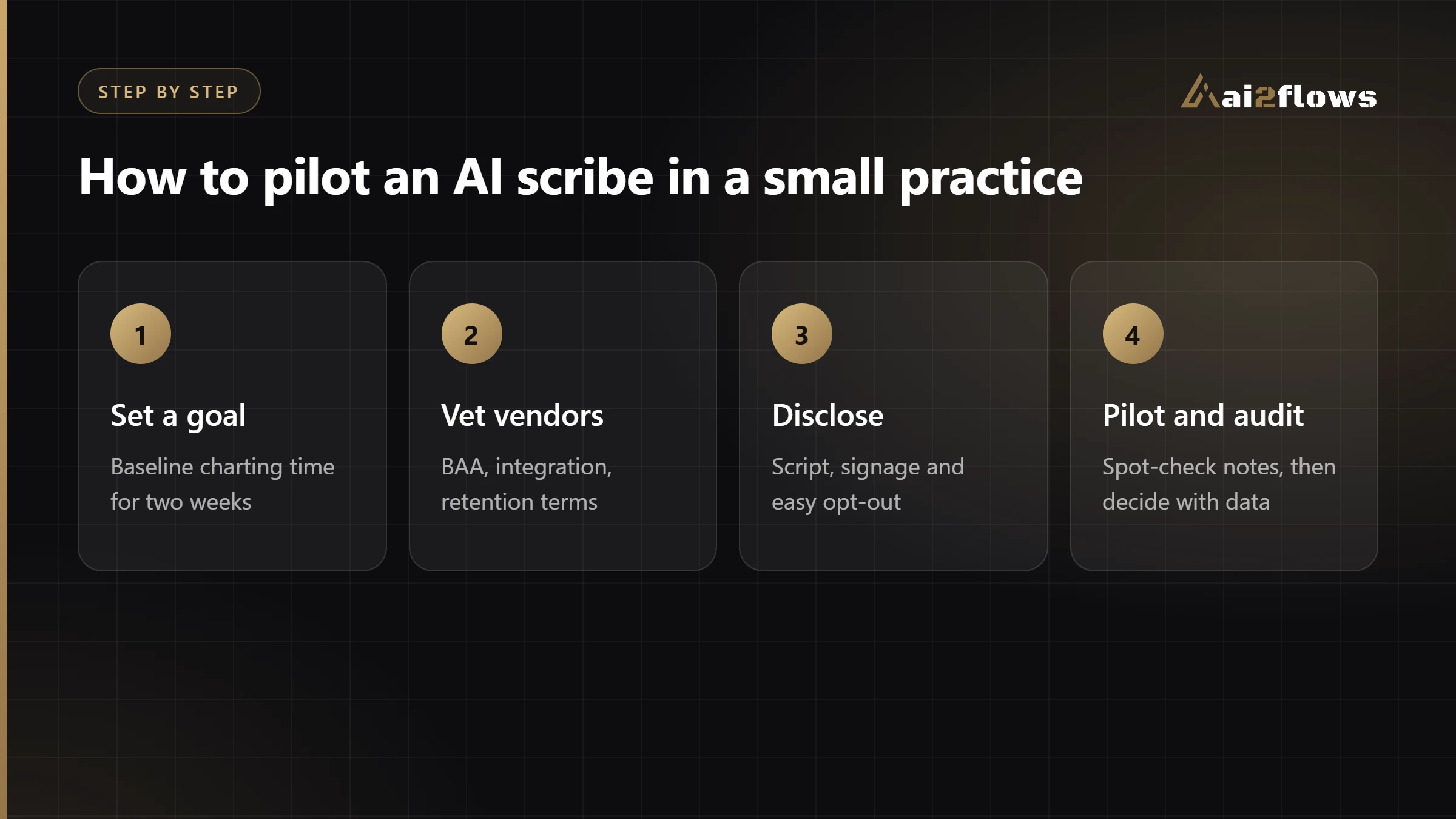
A focused 60 to 90 day pilot keeps risk low and gives you real data before you commit.
Pick a clear goal. Choose one measurable target, such as after-hours charting time, note turnaround or provider satisfaction, and record a two-week baseline.
Shortlist and vet vendors. Require a BAA, EHR or practice software integration, specialty templates, clear data retention terms and a trial period.
Set up disclosure and consent. Write a short script for front desk and providers, add signage and intake form language, and give patients an easy way to opt out.
Pilot with two or three willing providers. Mix visit types and track time in notes, edits per note and patient opt-outs.
Audit note quality. Spot-check a sample of notes each week for omissions, wrong medications or invented details, and log issues for the vendor.
Connect the downstream workflow. Route summaries and patient instructions into your CRM so follow-ups, recalls and review requests go out automatically.
Decide with data. Compare results to the baseline, then expand, switch tools or stop.
What questions should you ask an AI scribe vendor?
Will you sign a BAA, and where is audio and transcript data stored?
Is our data used to train your models, and can we opt out?
How long is audio kept, and can we set automatic deletion?
Which EHRs or practice management systems do you integrate with directly?
What published or independent evaluation exists for your accuracy?
How does the tool handle multiple speakers, interpreters and accents?
What happens if a patient declines recording?
Frequently asked questions
Is an AI scribe HIPAA compliant?
A tool can be HIPAA-ready, meaning the vendor signs a BAA and provides the safeguards HIPAA expects, but compliance depends on how your practice configures and uses it, so involve a compliance advisor.
Do patients have to agree to an AI scribe?
It depends on your state: Louisiana now requires verbal disclosure before AI-transcribed recording, some states require all-party consent for recordings, and best practice everywhere is to inform patients and let them opt out.
How many patients decline AI scribes?
In the UCLA randomized trial published in NEJM AI, fewer than 10% of patients declined the tool, according to UCLA Health.
Can an AI scribe make mistakes in a clinical note?
Yes, studies have found omissions and occasional clinically significant inaccuracies, which is why the provider must review and correct every note before signing.
How much does an AI scribe cost per provider?
Medical Economics reported in 2026 that stand-alone apps start around $40 per clinician per month, while enterprise platforms can cost several hundred dollars per clinician per month.
Are AI scribes worth it for a small practice?
They can be when providers use them in most visits and the practice tracks results, since research shows the biggest time savings come from consistent use rather than occasional use.
Sources
NEJM AI: Ambient AI Scribes in Clinical Practice, a Randomized Trial (PubMed)
UCLA Health: AI scribes may reduce documentation time and improve physician well-being
HealthExec: AI scribes add at least $167 per month to clinician income, five-site study
Healthcare Innovation: AMA survey, AI usage among doctors doubles since 2023
PYMNTS: As AI listens in on doctor visits, states are writing the rules
Arnall Golden Gregory: Louisiana requires verbal disclosure before AI-assisted recording
Want help connecting documentation, follow-up and patient communication into one HIPAA-ready workflow? Book a free strategy call with AI2Flows and we will map out what fits your practice.