Google AI Mode Healthcare Ads: 2026 Guide for Clinics
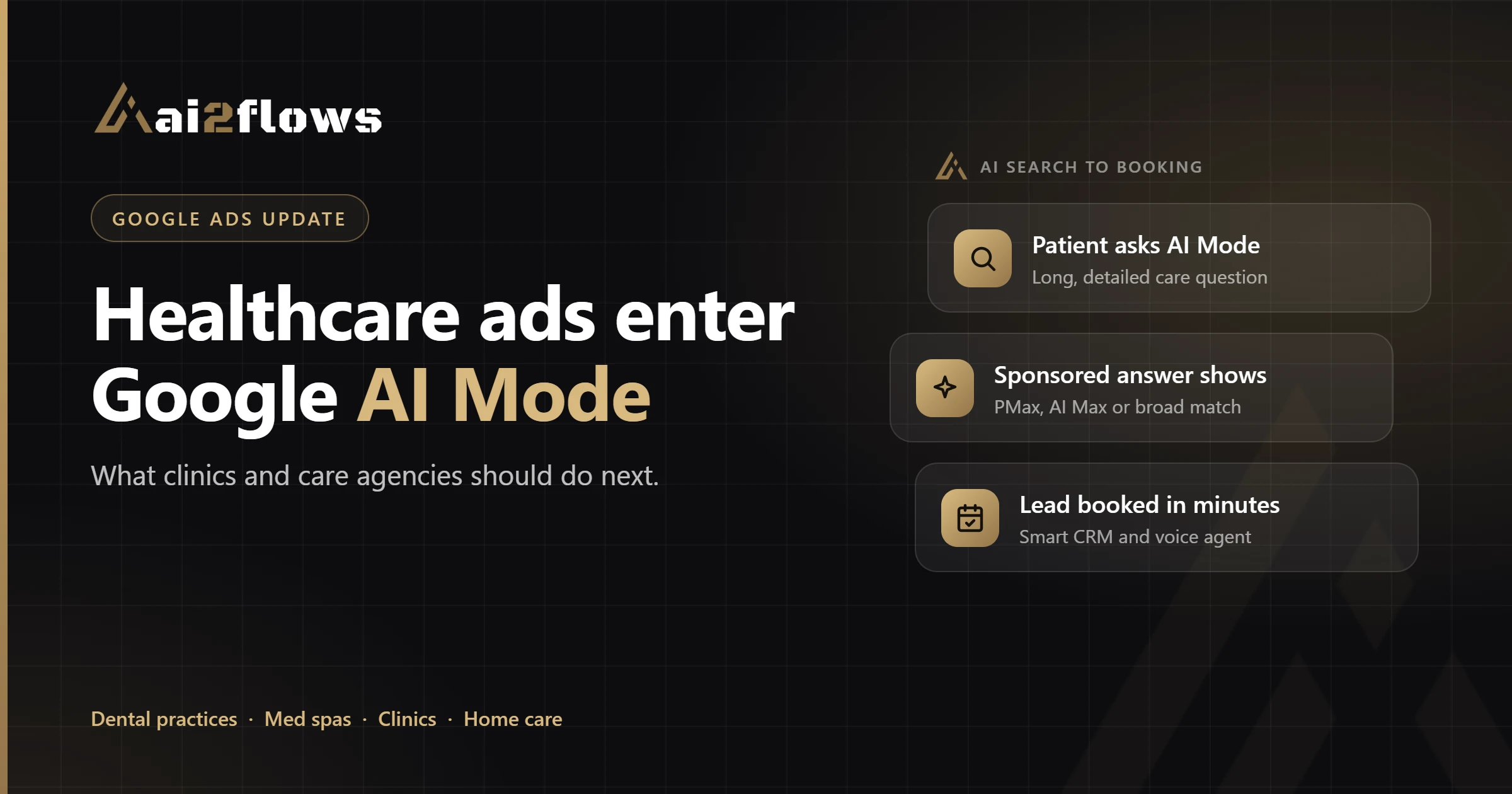
Quick answer: Google has started letting some healthcare ads appear inside AI Mode and AI Overviews in the US, after years of keeping the category out of AI answers. The test began in spring 2026 for Performance Max, AI Max, Shopping and broad match campaigns, and in October 2026 Google confirmed it is also testing branded prescription drug ads there. For dental practices, med spas, clinics and home care agencies, the practical move is to tighten your Google Ads setup, keep compliance text clean, and make sure the leads these new placements send you get a fast, human-quality response.
What changed with healthcare ads in Google AI Mode?
AI Mode is Google's conversational search experience, where a person asks a long question and gets a written answer with links, instead of a classic list of ten blue links. AI Overviews are the AI summaries that appear at the top of many normal Google results. Until 2026, healthcare was one of the sensitive categories Google kept out of ad placements inside these AI answers.
According to PPC Land's reporting, when Google expanded ads in AI Overviews to 11 countries in December 2025, healthcare, finance, gambling and politics were still excluded from those in-answer placements. That changed around Google Marketing Live 2026, which took place on May 20, 2026.
Search Engine Land reported that Google Ads Liaison Ginny Marvin confirmed a "small test" of ads in AI Mode for the healthcare vertical. The key facts from that confirmation:
Where: US healthcare advertisers only, on English-language queries.
Which campaigns: Performance Max, AI Max with search term matching, Shopping and broad match campaigns are eligible, and the same types can serve in AI Overviews.
Creative limit: in the first phase, only ads without pinned assets or text disclaimers are eligible.
Then, on October 12, 2026, Adweek reported that a Google spokesperson confirmed tests of branded prescription drug ads in AI Mode and AI Overviews, using standard text and Shopping ads labeled "Sponsored" and limited to the US.
Why does this matter for clinics, med spas and care agencies?
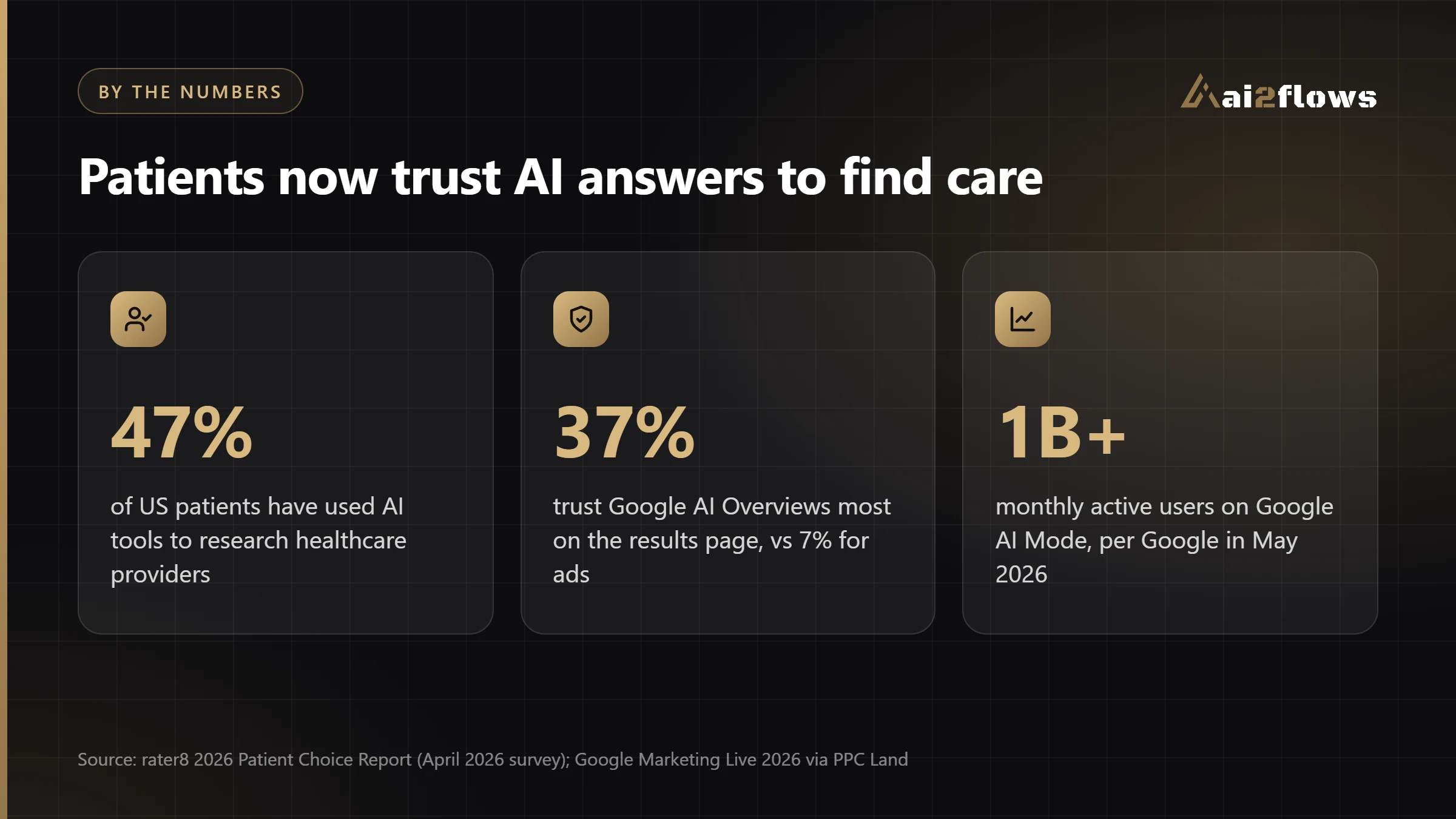
Patients are already using AI to choose providers. According to rater8's 2026 Patient Choice Report, a survey of roughly 1,000 US adults conducted in April 2026, 47% of patients have used AI tools such as ChatGPT or Google AI Overviews to research healthcare providers, up from 31% in the company's 2025 survey. The same report found 36% said AI tools influenced their choice of a new doctor, slightly ahead of Google search results at 34%.
Trust is shifting too. In the rater8 survey, 37% of respondents said they trust Google's AI Overview most among the parts of a results page, compared with 20% for organic links and only 7% for sponsored ads. That gap is the reason ads inside AI answers matter: they sit in the part of the page patients say they trust most.
The audience is large. Google said at Google Marketing Live 2026 that AI Mode has passed 1 billion monthly active users, as reported by PPC Land and IQVIA. PPC Land also notes AI Mode queries tend to be longer and more detailed than classic searches, which is exactly how patients describe symptoms, treatments and insurance questions.
We covered how patients use assistants to find care in our guide to AI provider search and ChatGPT. Ads in AI Mode are the paid side of the same shift.
Which healthcare businesses can show ads in AI Mode today?
Google has not published a full list of eligible healthcare subcategories for AI Mode. What we know comes from Google's confirmations and its long-standing Healthcare and medicines policy, which still applies to every ad. That policy, for example, requires advertisers to apply before promoting prescription drug services such as online pharmacies or telemedicine that prescribes, requires Google certification for recovery-oriented addiction services where they are allowed, and does not allow ads for speculative or experimental treatments.
Business type | Likely position in 2026 | What to check first |
|---|---|---|
Dental practices | Standard healthcare advertiser; can use eligible campaign types in the US test | Clean ad copy, no unverifiable claims, landing page matches services |
Med spas and aesthetic clinics | Eligible campaign types apply, but treatment claims draw extra scrutiny | Avoid outcome promises; check rules on prescription products such as injectables |
Home care agencies | Service advertiser with long, detailed family questions | Location targeting, licensing details on the site, fast call handling |
Telehealth that prescribes | Restricted; application or certification required | Google approval status before any AI placement testing |
Addiction treatment | Restricted; certification required where allowed | Certification and compliance review with an advisor |
Pharma brands | Branded Rx ads in US testing since October 2026 | Google pharmaceutical certification and legal review |
This table is a planning guide based on public reporting, not a policy ruling. Google's rules change often, so confirm your own eligibility inside your Google Ads account.
How do ads in AI Mode work for healthcare advertisers?
You do not buy "AI Mode ads" as a separate product. Your existing eligible campaigns become able to serve there. Google picks when an ad fits the conversation, based on the query and the context of the AI answer.
The campaign types that qualify all rely on Google's automation:
Performance Max: one campaign that serves across Search, YouTube, Maps and other Google inventory using your assets and goals.
AI Max for Search: a set of features for Search campaigns that expands matching beyond your exact keywords, can tailor ad text, and can send people to the most relevant page on your site.
Broad match with Smart Bidding: the loosest keyword match type, paired with automated bidding.
Unlock Health, a healthcare marketing agency, noted in its Google Marketing Live 2026 review that Google also introduced controls that matter for regulated advertisers, including natural-language brand and messaging guidelines for AI-generated copy and text disclaimers that always show. Keep in mind that, per Search Engine Land, ads with text disclaimers were not eligible in the first phase of the healthcare test, so advertisers who must show disclaimers may be left out of AI placements for now.
What are the risks and compliance issues?
AI placements bring new reach, but also less control. Unlock Health points out that search term reports for AI Max and Performance Max show approximations, which makes negative keywords less precise, and that AI Overview and AI Mode placements could not be reported separately under broad match at the time.
For healthcare businesses, the main risks are:
Off-target spend: broad matching can show your ad for questions you do not serve, such as emergency symptoms or out-of-area care.
Generated copy: automated text can drift into claims you would never approve, such as "painless" or "guaranteed results."
Privacy in tracking: conversion tracking on health pages must not send protected health information to ad platforms. HHS guidance on online tracking technologies is still the reference point for HIPAA-covered practices, even though a federal court vacated one part of it in June 2024.
Lead handling: a patient who clicks from an AI answer expects a quick, accurate reply. Slow follow-up wastes the click.
Human oversight note: keep a person in charge of ad copy approval, landing page claims and tracking setup. A HIPAA-ready setup reduces risk, but no tool guarantees compliance, so review your configuration with a healthcare compliance advisor.
How should a practice prepare? A 4-step plan
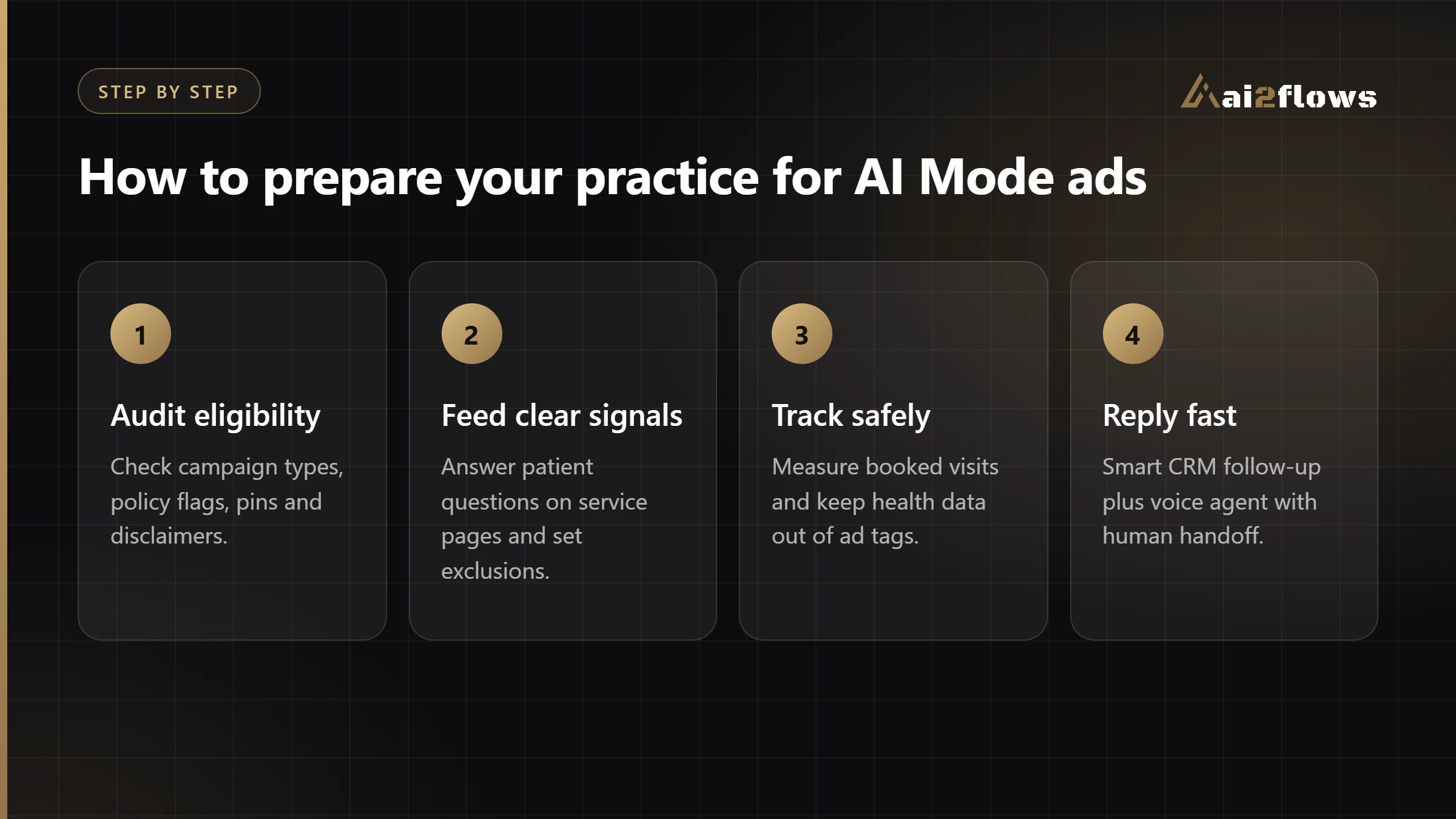
You do not need to rebuild your marketing. Most of the work is cleaning up what Google's automation reads and making sure you can convert the extra demand.
Audit eligibility and policy status. Confirm which of your campaigns are Performance Max, AI Max or broad match, check for policy flags, and review whether you rely on pinned assets or disclaimers that keep ads out of the first phase.
Feed the AI clear signals. Write service pages that answer real patient questions in plain language, keep business details consistent, add your brand and messaging guidelines in Google Ads, and exclude services and terms you do not want to appear for.
Track safely and by stage. Measure booked appointments and qualified calls, not just form fills, and remove any tracking that could expose health details. Separate brand and non-brand results so you can see what new placements add.
Answer every lead in minutes. Connect ads to a smart CRM with automated text and email follow-up, and use an AI voice agent or trained staff to answer calls after hours, with clear handoff to a human for clinical questions.
If you want help with the follow-up side, our healthcare CRM automation and AI voice agents pages explain how practices respond to every inquiry quickly.
How do organic AI visibility and paid ads work together?
Ads in AI Mode do not replace earning a place in the AI answer itself. In the rater8 survey, sponsored ads were the least trusted part of the results page, while AI Overviews were the most trusted. The strongest position is to be cited in the answer and to have an ad beside it.
Two findings from the same report show why reputation still decides the booking. 75% of respondents said they would not book with a provider rated below 4.0 stars, and 55% said they had canceled or avoided an appointment because of online reviews. AI answers often summarize reviews, so a weak rating can undercut even a well-placed ad.
That is why we pair paid search with AEO and GEO services: structured, quotable content and steady review requests make both the organic answer and the ad more likely to win the patient. Dental and aesthetic teams can see how this fits their workflow on our clinics and dental page.
Frequently asked questions
Can my dental practice run ads in Google AI Mode right now?
Possibly. Google confirmed a small US test of healthcare ads in AI Mode for English queries, open to Performance Max, AI Max, Shopping and broad match campaigns, but it has not published a full list of eligible healthcare categories, so check your account and campaign types.
Do I need a separate campaign for AI Mode?
No. Eligible existing campaigns can serve in AI Mode and AI Overviews automatically. Google decides when your ad fits the query and the AI answer, so the quality of your assets and landing pages matters more than a new campaign.
Why might my healthcare ads not show in AI Mode?
Common reasons include using campaign types outside the test, relying on pinned headlines or text disclaimers that were excluded in the first phase, policy restrictions on your service, or targeting outside the US.
Are AI Mode ads HIPAA compliant?
The ad placement itself does not handle patient records, but your tracking and follow-up can create HIPAA risk. Avoid sending health details to ad platforms, use HIPAA-ready tools for lead handling, and confirm your setup with a compliance advisor.
Should I move my whole budget to Performance Max or AI Max?
Not by default. Test with a controlled share of budget, compare booked appointments and cost per patient against your current campaigns, and keep tight exclusions, since AI placements reduce visibility into exact search terms.
Do online reviews affect how I appear in AI answers?
Reviews shape what patients decide after they see you. In rater8's 2026 survey, 75% of patients said they would not book a provider rated below 4.0 stars, so a steady review process supports both organic and paid visibility.
Sources
Search Engine Land: Google begins testing healthcare ads in AI Mode
PPC Land: Google breaks healthcare ad ban in AI Mode with a small US test (June 2026)
Adweek: Google opens AI Mode to prescription drug ads (October 2026)
TechTarget: Almost half of patients use AI for online provider search
HHS: Use of online tracking technologies by HIPAA covered entities
Want your ads, AI visibility and follow-up working as one system before AI Mode traffic grows? Book a free strategy call with AI2Flows and we will review your setup with you.